
Summary
The key conclusions from the analysis of data from the 2009 meetings survey follow.
Membership benefits
Gaining knowledge via ASA publications and conferences represents the most important benefit. Students use the ASA to network for career enhancement.
JSM
About 25% of ASA members attend any given JSM, but over a five-year period JSM attracts over 50% of ASA membership. When members can break away from work duties and/or professionally justify attending JSM, the length and location of the meetings are attractive.
ASA-sponsored thematic meetings
About 86% of the respondents indicated that they have not attended any ASA-sponsored thematic meeting during the past five years, while almost 45% have attended at least one major meeting in statistics not sponsored by the ASA, driven chiefly by university- and government-affiliated members. Most respondents (58%) feel that the ASA should expand its thematic and special interest meetings generally, while students and university-affiliated members feel more strongly about expansion outside the United States.
Chapter and regional meetings
While 68% of respondents think they have local chapters in their area, 73% of those who can be chapter members actually are, and only 56% of these are regularly active. Most members (62%) do not participate in regional meetings, but roughly as many (65%) think ASA should sponsor more such activities.
Webinars, video-conferences, and Internet
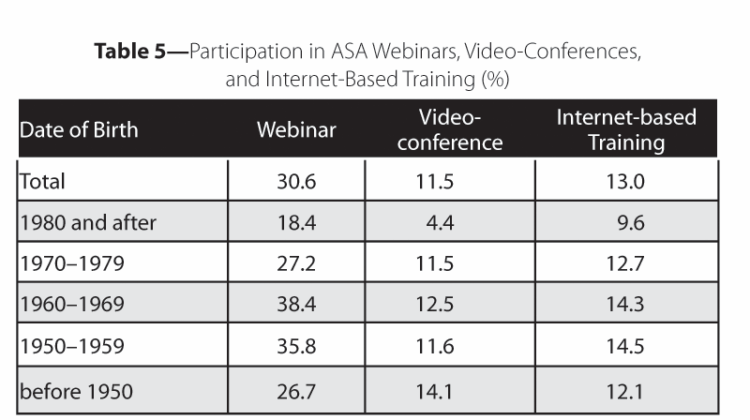
Participation. Webinars were the most often attended, albeit by ~31%, while videoconferences and Internet -based training were attended by ~25% combined. Younger and older members tend to participate less in webinars, which are more popular in the United States than outside.
Organization. Employers tend to organize videoconferences and Internet-based training, while nonemployer commercial enterprises tend to organize webinars.
Ratings. About 80% of respondents indicated that short seminars and one-day workshops by experts on specific statistical topics are valuable or very valuable. Almost 61% indicated that self-paced, web-based trainings are valuable or very valuable. Generally, 50% to 60% of ASA members would be interested in more of this type of education format. Making JSM conference presentations available via webcast had a very positive response: About 75% felt that it would be valuable or very valuable. A similar finding was observed regarding presentations given at topical and thematic meetings.
Survey Activity
Here is a brief summary of survey activity overseen by the Membership Surveys Committee, as previously reported in Amstat News.

To assess the validity of the survey, we performed additional analysis as outlined below:
Measurement Analysis. We compared meetings survey responses with answers received from other vehicles with exactly the same questions. Attendance at 2006–2008 JSM measured in post-JSM surveys was in close agreement with the meetings survey. Chapter membership, recorded in the ASA database, seems to differ from responders’ answers, perhaps owing to somewhat decentralized nature of how chapter membership is obtained.
Nonresponse Analysis. We attempted to discern any patterns among key demographic information to explain nonresponse. At a high level, it appears that a greater incidence of nonresponse can be associated with members with any of the following attributes: a student or respondent whose highest degree is a bachelor’s degree, Asian, recent members, not a chapter member, or has not recently attended JSM. Interestingly, Biopharmaceutical and Survey Research section members also tend to nonrespond more than average.
Imputation of Nonresponse. Where trustworthy data were available to impute answers in cases of nonresponse, we attempted to do so. This applied chiefly to JSM attendance 2006–2009. Nonresponse in prior periods (2004–2005) was considered nonattendance.
Leave a Reply