
Contributing Editor
Steve Pierson earned his PhD in physics from the University of Minnesota. He spent eight years in the physics department of Worcester Polytechnic Institute and later became head of government relations at the American Physical Society before joining the ASA as director of science policy.
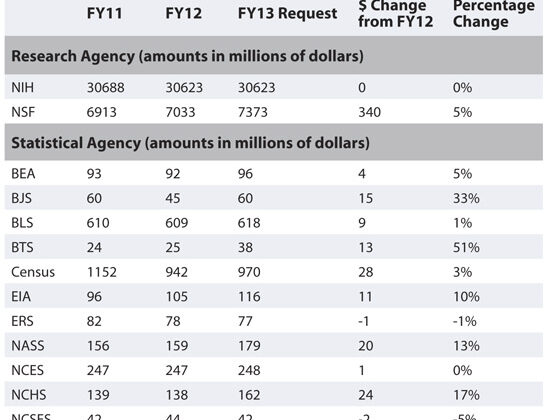
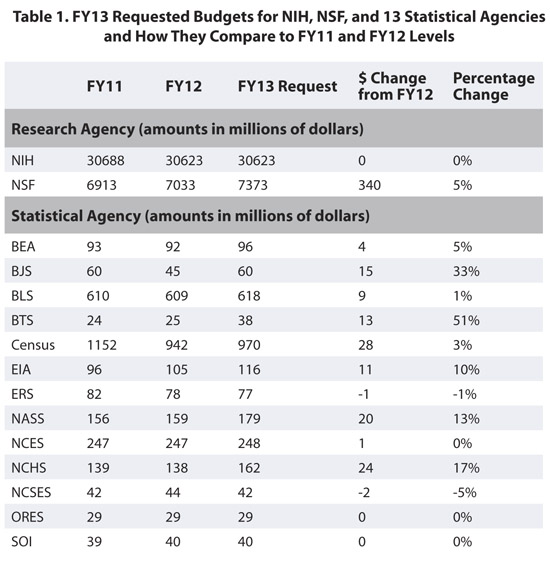
The president’s Fiscal Year 2013 (FY13) budget request included some bright spots for research funding agencies and the federal statistical agencies, as Table 1 illustrates. Realizing these requested increases and defending the other requested levels will be an uphill battle, with continued sharp disagreements on the federal budget within Congress and between Congress and the administration. Further, with 2012 being a presidential election year, agreement on the budget is unlikely until after the election. Throughout the process, it is important to communicate to Congress the importance of these agencies.
NIH and NSF
The administration demonstrated its commitment to increasing the budget for the National Science Foundation (NSF) by requesting a 5% increase for the agency in FY13. The National Institutes of Health (NIH) is flat funded for FY13 from FY12.
Despite the level of funding for NIH, the administration addresses the decreasing proposal funding success rate (especially for investigator-initiated grants and young, first-time researchers) by planning to increase the new or competing Research Project Grants (RPGs) by 672, which would result in a success rate of approximately 19%. According to NIH’s deputy director for extramural research, Sally Rockey, this would be accomplished by reducing noncompeting RPGs by 1% from the FY12 level, negotiating the budgets of competing RPGs to avoid growth in the average award size from FY12, and abandoning inflationary increases in the out-years of competing and noncompeting awards.
The $340 million increase requested for NSF bolsters a number of research and education programs. The highlights of the FY13 request includes funding for cybersecurity research and education; the next generation of computer tools and resources; the Science, Engineering, and Education for Sustainability portfolio; multidisciplinary research targeted at new materials, wireless communications, “smart” infrastructure, and robotics technologies; a new partnership with the Department of Education to transform K–16 mathematics teaching and learning; and research on implementation of undergraduate instructional practices leading to improved student outcomes.
Details of NSF’s FY12 budget also were recently finalized. (NSF’s total FY12 budget was settled in November, but Congress left the details for how to allocate the funding within NSF to the administration.) While NSF’s budget was increased by 2% from FY11 to FY12, the budget for the Mathematical and Physical Sciences (MPS) Directorate—the largest of NSF’s seven directorates—was decreased by a quarter percent to $1.309 billion. The Directorate for Education & Human Resources (EHR) was cut 4%. The directorates with the largest increases from FY11 to FY12 were Computer and Information Science and Engineering-CISE (3% to $654 billion); Engineering (6% to $673 million); and Social, Behavioral, and Economic Sciences-SBE (3% to $254 million). For FY13, all directorates would get an increase, ranging from 2% for SBE and 3% for MPS to 6% for EHR and 9% for CISE.
The Division of Mathematical Sciences (DMS)—part of the MPS directorate—had its budget cut 1% in FY12, from $239.8 million in FY11 to $237.8 million in FY12. The proposed DMS level for FY13 is $245 million, an increase of 3% over FY12. For further information, see the ASA Community blog entry.
- ASA signs onto letter opposing components of Grant Reform and New Transparency (GRANT) Act of 2011 (H.R. 3433)
- ASA signs onto letter in support of FY13 budget for NCHS
Statistical Agencies
The administration’s FY13 budget request shows a commitment to increasing or restoring the budgets of many statistical agencies, but it also demonstrates new priorities. Six federal statistical agencies receive requested increases of 5% or greater: the Bureau of Economic Analysis (BEA), Bureau of Justice Statistics (BJS), Bureau of Transportation Statistics (BTS), Energy Information Administration (EIA), National Agricultural Statistics Service (NASS), and National Center for Health Statistics (NCHS).
Five other agencies, to within 1%, are flat funded: the Economic Research Service (ERS), Bureau of Labor Statistics (BLS), National Center for Education Statistics (NCES), Social Security Administration Office of Research, Evaluation, and Statistics (ORES), and the Internal Revenue Service Statistics of Income Division (SOI). The requested FY13 budget for the NSF National Center for Science and Engineering Statistics (NCSES) is 5% lower than that of its FY12 budget, and the U.S. Census Bureau would see a 3% increase.
Looking first at the agencies with significant requested increases, the 33% for BJS would restore the 25% cut it received in FY12. The 10% for EIA would restore the significant cut it received in FY11. The 13% for NASS would restore a cut to its budget in FY11 and provide for the 2012 Census of Agriculture.
The requested increases for BEA and NCHS repeat the requested increases of the past few years for these agencies that Congress didn’t fund, showing the administration’s sustained commitment to increasing these agencies’ budgets. For BEA, the administration requests an increase of 5% to improve its measurement of the U.S. economy through more frequent GDP reports by industrial sector and better understanding of how the business cycle affects U.S. households’ ability to consume.
The 17% for NCHS would be used for implementation of electronic death records for a first set of states, new questions about sexual orientation into the full National Health Interview Survey (NHIS), and development of new sample designs for population-based surveys.
The $38 million request for BTS is a 50% requested increase ($13 million) and is unique in that it more than offsets the $1.8 million cut seen in FY12 and surpasses the FY11 and FY12 requested budgets of $30 million and $35 million. The requested funds would go to the National Long Distance Travel Data Program, a Safety Data and Analysis Initiative, and the Freight Statistics Program. The FY13 proposes the umbrella organization for BTS, the Research and Innovative Technology Administration, be elevated to a new office within the Office of the Secretary.
As noted above, many of requested increases represent a commitment to previous attempts to increase a statistical agency’s budget, albeit, in some cases, more modestly (e.g., the requested budget for BEA in FY11 and FY12 was $108 million.) For some agencies, however, the administration has backed off of previous requested increases that weren’t funded by Congress. For FY11 and FY12, the administration requested $645 million and $647 million for BLS; for ORES, $32 million and $35 million. Similarly, the administration did not renew the $15 million increase for NCES it requested in FY12.
The requested budget for the U.S. Census Bureau includes increased funding to account for the execution of the 2012 Economic Census (a quinquennial survey) and the planning of the 2020 Decennial Census. The budget also accounts for the continued ramping down of the 2010 Decennial Census and decreases for the American Community Survey (4%) and Geographic Support (19%).
Leave a Reply