• Skip to main content
  • Skip to secondary menu
  • Skip to primary sidebar
  • Skip to footer
  • Homepage
  • About Us
  • Advertising
  • Submission Instructions
  • Editorial Calendar
Amstat News

Amstat News

The Membership Magazine of the American Statistical Association

  • Printed Issues
  • Practical Significance Podcast
  • Additional Features
  • Columns
  • Member News
  • Departments
You are here: Home / Featured Stories / Statistics Degrees Continue Strong Growth

Statistics Degrees Continue Strong Growth

October 1, 2015 1 Comment

Steve Pierson, ASA Director of Science Policy
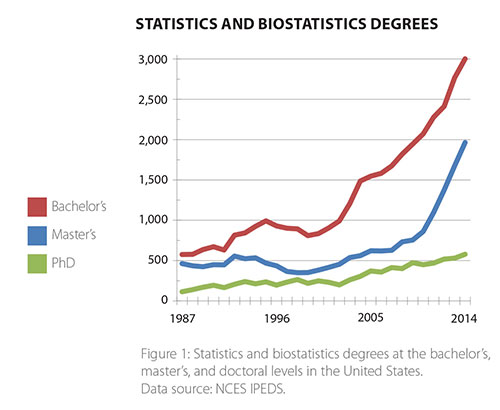
    Figure 1: Statistics and biostatistics degrees at the bachelor’s, master’s, and doctoral levels in the United States.  Data source: NCES IPEDS.
    Figure 1: Statistics and biostatistics degrees at the bachelor’s, master’s, and doctoral levels in the United States.Data source: NCES IPEDS.

    The 2014 degree data released in late August by the National Center for Education Statistics (NCES) reveal continued strong growth of undergraduate and graduate statistics and biostatistics degrees (Figure 1). Bachelor’s degrees increased 17% over 2013, master’s degrees 8%, and PhDs 9%. The increase is especially dramatic for bachelor’s degrees, with a more than doubling (2.28) from 2010 to 2014 and a quintupling from 2000 to 2014. Master’s degrees increased 45% from 2010 to 2014 and more than tripled from 2000 to 2014; PhDs increased 29% from 2010 to 2014 and more than doubled from 2000 to 2014. Read the data for this chart, which represent NCES CIP Code 27.05 (Statistics) and 26.1102 (Biostatistics).

    Figure 2: Biostatistics degrees by degree level awarded in the United States.
    Figure 2: Biostatistics degrees by degree level awarded in the United States.

    For biostatistics degrees, for which NCES started providing data specifically in 1992, master’s degrees track the overall increase from 2010–2014 at 47%, but a roughly four-fold increase from the 1990s (Figure 2). Biostatistics PhDs are up 45% since 2010 and more than 400% since the 1990s. The number of undergraduate degrees in biostatistics remains below 30. See the table for this data and for only statistics degrees.

    The percentage of women earning statistics degrees in 2014 is between 43% and 49%, with master’s degrees having the highest percentage for the last several years, as shown in Figure 3.

    Figure 3: Percentage of statistics and biostatistics degrees awarded to women by degree level for 1987–2014. Data source: NCES IPED.
    Figure 3: Percentage of statistics and biostatistics degrees awarded to women by degree level for 1987–2014. Data source: NCES IPED.

    Biostatistics degrees at the graduate level generally have a higher proportion of women earning the degrees than statistics degrees, as seen in figures 4 and 5.

    The September 2014 Amstat News article about the release of the 2013 NCES degree data also had charts of the number of universities granting statistics and biostatistics degrees—graduate and undergraduate—from 2003–2013, a table of the 10 universities granting the most bachelor’s degrees in statistics for 2011–2013, and links to tables of all universities granting such degrees. These data have been updated.

    Figure 4: Percentage of statistics degrees awarded to women by degree level for 1987–2014. Data source: NCES IPED.
    Figure 4: Percentage of statistics degrees awarded to women by degree level for 1987–2014. Data source: NCES IPED.
    Figure 5: Percentage of master’s and PhD biostatistics degrees awarded to women for 1992–2014. Data source: NCES IPED.
    Figure 5: Percentage of master’s and PhD biostatistics degrees awarded to women for 1992–2014. Data source: NCES IPED.

    Filed Under: Featured Stories, Science Policy Tagged With: ASA, biostatistics, statistician, statisticians, statistics, students

    Reader Interactions

    Comments

    1. Randy says

      October 14, 2015 at 2:39 pm

      Deming would say that we need measures of quality.

      Reply

    Leave a Reply Cancel reply

    Your email address will not be published. Required fields are marked *

    Primary Sidebar

    Search

    More to See

    Jennifer L. Green: The Collaborative Life of a Statistics Professor and Teacher Mentor

    September 1, 2026 By Megan Murphy

    Meetings, Manuscripts, and Meows: Spend a Day with Charlotte Walsh

    September 1, 2026 By Megan Murphy

    Students’ Statistical Thinking When Using Generative AI

    September 1, 2026 By Megan Murphy

    What Students Taught Me About Teaching Statistics

    September 1, 2026 By Megan Murphy

    STATAcorp. Efficiency matters. Stata is easy to use, so you spend less time learning software and more time focusing on your research
    Data Science Certification

    ASA HOME

    American Statistical Association

    Communications from the Executive Director

    ASA Leader Hub

    ASA Career Connect

    ADVERTISERS

    STATA
    SIAM

    Archives

    Categories

    Footer

    Editorial Staff

    Managing Editor
    Megan Murphy

    Graphic Designers / Production Coordinators
    Olivia Brown
    Meg Ruyle

    Communications Strategist
    Val Nirala

    Advertising Manager
    Christina Bonner

    Contributing Staff Members
    Kim Gilliam

    American Statistical Association
    277 South Washington Street, Suite 370
    Alexandria, VA 22314-3646
    Phone: (703) 302-1857


    Copyright © 2026 · Magazine Pro on Genesis Framework · WordPress · Log in