
Lisa LaVange, William Sollecito, David Steffen, Lori Evarts, and Michael Kosorok

A new course on statistical leadership, offered by the department of biostatistics in the Gillings School of Global Public Health at The University of North Carolina at Chapel Hill, was launched last fall. The course was the result of a year-long planning effort initiated by department chair, Michael Kosorok, and a planning committee of senior faculty led by professor William Kalsbeek.
The motivation for offering a course in leadership was two-fold. First, the planning committee determined that many UNC biostatistics graduates held leadership positions throughout academia, government, and industry. Providing a course in leadership would ensure graduates were well-equipped to meet the challenges they would face when tapped for such a position. Second, the committee determined the concepts of organizational leadership and skills required to become an effective leader were not covered in any other course.
As stated by the planning committee, “The general goal of this course is for students to understand where and how biostatisticians can offer leadership (statistical and otherwise) in both academic and nonacademic public health settings.” The committee was also specific in requiring that the course combine lectures with “learning from the experience of biostatisticians who have served in various statistical leadership roles.”
To address these goals, a team-teaching approach was used. The instructors were faculty members in the school of public health with extensive leadership experience. The team included Lisa LaVange, William Sollecito, David Steffen, Lori Evarts, and Kosorok and was led by LaVange and Sollecito, each with leadership experience in both the private and academic sectors. Steffen conducted a workshop on personal leadership styles, and Evarts taught project management and team leadership. An additional lecturer, Vaughn Upshaw of the UNC School of Government, provided a session on conflict resolution.
A broad-based applications approach that took full advantage of the instructors’ experience and combined both leadership and management skills was used to develop the course. Important in this decision was that students enrolled in the course had limited prior management or leadership experience. A large bibliography of suggested readings was provided, but only two texts were required—one directed at managing scientists and one directed at team leadership.

A key component of the course content was provided by guest lecturers representing contemporary leaders of statistical units in industry, government, and academia. These guests served the dual purpose of being role models for students—sharing their personal stories while also posing specific challenges for the class to solve, drawing upon real-world problems each faced in their leadership positions.
Laura Meyerson, vice president of biometrics at Biogen Idec, Inc., served as the leadership role model from industry, and Kosorok was the guest academic leader. Also, ASA President Robert Rodriguez served as a leader of a professional society/nonprofit organization. LaVange transitioned from academia to government mid-semester and was able to substitute for the guest lecturer from the government sector.
The course was divided into the following four modules:
- 1. Broad leadership concepts (e.g., vision, culture, strategic thinking, communication, motivation)
- 2. Management skills (e.g., delegation, decisionmaking/analysis, project management)
- 3. Leadership styles (personal, team, and organizational)
- 4. Guest leader presentations (leadership stories and class problemsolving)
Additional topics that spanned the modules included financial literacy, conflict resolution, empowerment, diversity, and leading change.
During this inaugural semester, the class included doctoral students with varying degrees of work experience, as well as two faculty members who audited the course. Discussion benefited from the variety of backgrounds and expectations brought into the classroom. The class met once a week for three hours.
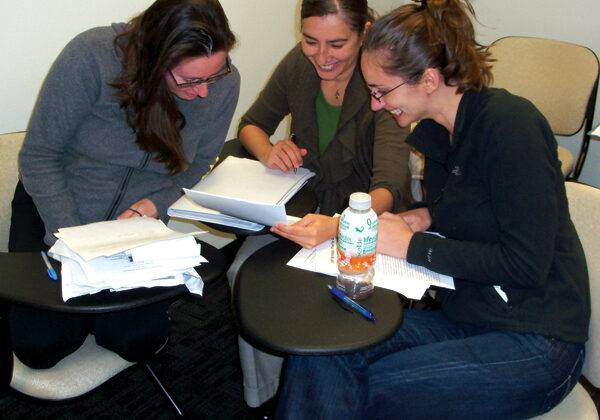
Exercises that involved team activities were emphasized early on, and—based on student feedback—provided a good learning experience. Problems posed by the guest lecturers for students to solve in class ranged from developing strategic plans to addressing personnel issues in the workplace to balancing work and family life. The guests gave feedback to the students on their proposed solutions. This real-world problemsolving was clearly one of the most well-received parts of the course.
Another popular and unique aspect of the course was a workshop to determine personal leadership style. Individual assessments were completed using the Myers-Briggs Type Indicator and Emotional Intelligence Indicator. An analysis and discussion was carried out in class, including group exercises to illustrate differences among the leadership styles.
The course ended with a review of key concepts and an emphasis on the fact that leadership education requires lifelong learning, much like mastering statistical skills. It was emphasized that this course was not an end to the students, leadership education.
Feedback from students about the course was positive. The students exhibited high levels of enthusiasm and class participation, and all agreed the course was a valuable learning experience. Comments from students included the following:
“This is a great course that I would recommend to any biostat student.”
“This was a great course with speakers that had very useful and relevant information and first-hand experience that would have been difficult for me to find/learn on my own.”
Leave a Reply