
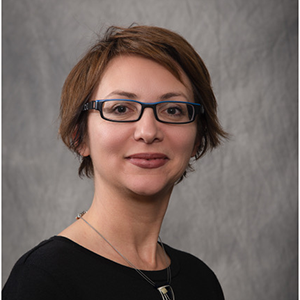
Aleksandra (Seša) Slavkovic
Professor of Statistics and Associate Dean for Graduate Education, Eberly College of Science, Penn State University
Educational Background
PhD, Statistics, Carnegie Mellon University
MS, Statistics, Carnegie Mellon University
Master of Human-Computer Interaction, Carnegie Mellon University
BA, Psychology, Duquesne University
Aleksandra (Seša) Slavković is a professor of statistics with appointments in the department of statistics and Institute for Computational and Data Sciences at Penn State University, as well as the department of public health sciences in the Penn State College of Medicine. She has also held visiting scholar positions at Cornell University, the University of California, Berkeley, the University of Minnesota, and Utrecht University. She is currently serving as the associate dean for graduate education in the Eberly College of Science at Penn State. In the statistics department, she served as associate head for diversity and equity and associate head for graduate studies. In 2017, she received the Penn State Graduate School Alumni Society Graduate Program Chair Leadership Award.
Slavković is associate editor of the Annals of Applied Statistics and Journal of Privacy and Confidentiality. She also chairs the ASA Privacy and Confidentiality Committee and serves on the NORC Advisory Committee on Statistics. She has served on a number of National Academy of Sciences/National Research Council committees. She is an elected fellow of the ASA (2018), an elected member of the International Statistical Institute (2012), and proud parent of a happy 3-year-old.
Born and raised in Čačak, Serbia, Slavković competed in mathematics and sciences at local and national levels while enjoying sports, music, and dance. As an international student at Duquesne University, she studied psychology and biology and was supported by the Tamburitzan Scholarship. This allowed her to explore her academic curiosities while traveling the country and being on stage with this unique, culturally diverse performance ensemble.
Slavković was initially drawn to teaching and planned to pursue a PhD in psychology. However, during her master’s in human-computer interaction—an interdisciplinary field that investigates the relationship between computer technology, human activity, and society—she realized the importance of statistics to all areas of science and policy. At that time, she was fortunate to meet Steve Fienberg, who recruited her to the doctoral program in statistics at Carnegie Mellon and became her thesis adviser and mentor. She credits Fienberg with helping her unravel the beauty of statistics by examining its key role in the collaborative cross-disciplinary research and instilling in her the importance of good mentoring.
Slavković leads methodological developments in data privacy and confidentiality in the context of small- and large-scale surveys, health, genomic, and network data. Her focus is on the interplay of tools from statistics and computer science that leads to formal privacy protection—such as differential privacy—and broad data access, but also offers guarantees of accurate statistical inference needed to support reliable science and policy. Other past and current research interests include evaluation methods for human performance in virtual environments, statistical data mining, application of statistics to information sciences and social sciences, algebraic statistics, and causal inference.
In her role as associate dean for graduate education, Slavković supports the enhancement of the graduate programs in her college and works closely with its office of diversity and inclusion to foster a positive climate for all members of the college. She also works with students and faculty to improve graduate student mentoring and oversees the Science Achievement Graduate Fellows Program, designed to recruit, recognize, and promote outstanding students seeking a doctoral degree in each of the college’s seven departments and who have demonstrated interest in the advancement of women in sciences.
Leave a Reply