
Jingye Wang and Ling Shen
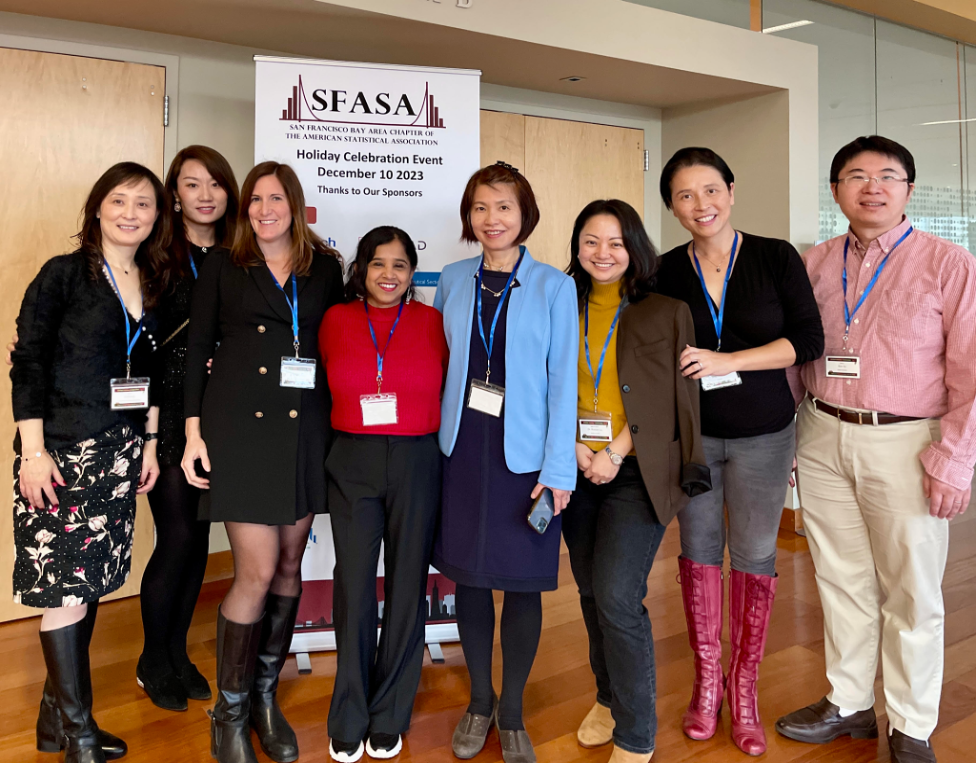
The San Francisco Bay Area Chapter held its holiday celebration December 10, 2023, at San Jose State University. Keynote speakers James Zou, Jian Dai, and Viji Krishnamurthy, along with panelist Haiyan Huang, shared their insights into the transformative effect of large language models such as ChatGPT. Approximately 160 chapter members attended.
David Czerwinski, associate dean of Lucas College and San Jose State University Graduate School of Business, welcomed all attendees. Ling Shen, chapter president, discussed the chapter’s core values, highlighted activities held in 2023, and previewed upcoming events. ASA President Bonnie Ghosh-Dastidar endorsed the chapter’s core values and initiatives, emphasizing that statistical science is essential to generating reliable information on which a healthy society and democracy rely.
In his keynote presentation, Zou—an assistant professor of biomedical data science, computer science, and electrical engineering at Stanford University—discussed the role of LLMs in personalized medicine, unveiling projects showcasing the potential of AI to transform medical processes and enhance patient care. One such project, featured on the front cover of Nature Medicine, is a visual-language AI designed for pathology. This system leverages the capabilities of AI to interpret complex pathology images. By combining visual recognition with language understanding, the tool can provide pathologists with descriptive analyses and preliminary diagnoses, potentially increasing the speed and accuracy of pathology reports.
Krishnamurthy, senior director of generative AI solutions at Oracle, introduced recent industry development of generative AI and discussed how it is transforming health care, the life sciences, and enterprise applications. Her keynote underscored the role of AI in augmenting the capabilities of clinical professionals.
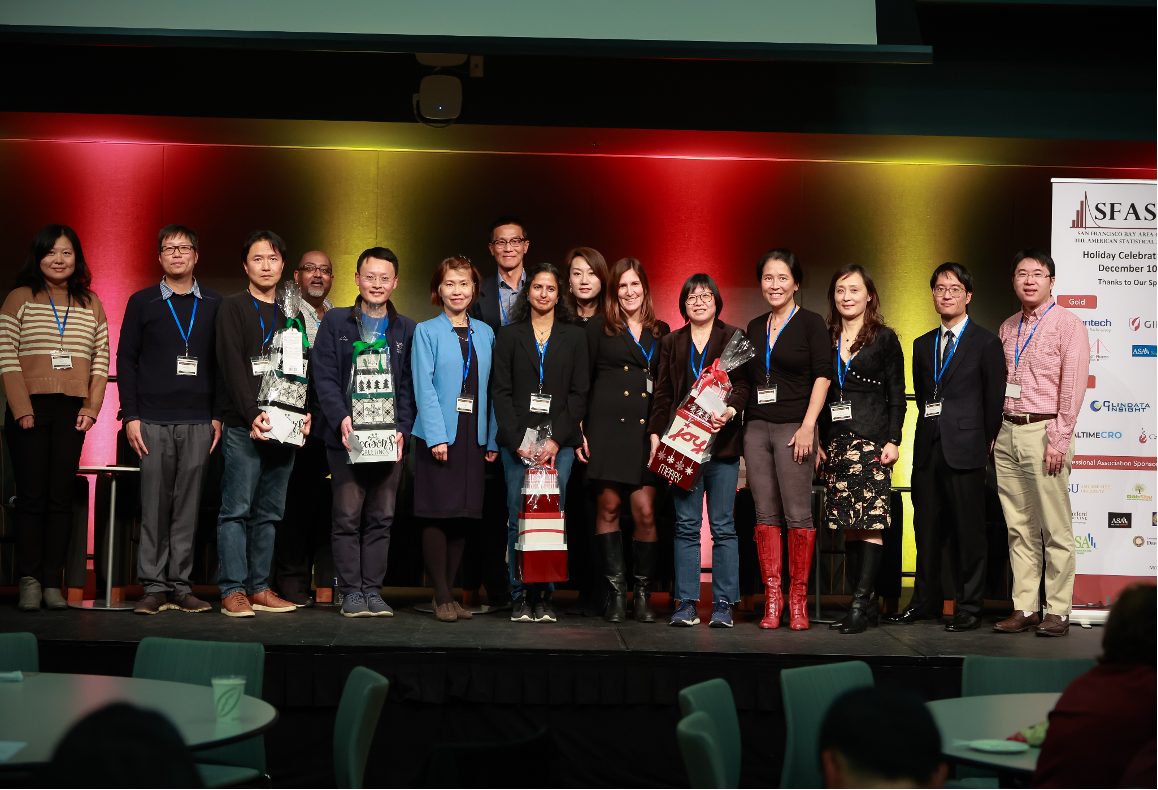
Dai, an expert data scientist at Genentech pioneering AI in genomics, presented opportunities for LLM applications in clinical development. He highlighted a project aimed at uncovering overlooked hypotheses in neurodegenerative diseases with LLMs. By sifting through extensive scientific publications, the AI model identifies and reevaluates potential research avenues that may have been overlooked. In his closing remarks, Dai emphasized the need for collaboration to harness the full potential of LLMs. He said the industry must remain agile, embrace new technologies, and foster a collaborative environment.
Chenglin Ye, senior principal statistical scientist at Genentech, moderated a panel discussion featuring Haiyan Huang of the University of California, Berkeley, along with Zou, Krishnamurthy, and Dai.
The panelists explored practical and philosophical aspects of AI in health care and education. One such aspect is the use of ChatGPT by students for completing homework. The panelists shared a nuanced view, recognizing the tool’s potential to aid learning but also cautioning against a reliance that bypasses critical thinking. The conversation took a visionary turn when discussing AI acceleration versus AI alignment—concepts that deal with the pace of AI development and the importance of aligning AI systems with human values. When addressing the technological singularity—a hypothetical point in time when AI surpasses human intelligence—the panelists concluded that while the future of AI is fraught with uncertainties, it also offers unprecedented opportunities for positive change.
Rex Cheung, chapter president-elect, concluded the celebration by thanking the speakers, panelists, event organizers, and participants.
Leave a Reply