
Michelle Shardell, University of Maryland School of Medicine, and Xiaojing Wang, University of Connecticut
The Statistical Partnerships Among Academe, Industry, and Government Award annually recognizes outstanding partnerships among organizations from academia, industry, and government and aims to promote new cross-sector collaborations. This distinct ASA award emphasizes recognition of outstanding collaborations between organizations, while also recognizing key individual contributors and important advances.
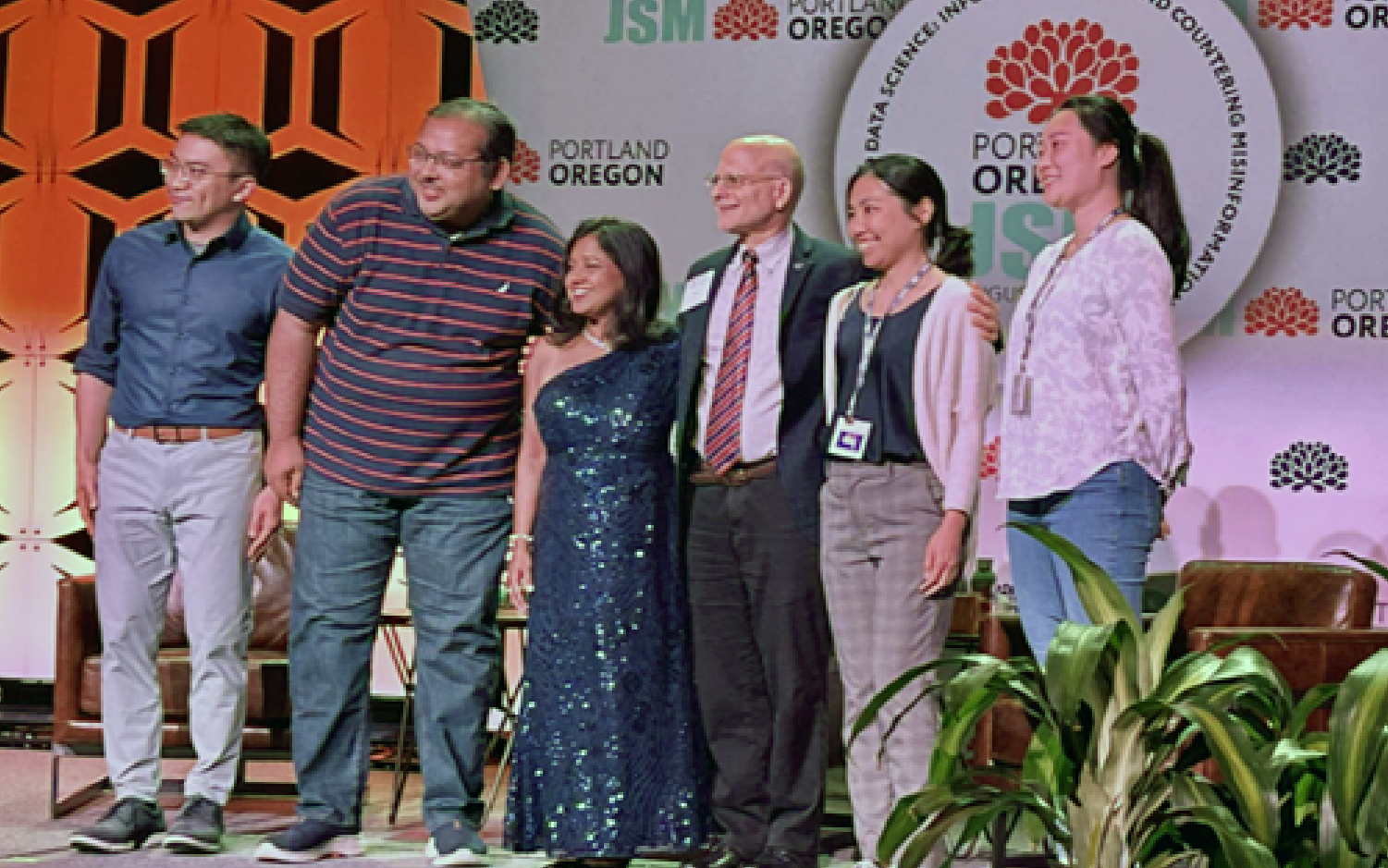
The SPAIG award winner was announced at the 2024 Joint Statistical Meetings in Portland, Oregon. This year, the SPAIG award honors the Setting International Standards in Analyzing Patient Reported Outcomes and Quality of Life Data-Innovative Medicines Initiative (SISAQOL-IMI) Consortium, a collaboration among 41 international organizations from academia, industry and government for impactful recommendations to improve design, analysis, and interpretation of patient-reported outcomes data in cancer clinical trials. The collaboration is co-led by the European Organisation for Research and Treatment of Cancer (academia) and Boehringer Ingelheim (industry). Joseph Cappelleri nominated SISAQOL-IMI and served as project lead for Pfizer on the collaboration.
For almost a decade, the SISAQOL-IMI Consortium has established an intercontinental collaboration to provide guidance on how to collect, analyze, and present patient-reported outcomes data in cancer clinical trials. The collaboration has led to recommendations to improve practice and understanding of patient-reported outcomes data and has yielded multiple achievements, including training nine students and fellows, publishing two manuscripts, and giving 16 workshops and presentations.
The ASA SPAIG Committee had the opportunity to talk to the individual contributors and leaders to learn about the winning collaboration, the challenges they faced, and their keys to success. Madeline Pe of EORTC and Anders Ingelgaard of Boehringer Ingelheim—with input from Vishal Bhatnagar of the US Food and Drug Administration), Mallorie Fiero of the FDA, and Cappelleri—responded to the following questions about their experience participating in the SISAQOL-IMI Consortium:
How did the collaboration start?
The overall aims for cancer therapies are to cure patients, extend their lives, and ensure a good quality of life. While survival and tumor-related endpoints are commonly used in assessing cancer therapies, health-related quality of life and other patient-reported outcomes have lagged due to a lack of standards. To address this, the SISAQOL consortium was started by the EORTC in 2016, involving various international stakeholders to create consensus-based standards in the design and analysis of HRQoL and patient-related outcomes data in cancer randomized controlled trials. The SISAQOL-IMI Consortium expanded on this work, engaging more stakeholders and addressing additional areas needing harmonization, such as presentation and visualization of results, use of patient-reported outcomes in single-arm studies, and defining clinically meaningful thresholds.
What are some of the major benefits of the collaboration?
The collaboration brings together statisticians, health-related quality of life and patient-reported outcome methodologists, clinicians, and patients from various sectors (regulatory, academia, industry). Some people may wonder what the role of clinicians and patients is in a statistical project. But clinicians and patients are essential in evaluating the clinical meaningfulness of statistical decisions, such as, “Is it appropriate to impute worst patient-related outcome score for death? What would that mean for the interpretability of the results if we do that?” This interdisciplinary approach ensures that statistical analyses are relevant and beneficial in real-world clinical settings. Moreover, by voting on consensus statements over the last few years, each organization needed to come to internal consensus and then consider the perspectives of others. With this process, there was self-reflection and consideration of the perspectives of multiple interested parties. Regardless of the product, the process itself was extremely beneficial for all.
What have been the most rewarding and most challenging aspects of the collaboration?
The most challenging aspect of this undertaking has been obtaining consensus on the recommendations to improve design and analysis standards for health-related quality of life and patient-reported outcomes data across a large, international, and diverse group of 41 organizations on a very niche statistical research area. However, since each organization had only one vote, this meant that individuals within organizations had to meet and prepare a common response for the consensus meetings with other organizations. This implied that a small group of individuals with busy day jobs had to devote four to five years to achieve this common goal.
The most rewarding aspect was overcoming different organizational perspectives on key statements through a consensual framework that emphasized mutual respect and engaged discussions grounded in shared values. It was rewarding to have in-depth discussions between clinical and statistical colleagues to align on a standpoint on a specific issue. The strong commitment from the community resulted in a timeless and valuable resource that is globally accessible, serving patients, trainees, drug developers, regulators, health technology assessment bodies, academia, and more. Despite the challenges of reaching consensus among diverse perspectives, SISAQOL effectively navigated the process, resulting in a significant and enduring contribution to the field.
What advice would you give to individuals and organizations that are looking to be more collaborative?
Actively connecting with individuals and organizations that share similar interests and values can lead to meaningful professional relationships and unexpected opportunities. A shared vision helps initiate collaboration, but working across various organizations and experts requires patience and active listening to address each other’s concerns to achieve a higher collective aim. Collaboration across individuals from various organisations takes more time but allows everyone to learn and adapt their views based on other’s perspectives, which ultimately makes the project’s outcome more impactful.
The SISAQOL-IMI project has received funding from the Innovative Medicines Initiative 2 Joint Undertaking under grant agreement No. 945052. This joint undertaking receives support from the European Union’s Horizon 2020 research and innovation programme and the European Federation of Pharmaceutical Industries and Associations.
Leave a Reply