
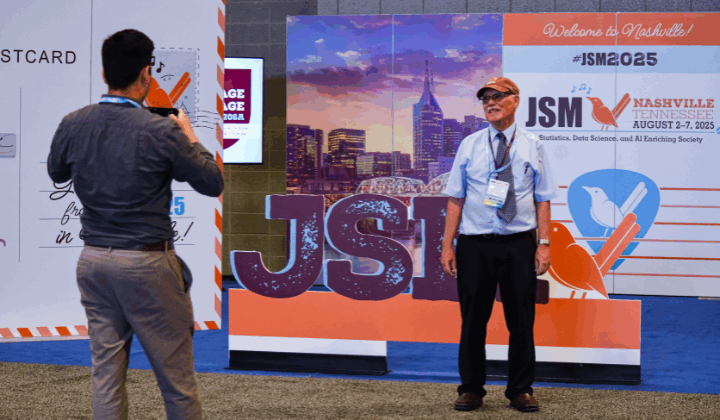
Alexandra M. Schmidt, JSM 2025 Program Chair; Caitlin Ward, JSM 2025 Associate Program Chair; and Shirin Golchi, JSM 2025 Poster Chair
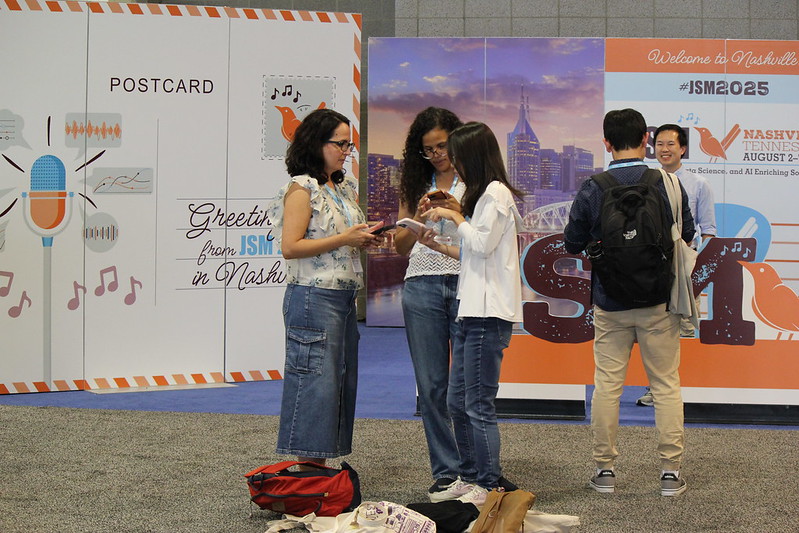
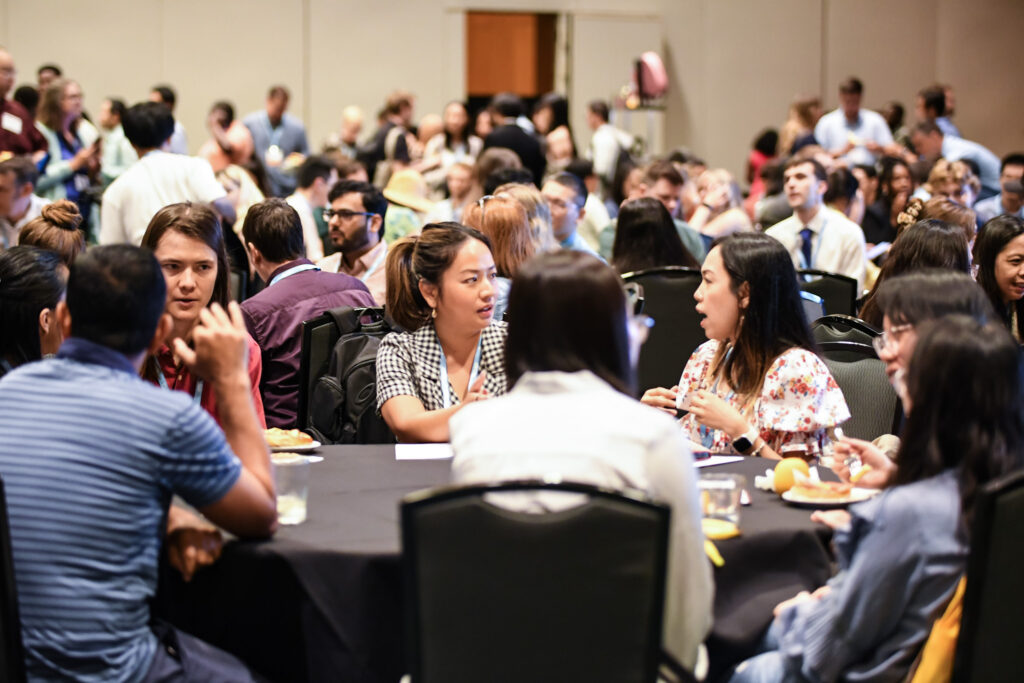
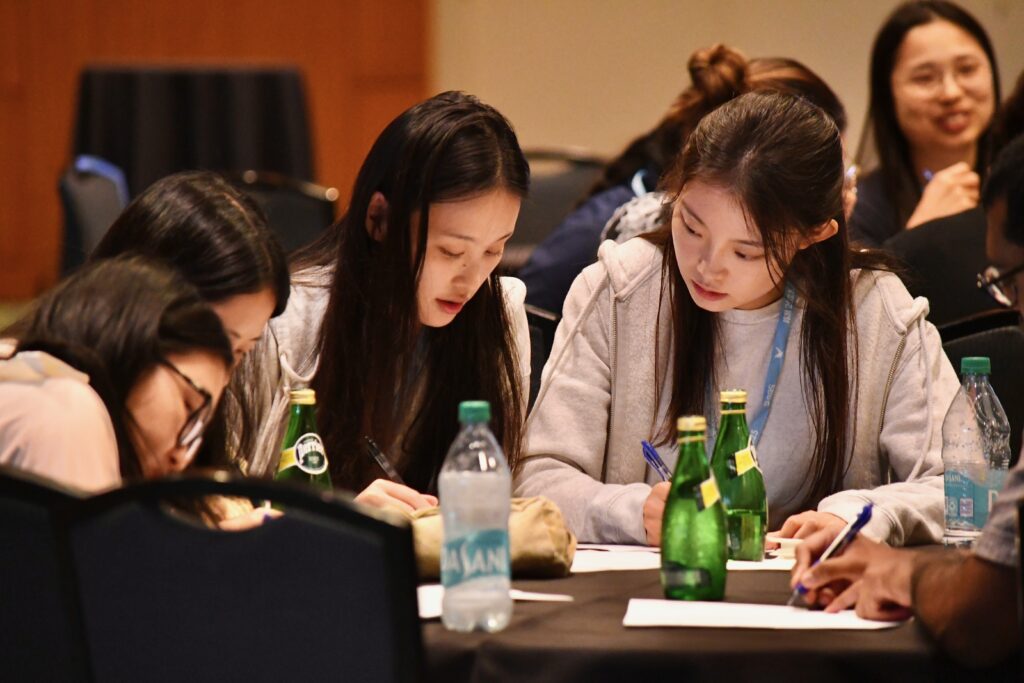
The 2025 Joint Statistical Meetings was held in Nashville from August 2–7. The technical program spanned diverse sessions and topics, while Nashville’s ‘Music City’ spirit kept the energy high. There were 206 invited sessions, 154 topic-contributed sessions, and 171 contributed sessions.
As AI played a central role in the program, the following introductory paragraph about JSM 2025 comes from ChatGPT:
The buzz at the 2025 Joint Statistical Meetings was unmistakable: This is the age of AI, and statistics is right in the middle of it. With generative models writing code, drafting reports, and even guiding decisions in medicine and policy, the world is grappling with the speed and scale of change. At JSM, the world’s largest gathering of statisticians and data scientists, the mood was both electric and urgent. Far from being sidelined, statistics is proving to be AI’s backbone—the discipline that tests its limits, explains its inner workings, and keeps it accountable. Panelists and keynote speakers drove home a simple but powerful message: In a world awash with algorithms, it’s statistical thinking that will determine whether this revolution delivers on its promise—or spins out of control.
Following up on the theme, the ASA President’s Invited Address was given by Juan Lavista Ferres, from the AI for Good Lab at Microsoft. He talked about AI for Good in the Era of GPT. James Robins, from the Harvard School of Public Health, delivered the COPSS Distinguished Achievement Award and Lectureship. He shared his experience in the last 40 years in the field of Causal Inference and ended his talk with a discussion about the future of causal inference in the age of AI. The IMS Presidential Address was given by Tony Cai of the University of Pennsylvania. Additionally, the program featured the following named lectures:
- Rietz Award & Lecture
Kathryn Roeder, Carnegie Mellon University, “Genomic Inferences in the Era of Black Box Predictions” - Neyman Award & Lecture
Regina Liu, Rutgers University, “Fusion Learning: Combining Complex Inferences from Diverse Data Sources” - David R. Cox Foundations of Statistics Award
Philip Dawid, University of Cambridge (retired), “A Lifetime of Irrelevance” - Deming Lecturer Award
Jianjun Shi, Georgia Institute of Technology, “From Statistical Process Control to In-Process Quality Improvement” - IMS Grace Wahba Award and Lecture
Richard Samworth, University of Cambridge, “Nonparametric Inference Under Shape Constraints: Past, Present, and Future” - Florence Nightingale David Award Lecture
Katherine Ensor, Rice University, “Brave New World: Fact or Fiction” - Le Cam Award & Lecture
Peter Bickel, University of California at Berkeley, “Local Asymptotic Analysis: A General Quantitative Tool” - Medallion Lectures
– Ery Arias-Castro, University of California San Diego, “Modal Clustering: Past and Present”
– Sandrine Dudoit, University of California at Berkeley, “Learning from Data in Single-Cell Transcriptomics”
– Florentina Bunea, Cornell University, “Learning Softmax Mixture Ensembles for AI Applications”
– Victor Panaretos, EPFL, “Near the Diagonal”
– Boaz Nadler, Weizmann Institute of Science, “Finding Structure in High-Dimensional Data: Statistical and Computational Challenges”
Introductory Overview Lectures
This year’s program featured the following four IOLs on timely statistical topics relevant to those across academia, industry, and government and fitting within this year’s JSM theme of “Statistics, Data Science, and AI Enriching Society.”
- Christopher Wikle of the University of Missouri and Andrew Zammit-Mangione of the University of Wollongong presented on hybrid deep learning and AI methods for modeling large spatial and spatio-temporal data sets and offered insight into current and future challenges in this evolving field.
- Jerome Reiter of Duke University and Claire Bowen of the Urban Institute talked about how statistical methods can protect the confidentiality of sensitive data, such as social media or AI, while maintaining its value for the public good.
- J. Jack Lee and Ying Yuan from the University of Texas MD Anderson Cancer Center reviewed statistical considerations and design strategies to address challenges related to the recent US Food and Drug Administration Project Optimus, which has reformed dose optimization trials.
- Nancy Zhang and Mingyao Li of the University of Pennsylvania covered fundamental and advanced data analysis for single-cell and spatial omics data, providing inspiration and guidance to statisticians wanting to break into the rapidly advancing field.
Invited Posters
The invited poster session consisted of 40 posters and was held in two sections during the Opening Mixer. Presentations spanned topics in statistics, biostatistics, and data science including Bayesian methods; causal inference; high-dimensional and functional data analysis; spatial statistics; and statistical education and computational statistics applied to areas such as epidemiology, clinical trials, health policy, computer experiments, and ecology.
Memorial Sessions
The program also included memorial sessions to honor the legacies of Don Dillman, Katherine Wallman, Ralph D’Agostino, Myles Hollander, P. K. Sen, and David Wheeler.



Leave a Reply