
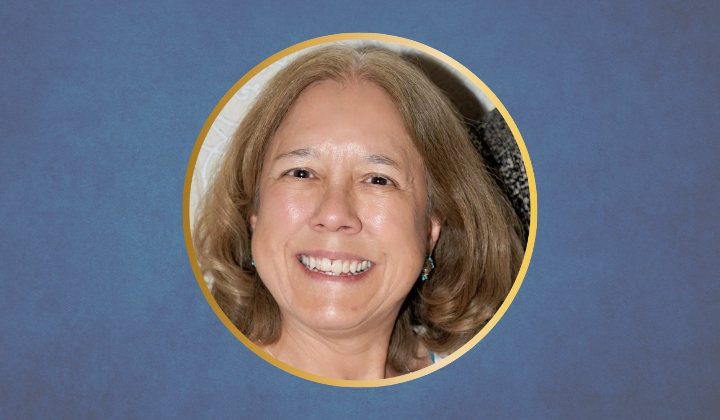
I believe there’s something remarkable that happens when we come together with genuine intention. Whether it’s sharing a conversation about a thorny problem, collaborating on a challenging project, or simply offering words of encouragement during difficult times, these moments form the foundation of what we call our “ASA community.” These connections have been essential for me throughout my career, so there was no choice but to focus on communities in action for my year as ASA president.
Let me begin by sharing my career story. I am an applied statistician with nearly 40 years of experience. I spent most of my statistical career in service to the federal statistical system, working to provide critical data and information to the public to inform policy decisions.
Thinking back on it now, I cannot remember why I initially decided to major in chemical engineering, but I did and received a scholarship to Montana State University. After one semester of engineering courses, I knew that was not the area for me and switched to mathematics. In my junior year, my adviser insisted I take applied mathematics courses such as statistics, computer science, and accounting. I dropped accounting after two weeks. Computer programming classes were okay, and I wasn’t convinced statistics was more than just a bunch of formulas and not challenging. Fortunately, my adviser insisted I take more statistics classes, including regression, analysis of variance and design of experiments. Well, statistics had me after that. I took as many statistics courses as I could pack into my senior year at MSU and applied to graduate school in statistics. The rest is, as we say, “history.”
I attended graduate school at Colorado State University where I met a lot of great people, both professors and students, and my husband. I wrote a master’s thesis and passed my qualifying exams before deciding to work in the statistical engineering division at the National Institute of Standards and Technology in Boulder, Colorado. My work experience in applied statistics includes two years at NORC learning about surveys and variance estimation, five years at Ernst & Young helping to build their statistical sampling practice, and more than 25 years working in three federal principal statistical agencies: Statistics of Income Division at the Internal Revenue Service as a mathematical statistician; the National Center for Science and Engineering Statistics at the National Science Foundation as deputy division director; and the Bureau of Justice Statistics at the Department of Justice as principal deputy director and acting director. I’ve spent the last seven years at Westat and am currently the vice president and data solutions sector lead.
I began this column acknowledging how important the ASA community has been to me. But what exactly do we mean when we talk about ASA community? At its most fundamental level, a community is more than just a group of people who happen to work in the same field or share the same job title. True community involves an active exchange that enriches everyone involved. It means sharing your hard-won expertise with others who are navigating challenges you’ve already faced. It means contributing your perspective to opportunities that could benefit from diverse thinking. And, yes, it also means showing up when things get difficult, offering support during setbacks, and collectively working through the challenges no individual could solve alone.
When we ground our conversations in data and research, we elevate the entire community’s thinking. We move beyond anecdotal experience to patterns and insights that can inform better decisions.
Meaningful connection is the operative phrase here. We’ve all been part of groups that existed only on paper—committees that met out of obligation and meant little more than a line on a CV or workplace teams that functioned as collections of individuals, rather than cohesive units. These aren’t communities; they’re simply assemblies of people. What transforms a group into a community is the sense that people genuinely care about each other’s success, that knowledge flows freely—rather than being hoarded—and that members feel safe bringing both their questions and insights to the table. This is where the intersection of community and data becomes particularly powerful. When we ground our conversations in data and research, we elevate the entire community’s thinking. We move beyond anecdotal experience to patterns and insights that can inform better decisions. As statisticians and data scientists, our superpower is the ability to frame questions in ways that can be answered using data.
The beauty of this data-driven approach is it strengthens community, rather than diminishing it. When we bring data to our discussions, we create common ground. We give quieter voices a way to contribute beyond personal charisma or organizational rank. We build trust by showing that decisions aren’t arbitrary but grounded in thoughtful analysis. And we acknowledge that even our best assumptions need to be tested against reality.
Communities in Action Steering Committee






I selected “Communities in Action: Advancing Society” for the JSM 2026 theme and want to make this the focus of my year (and beyond) as president. This initiative is designed to strengthen the connection between ASA members and community leaders. By developing the tools, knowledge, and networks needed to engage meaningfully with decision-makers, we aim to amplify the voice and impact of our profession.
The initiative focuses on building relationships with diverse community leaders and decision-makers, including the following:
- Local Government Bodies: School boards, city councils, and municipal planning committees
- Business Community: Chamber of commerce members, local business leaders, and economic development organizations
- Civic Organizations: Community groups, neighborhood associations, and nonprofit organizations
- Policymakers: State legislators, regulatory agencies, and policy advisers
- Engaged Citizens: Members of the interested public who are invested in community development and policy outcomes
Through this initiative, we will develop a deeper awareness of local challenges and opportunities, positioning ourselves as informed contributors to community dialogue and problem-solving. By establishing regular channels and touchpoints with decision-makers, we will be better positioned to share professional expertise, research, and perspectives that inform data-driven policy development. Not only does our professional expertise ensure our communities benefit from more thoughtful, effective solutions that account for real-world implications, but we also increase the visibility of our profession.
The big picture of how it will work involves the following:
- Developing and distributing a repository with a toolkit that includes how to build relationships
- Crafting initial outreach messages and creating and delivering effective presentations
- Establishing a mentoring program to support and sustain the initiative
- Creating sustainable engagement channels between data experts and local communities
This is an ambitious initiative that will require collaboration from all of us to bring it to life. I know there are many challenges, and it won’t be easy, but I believe the potential impact makes it worth pursuing together.
As we move forward with implementing this plan, I need to hear from you. What initiatives or projects are you already working on that align with this vision? And in what ways would you like to contribute or get involved? Your insights and expertise will be essential to making this a reality, so please share your thoughts on where you see opportunities to make the greatest impact. To make it easy for you, we’ve created an input form.
Many of us are facing significant career and personal challenges. I remain certain that investing in professional community isn’t optional. It’s essential. In a world that increasingly feels fragmented and isolating, these connections sustain us.
Serving as president of the American Statistical Association is one of the greatest privileges of my life, and I am deeply committed to strengthening our community for years to come. The work ahead will require all of us, but I am confident our shared commitment will carry us forward.
Well-said!
The vision outlined here deeply resonates with many of us within the ASA and beyond. Strong communities are built through meaningful connection, shared purpose, and a commitment to evidence‑informed action.
As statisticians and data scientists in an era of AI, we have the responsibility and the privilege to contribute clarity, rigor, and insight to the conversations shaping our society. Here,
Let’s form and foster broad partnership and collaboration across sectors and the call to engage thoughtfully with local leaders and citizens.
When we combine data with trustworthiness, responsibilities, empathy and collective efforts, we elevate not only our profession but the communities we serve. Look forward to supporting this initiative and contributing to its impact.