
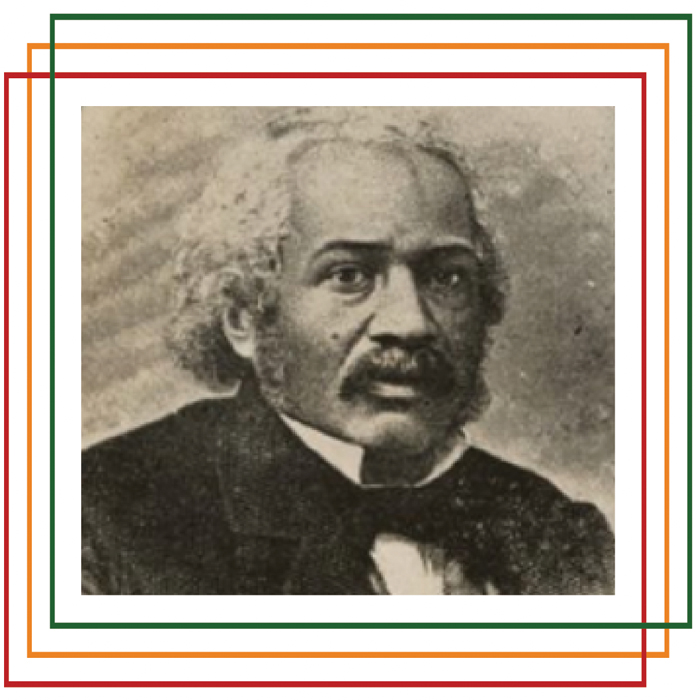
(April 18, 1813 – November 17, 1865)
Born into slavery in 1813, James McCune Smith was the first African American to obtain a university degree in medicine and the first professionally trained Black physician to practice in the United States. After returning from Scotland, he established a successful medical practice and pharmacy in New York City, where he served patients of all races and social classes.
Smith was a founding member of the New York Statistical Society and joined the American Geographical and Statistical Society in 1853, two years after its founding. A leading abolitionist, public intellectual, and accomplished linguist, he wrote extensively for both scholarly and popular audiences and collaborated with figures such as Frederick Douglass. Across his work, Smith pioneered the use of statistical evidence to evaluate the efficacy of medical treatments and dismantle racist claims of Black biological inferiority.
Denied admission to American universities because of his race, Smith trained at the University of Glasgow, earning a Bachelor of Arts in 1835, a master’s degree in 1836, and a medical degree in 1837. That same year, he published two articles in the London Medical Gazette using statistical analysis to demonstrate that silver nitrate treatments for sexually transmitted diseases in women were both ineffective and harmful—an early example of evidence-based medicine. Smith went on to use statistical reasoning to expose other spurious medical practices, including what he called the “lay puffery” of homeopathy and the pseudoscientific study of phrenology.
Drawing on data compiled by Edward Jarvis (the third ASA president), Smith identified and corrected errors in the 1840 US Census that had been used to support pro-slavery arguments that claimed freedom was detrimental to the health and well-being of formerly enslaved people.
His analysis helped prompt congressionally mandated reforms to the 1850 census and contributed to the creation of a centralized US Census Office in Washington.
Smith credited Adolphe Quetelet and William Farr as key influences on his work, which laid early foundations for the use of social statistics to study population health and racial disparities. Through his insistence on rigor, evidence, and moral clarity, Smith demonstrated how statistics can serve as a powerful instrument for both scientific progress and social justice.
I love this educational information.
Thank you.