
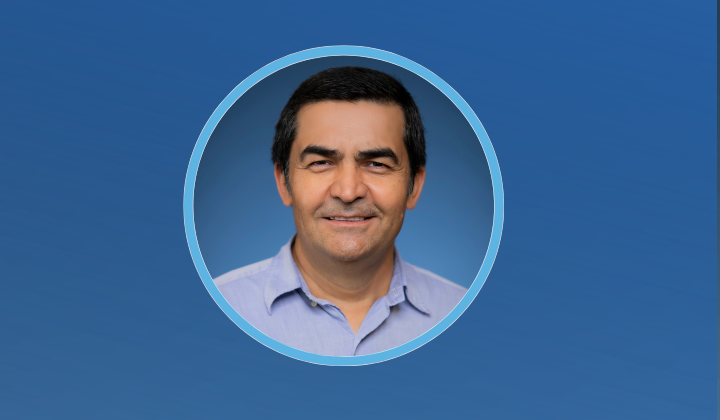
This month, we’re highlighting Elvan Ceyhan, the Marguerite Scharnagle Endowed Professor in the department of mathematics and statistics at Auburn University. He’s also co-director of the proposed Center for Data Science Innovation and president of the ASA Alabama-Mississippi Chapter.
What is your current role or area of expertise in statistics and/or data science?
I am the Marguerite Scharnagle Endowed Professor in the department of mathematics and statistics at Auburn University, where I’m also involved in leading campus-wide efforts in interdisciplinary data science through Auburn’s Collaborative Data Science Initiative. My work lies at the interface of statistical learning and decision-making under uncertainty, with a particular emphasis on networks and spatial structure.
Methodologically, I develop graph-based approaches for classification and clustering, often in settings with class imbalance or overlapping structure. I study random geometric graphs, especially proximity catch digraphs and their theoretical and computational properties. I also develop stochastic network optimization and traversal methods—such as for the Canadian traveler’s problem and the stochastic obstacle scene problem—while applying graph-based and nearest-neighbor approaches (including spatial point pattern tests based on proximity catch digraphs) to pattern recognition, spatial statistics, and high-dimensional biomedical and neuroimaging data analysis. This work can directly inform scientific and societal questions.
What has been one of your biggest professional achievements?
One of my biggest professional achievements has been building a sustained research and leadership agenda that connects foundational statistics with decision-making under uncertainty on graphs/networks.
On the research side, my work has focused on advancing graph-based learning and stochastic network optimization. Especially in navigation and adversarial contexts through externally funded projects such as National Science Foundation support for the stochastic obstacle scene problem with adversarial agents and Office of Naval Research funding for adversarial network traversal.
On the leadership side, my time as deputy director of the Statistical and Applied Mathematical Sciences Institute helped me learn how to build interdisciplinary infrastructure and partnerships. I spearheaded outreach to local minority-serving universities through workshops and events, and I directed the professional development workshop series for postdocs and graduate students.
More recently, being named the Marguerite Scharnagle Endowed Professor was a meaningful recognition of this combined trajectory in research, teaching, and service.
What career advice do you live by, and who gave it to you?
The career advice I try to live by is to optimize for substance and integrity, not short-term visibility. Do work you can defend technically and ethically. Let recognition and impact follow.
I first adopted this mindset from my PhD adviser, Carey Priebe, who consistently modeled high standards, intellectual honesty, and long-range thinking in both research and mentoring. Later, David Banks reinforced this perspective by encouraging me to work in modern, emerging areas, so I could both stay relevant and help shape where the field is going—whether in graph-based methods, spatial statistics, or stochastic network models. That combination—deep rigor paired with a willingness to engage with new problems—has guided how I choose projects, collaborations, and leadership roles throughout my career.
What experiences and past roles have led you to where you are today?
My path has been shaped by a mix of rigorous training, interdisciplinary collaborations, and leadership roles that kept pulling me toward problems where statistics can genuinely move the needle. I started with a strong mathematics foundation at Koç University, then pursued graduate training with an MS in statistics at Oklahoma State University and a PhD in applied mathematics and statistics at Johns Hopkins University, where my dissertation focused on proximity catch digraphs and related random geometric graph ideas.
After a postdoctoral fellowship at the Johns Hopkins Center for Imaging Science, I joined the faculty at Koç University (assistant to associate professor), where I served a one-year rotational term as chair of the department of mathematics. A visiting appointment at the University of Pittsburgh, followed by a dual role as research associate professor at North Carolina State University and deputy director at SAMSI, deepened my engagement with collaborative, cross-sector research and professional community-building.
I am now a professor at Auburn University, where I continue to integrate research, education, and outreach in statistics and data science, including collaborative interdisciplinary data science initiatives across campus.
What is the biggest career challenge you’ve overcome?
Instead of highlighting a single “biggest” challenge, I’ll mention two that are strong contenders for first place. One of the biggest challenges I’ve faced has been carving out a clear research identity, while working at the intersection of statistics, applied probability, optimization, and data science. Interdisciplinary work is deeply rewarding, but it can be harder to communicate and “place.” So, I had to learn how to frame problems by leading with the inferential or decision question, stating assumptions plainly, and making the statistical core of each contribution unmistakable.
A second major challenge came after nearly three years in a primarily administrative leadership role at SAMSI. Transitioning back into a research-intensive faculty position required rebuilding momentum: refreshing my pipeline, re-establishing day-to-day research habits, and re-centering teaching and mentoring. In the long run, though, that experience sharpened my sense of which problems I most wanted to pursue and how to balance leadership with a sustainable, research-active academic life.
As the president of the Alabama-Mississippi Chapter, would you recommend others get involved in an ASA chapter? Why?
Yes, I would strongly encourage others to get involved in an ASA chapter. Chapters make the profession feel local and personal, connecting statisticians and data scientists across academia, industry, and government. They give students and early-career members a low-pressure venue to present and be mentored. They also create natural entry points for outreach and partnerships in the communities in which we live.
As president of the AL-MS Chapter, I’ve learned that thriving chapters are built on sustainability rather than one-off events: regular programming (like our annual conferences); shared leadership; and smooth continuity from year to year. I’ve also learned how important it is to listen carefully to what members actually need and want—whether that’s networking, professional development, or stronger support for students. And then, design activities that are practical, welcoming, and easy for people to say “yes” to.
What is something you’d like people to know about you that we haven’t asked?
One thing I’d like people to know is that mentoring and community-building are central to how I think about research, not an add-on. I especially enjoy working with students and collaborators as they develop technical depth, good scientific habits, and confidence in their own voice. More broadly, I am drawn to problems in which statistical thinking has real consequences—particularly for decision-making under uncertainty—such as in stochastic network navigation, adversarial settings, and spatial applications. That keeps me focused on clarity about assumptions, uncertainty, and what counts as good evidence in practice, so the methods we develop can genuinely inform action in science, policy, and beyond.
Leave a Reply