
Valerie Nirala, ASA Communications Strategist
In every community, mathematics and statistics are at work—in the hospitals tracking vaccination coverage, in traffic systems optimizing commute times, in schools identifying achievement gaps, and in city offices measuring voter turnout and neighborhood equity. From monitoring air quality and mapping food insecurity to analyzing small business trends and planning transit routes, data quietly powers the systems that keep communities moving.
Each April, Mathematics and Statistics Awareness Month invites us to make that work more visible. And this year’s theme invites us to take a journey through our communities, tracing the pathways on which data shapes daily life.
Since 2017, MSAM has served as a national reminder that mathematics and statistics are not abstract pursuits but instead are shared tools communities use to allocate resources, protect public health, strengthen local economies, and build sustainable futures.
The observance traces its origins to 1986, when Mathematics Awareness Week was first established. In proclaiming the initiative, President Ronald Reagan emphasized the indispensable role of mathematics in fields ranging from medicine and computer science to government and defense.
Over time, the celebration expanded—first to Mathematics Awareness Month and, in 2017, to Mathematics and Statistics Awareness Month—formally recognizing the distinct and growing contributions of statistics.
Today, MSAM reflects a simple but powerful idea: Progress is collective. It is the power of many—many data points, many decisions, many communities—working together.
ASA’s Initiatives for 2026
This year, the American Statistical Association invites members and the broader community to celebrate MSAM through a range of activities and resources centered on the theme “The Power of Many: How Mathematics and Statistics Strengthen Communities.”
Highlights include the following:
- A dedicated MSAM website featuring downloadable resources, historical materials, and promotional tools
- A free poster included in this issue of Amstat News aligned with this year’s theme
- Publicity tips to help members amplify their outreach efforts
- The Predict 5 Contest, in which participants made predictions about five April events (with winners to be announced in early May)
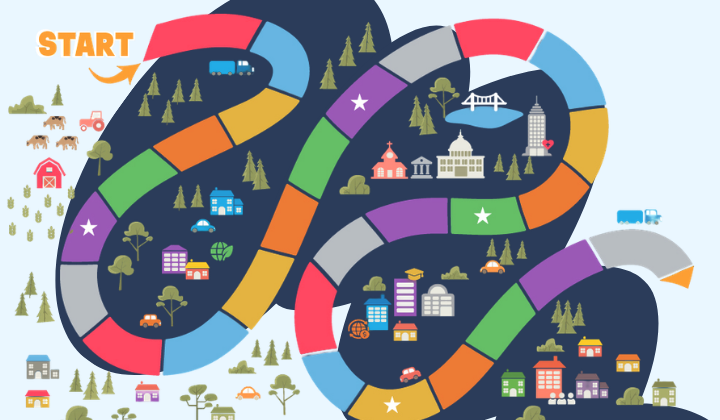
- The Community Game, a board game built around this year’s poster with downloadable rules and questions
- Downloadable Zoom backgrounds to help promote MSAM throughout the month
Together, these initiatives offer practical ways to make mathematics and statistics visible—not only within classrooms and research institutions, but across workplaces and communities.
Get Involved
MSAM thrives when communities make it their own. Members are encouraged to organize activities that showcase the real-world impact of mathematics and statistics, from workshops exploring practical applications in health care, policy, or data science to student competitions, public lectures, and creative projects that invite broader participation.
For inspiration, visit the MSAM website to explore past posters and learn more about the initiative’s history. Share your activities all month using #MathStatMonth to join the conversation.
At its heart, Mathematics and Statistics Awareness Month is about connection. It’s about recognizing the many ways data links neighbors to neighborhoods, classrooms to city councils, and hospitals to highways. It’s about tracing the pathways that shape daily life and seeing, perhaps more clearly than before, how the power of many strengthens us all.
A Brief History of MSAM
1986: Mathematics Awareness Week is established by presidential proclamation, highlighting mathematics as essential to national progress.
1999: The observance expands to a full month, becoming Mathematics Awareness Month.
2017: The initiative evolves into Mathematics and Statistics Awareness Month, recognizing the growing visibility and impact of statistics as a discipline.
TODAY: MSAM spotlights how mathematics and statistics strengthen communities, from public health and infrastructure to education, environmental sustainability, social services, local economies, and civic engagement.
Thank you for this insightful piece. The theme “The Power of Many” is both meaningful and inspiring.