
In recognition of National Disability Employment Awareness Month, the Committee on Statistics and Disability highlights three statisticians and data scientists with disabilities. Through their stories, we’ll learn more about their careers, accomplishments, experiences in the field, and perspectives on statistics and data science. Read on to meet these colleagues and learn more about their work and journeys.
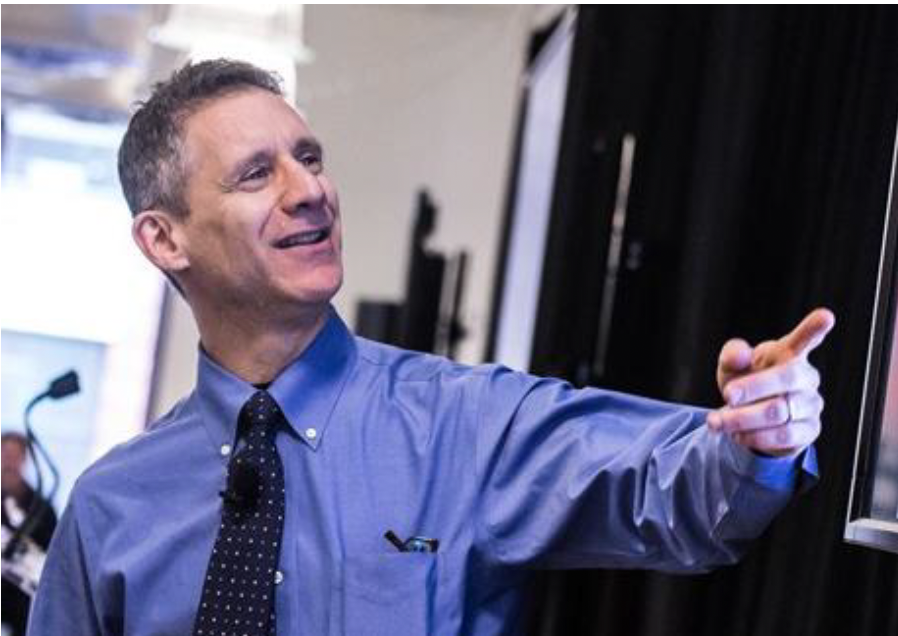
Andrew Gelman
Professor of Statistics and Political Science, Columbia University
Where did you grow up?
I grew up in Silver Spring, Maryland, a suburb of Washington, DC. My parents both worked for the government. Earlier, my dad had worked for General Electric in their aerospace division, building circuits to compute missile trajectories. Around 1970, he was laid off for a while, then later transferred to the DC area. A couple years after that, he took a job at the Environmental Protection Agency, working in the division that enforced the phase-out of leaded gasoline. He learned there were openings at the EPA from an announcement one day in Mike Causey’s Federal Diary column in The Washington Post.
My mom was a housewife, and when I was old enough to take care of myself after school, she worked as a secretary, substitute teacher, and then as an economist for the Bureau of Labor Statistics. One of her jobs there was to call up companies and check on the employment numbers they were sending to the government.
Silver Spring is in Montgomery County, Maryland, which, at the time I was growing up, was the richest county in America as measured by median income. Montgomery County was not a haven for the ultra-rich, but it had very few poor people. It seemed nearly uniformly upper middle class. Where I grew up was not the richest part of the county, but we were all comfortably middle class. Our family did not have extra savings in the bank, but there was no concern about paying the bills each month. My parents, like many people in the area, worked at desk jobs for the government. These were non-supervisory jobs with nothing close to the autonomy and pay I get as a tenured professor, but they were secure jobs with steady incomes.
In Montgomery County, compared to the country (and world) as a whole, we had something approximating political, social, legal, and economic equality. The police were part of the community. The doctors and nurses were part of the community. We felt neither like an occupied country, nor a colonial power.
I’m not completely sure why this should be, but it often seems like local equality is a sort of privilege, bought by amassing enough of a surplus that society can afford to underwrite the efforts needed to keep a more natural state of inequality at bay. I think equality is desirable, and I count myself very lucky to have grown up in a community that was both prosperous and equal.
Where did your interest in statistics/data science come from?
I studied math and physics at MIT. To be more precise, I started in math as default; ever since I was two years old, I’ve thought of myself as a mathematician, and I always did well in math class, so it seemed like a natural fit.
But I was concerned. In high school, I’d been in the US Mathematical Olympiad training program, and there, I met kids who were clearly much better at math than I was. In retrospect, I don’t think I was as bad as I’d thought at the time. There were 24 kids in the program, and I probably ranked around number 20 (if that), but I think a lot of the other kids had more practice working on Math Olympiad–type problems. Maybe I was really something like the 10th best in the group.
Tenth-best or 20th, whatever it was, I reached a crisis of confidence around my sophomore or junior year in college. At MIT, I started right off taking advanced math classes, and somewhere along the way, I realized I wasn’t seeing the big picture. I was able to do the homework problems and do fine on exams, but something was missing. Ultimately, I decided the problem was, in the world of theoretical math, there were the [Augustin-Louis] Cauchys, the [Bernhard] Riemanns, etc., then everybody else. I didn’t want to be one of the “everybody else.” Unfortunately, I didn’t know about applied math at the time. At MIT, as elsewhere, I imagine the best math students did the theory track.
I was also majoring in physics, which struck me as much more important than math, but which I felt I understood even less. I did well in my classes—it was MIT. I didn’t have a lot of friends, and I didn’t go on dates, so that gave me lots of time to do my problem sets each week. I reached the stage of applying to physics grad schools. It was only at the very last second in April of my senior year that I decided to go for a PhD in statistics rather than physics.
I had some good experiences in physics, most notably taking the famous Introduction to Design course at MIT. Actually, that was a required course in the mechanical engineering department, but many physics students took it, too. I worked for two summers doing solid-state physics research at Bell Labs. We were working on zone-melt recrystallization of silicon and, as a byproduct of our research, we discovered a new result (or, at least it was new to us)—that solid silicon could superheat to something like 20 degrees above its melting point before melting. This wouldn’t normally happen, but we had a setup in which the silicon wafer was heated in such a way that the center got hotter than the edges. At the center, there were no defects in the crystal pattern for the melting process to easily start. So, it had to get really hot for it to start to melt.
Figuring this out wasn’t so easy—it’s not like we had a thermometer inside our wafer. (If we did, the crystalline structure wouldn’t have been pure, and there wouldn’t have been any superheating.) We knew the positions and energies of our heat sources, and we had radiation thermometers to measure the exterior temperature from various positions. We knew the geometry of the silicon wafer (which was encased in silicon dioxide), and we could observe the width of the molten zone.
I programmed a finite-element model on the computer and played around with its parameters until I matched the observations, then I looked inside to see what our model said was the temperature at the hottest part of the wafer—statistical inference, really (although I didn’t know it at the time). When I came to Bell Labs for my second summer, I told my boss I’d decided to go to grad school in statistics. He was disappointed and said that this was beneath me—that statistics was a step down from physics. I think he was right (about statistics being simpler than physics), but I really wasn’t a natural physicist, and I think statistics was the right field for me.
Why did I study statistics? As part of my understanding of statistical workflow, I’ve come to consider “why” questions as pointers to potential interventions. The intervention that happened to me was that I took a data analysis course from Don Rubin when I was a senior in college. MIT had very few statistics classes. I’d taken one of them and liked it, and when I went to a math professor to ask what to take next, he suggested I go over to Harvard and see what they had to offer.
I sat in on two classes. One was deadly dull, and the other was Rubin’s, which was exciting from Day 1. The course just sparkled with open problems, and the quality of the 10 or so students in the class was amazing. I remember spending many hours laboriously working out every homework problem, using the Neyman-Pearson theory we’d been taught in my theoretical statistics course. It’s only by really taking this stuff seriously that I realized how hopeless it all is. When I took a class two years later on Bayesian statistics from John Carlin, I was ready to move to a model-based philosophy.
Would you share information about your disability?
I have Tourette’s syndrome, which manifests for me as an uncontrollable need to twitch. I’ve had it since around age 6, which I’ve been told is the usual pattern. Over the years, the twitches have moved around—they’ve included coughing, swallowing, and other small vocalizations; chewing on things; head shaking; and movements of my shoulders or other joints.
Perhaps related, I’ve never been able to sit still, and I almost never look people in the eye. I’d lose a staring contest with just about anybody. When I was a kid, adults would sometimes get mad at me for not looking them in the eye. I remember being shouted at by an assistant principal in elementary school. As an adult, I still usually let my eyes dart around rather than locking eyes with people in conversation. Also, I can’t visualize people or faces. If I close my eyes and try to picture people I know, I can’t visualize their faces. I can only think of them as collections of attributes (shape of face, hair color, hairstyle, etc.) When I run into people I know, I recognize them—I’m not “face blind.” But I’m not so good at the task. Often, it takes me a while to be sure, and I can be thrown off when someone is wearing different clothes or has new glasses or a new haircut, which I guess is consistent with me remembering people as collections of attributes rather than visual images. Maybe this is because, unlike most people, I don’t have decades of practice looking people in the eyes.
I’m not sure how much of the above is Tourette’s-specific and how much is just me, but I’m mentioning it because it all seems connected in how I feel. It goes like this: Sometimes, I feel a need to twitch—it either comes all by itself or because I’m thinking about it (like right now). With great effort, I can suppress the twitch for a half minute or so. Maybe the best analogy I can give you is how it feels when you’re hanging from the pull-up bar or holding your breath—the longer you do it, the harder it is, and eventually you just have to let go. Twitching exists in the zone between tremors and voluntary motion. When I twitch, I’m deciding to do so; it’s just that I can’t decide not to do it.
One thing, though: I don’t have coprolalia, which is when people blurt out inappropriate swear words. I like to swear as much as anyone, I guess, but it’s just part of my speech; it doesn’t come out as a twitch. I’ve read that most people with Tourette’s don’t have coprolalia; it’s just a dramatic thing that gets associated with the condition. This is not to say I never say anything inappropriate—I remember in a faculty meeting about 30 years ago, someone said something, and I responded, “Get the fuck outta’ here!” in my best Eddie Murphy voice. Unfortunately, I don’t think anyone else in that room had seen Beverly Hills Cop, so they just thought I was cussing the guy out! My bad. This had nothing to do with Tourette’s; it was just poor judgment in the moment. It’s not like I was feeling a need to curse.
But here’s the biggest thing. I never thought of myself as having Tourette’s until I was 28! It’s not that I thought I didn’t have Tourette’s—and I’d heard of the condition—it’s just that it had never crossed my mind that I might have it. What happened was one day I was chatting with a colleague at the medical school, and he offhandedly mentioned that I had Tourette’s. I don’t remember how it came up, but once I heard it, I was like, yeah, I guess that’s right. And after that, I read up on it a bit. Years later, I asked my parents how they thought about my twitching. They told me they never talked with me about it because they didn’t want me to be self-conscious about it. That sounds about right. It would’ve been horrible if they’d tried to get me to stop. I’ve tried to keep this in mind—not always with success—when my kids do things that annoy me.
I’m not part of any Tourette’s community. Every once in a while, I see someone on the street who’s twitching, and it kind of makes me happy. I added my name to the Wikipedia page of people with Tourette’s syndrome. But every time I do this, someone takes it down because I can’t point to any authoritative source and, as you might know, blogs don’t count. Once this interview officially appears, I can link to it and finally remain listed on that page.
Now and then, I see something in the news media on Tourette’s, and I react to it. For example, the neurologist Oliver Sacks has written very perceptively on the topic, and that’s great, but then after he died, some material from his journal was published, including this bit about Tourette’s patients: “With my help, and almost my collusion, they can extract the maximum possible from their sickness—maximum of knowledge, insight, and courage. Thus, I will first help them to get ill, to experience their illness with maximum intensity; and then, only then, will I help them get well!” My reaction was, well, maybe we don’t want to “get well,” dude! A few years ago, I was motivated to write the following letter to the London Review of Books:
‘Aggressive, fizzing nonconformity—the diplomatic equivalent of Tourette’s syndrome—is an essential part of North Korea’s nature,’ Richard Lloyd Parry writes. This is a terrible analogy. If you have Tourette’s syndrome, twitching is not something you have any desire to do, and it doesn’t serve your interests. Rather, you twitch because it becomes increasingly uncomfortable to keep from twitching. In contrast, as Lloyd Parry explains, the North Korean government has a strong rational incentive to develop nukes as a deterrent. I don’t know what the diplomatic equivalent of Tourette’s syndrome would be, but it wouldn’t be an action that instrumentally benefits one of the players in a negotiation. It would have to be some action that is noticeable, can’t be stopped, and does no harm to anyone else involved.
How has your disability affected your work as a statistician, if at all?
For me, Tourette’s syndrome has not been a disability. It has not interfered with my ability to function in the world, and I have not needed to accommodate or work around it in any way. When I was a kid, I’d get teased and get into fights, but if it hadn’t been the twitching, I’m sure it would’ve been something else. I kind of wonder what other people say about my twitching when I’m not around. I give a lot of talks, and you can see me twitching all over YouTube, but that’s one of the blessings of the world—that we don’t hear what people say about us behind our backs.
I don’t know if this is true, but I like to think Tourette’s has actually helped me with my work. I say this because I associate my Tourette’s with a lack of ability to concentrate—but another way of saying it is I always have about a hundred ideas in my mind at once. I carry a notebook around with me to write down ideas as they come up because I might otherwise forget. It’s not that I can never focus, but my work as a statistician typically involves bouncing from one idea to another. This can also help with writing. People sometimes ask how I can be so productive, writing all these books, articles, and blogs. One answer is that a limiting factor in writing can be waiting for inspiration, but I never need to wait because some new idea is always popping in, so when I get stuck, I can jump from project to project. I have lots of bad ideas, too—that’s just how it goes. And there are lots of other ways to do research; this is just a style that’s worked for me.
What message would you share with your younger self about life as a statistician with a disability?
You know that saying, that being a white guy is like playing the game of life on easy setting? No way that’s true of all white guys, but it’s definitely been true of me. I’ve had the occasional setback in life, but mostly, I’ve had all the breaks. Obviously, I’ve been lucky enough to have a career doing something I’m very good at. OK, it’s not all luck. I’ve worked hard, and I consciously moved away from options where I wouldn’t have been the best at what I do. But to have grown up in a society where this has been possible, with such wonderful public and private education systems from high school onward, that’s all gone so smoothly.
When I was a kid, my mother told me I could do great things and I had a responsibility to the world to do so. I’ve taken that to heart. One thing it took me a bit longer to realize is that just about everyone has something unique and valuable to contribute to the world. I try to convey this to students. I’m not a great teacher—I tend to focus on the material being taught rather than individual students, and indeed, one reason I wrote two pretty good books (I think) on how to teach is that I’ve needed to work through a lot of specific techniques to get students involved. Even if I’m not tuned in to what each student can do, I remember the larger goal of giving them the tools to be able to do their best work.
To answer your question above, if I could talk with my younger self, I’d say, “Hey—you know that twitching you do? It’s called Tourette’s syndrome, and it’s no big deal.”
What would you like people to know about working with others with your kind of disability?
If you see someone who twitches, and it bothers you, or if you’re curious about it, just ask! People are typically very willing to talk about their health or body issues, and you might learn something. It’s been very rare that anyone has ever come up to me and asked about my twitching. Maybe they think it would offend me to bring it up, or perhaps it’s more that people who don’t twitch won’t find Tourette’s syndrome very interesting. It could well be something that’s much more fascinating from the inside than to others.
Which of your achievements are you most proud of and why?
A great achievement is anything that is difficult, requires sustained effort, and has intrinsic value as judged by people you respect. I will leave it to those people to decide what they consider to be my most important personal and professional achievements.
Is there anything else you’d like to share about your experiences as a statistician with a disability?
I do not think of myself as being disabled or as having a disability. There’s an expression, “temporarily abled,” that describes all of us whose bodies are working well. As babies and young children, we are disabled in the sense of needing others to take care of us at all times, and if we reach old age, we again lose the ability to function autonomously throughout the day. If we are lucky, we get several decades of non-disability in the middle of our lives, something I’ve experienced ever since the age of 5 or so, and I hope to maintain that for a few decades longer.
To the extent that Tourette’s is associated with disability for me, it’s that I’ve been told that all this twitching will give me arthritis, so maybe when I’m in my ’70s I’ll barely be able to move my neck and be in pain all the time. That would be horrible. But I don’t think about it much now except to do my stretching and core exercises every day.
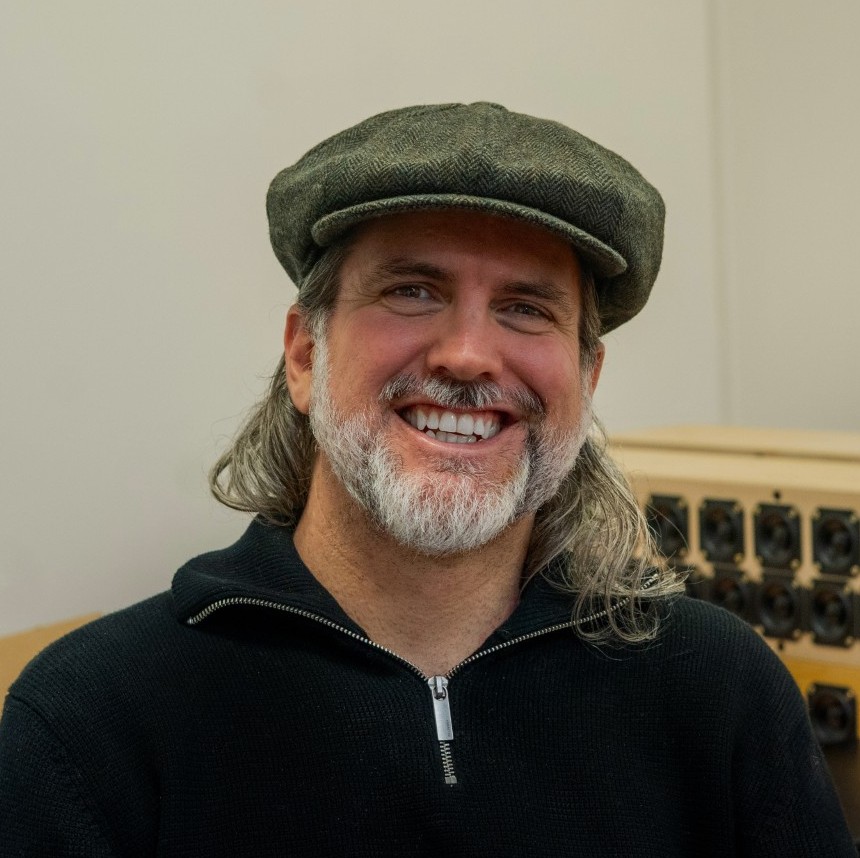
Kyle Keane
Senior Lecturer, Assistive Technologies, University of Bristol
Where did you grow up?
I grew up in Southern California.
Where did your interest in statistics/data science come from?
I took my first statistics course during high school, and it was the first subject I ever dropped out of because I found it so difficult. But during my undergraduate degree at California State, Fullerton, I took an introduction to probability course with Mortaza Jamshidian, who ignited a deep passion and excitement for statistical analysis and reasoning that I have carried with me throughout my career—from using Bayes’ theorem to describe the evolution of quantum systems induced by partial measurement to the statistical characterization of natural and artificial intelligence systems.
Would you share information about your disability?
I have a degenerative retinal condition called retinitis pigmentosa that has involved a slow, constant distortion and degradation of the information that can transmit through my retina to my brain. Although I still get some visual stimuli, I identify as blind.
How has your disability affected your work as a statistician, if at all?
I used to do a lot of work with pencil and paper, which I adapted to using large markers on bigger paper. When those traditional methods were no longer viable, I transitioned to using a computer. To use a computer, I rely on a software called a screen reader that focuses on individual elements of content that are traditionally rendered visually on a screen and converts them to speech for me to hear. There is a complex challenge in that many statistical analysis practices involve rendering complex datasets on the screen using visualization techniques or analyzing complex mathematical equations that represent probability distributions. There are some sophisticated visual interpretation techniques involved in working with these representations, and I have worked hard to find alternative nonvisual representations that are equivalent.
What message would you share with your younger self about life as a statistician with a disability?
Unusually rare stochastic outliers achieve unique things.
What would you like people to know about working with others with your kind of disability?
The tools and techniques we use to communicate about mathematical concepts are not the concepts themselves. It is important to broaden our communication strategies by respectfully integrating alternative representations.
Which of your achievements are you most proud of and why?
After my PhD, I decided to transition into focusing on natural language generation of mathematical concepts that were traditionally represented using graphics and formatted mathematical expressions. I did this with an interest in helping my blind colleagues have access to spoken versions of this content. During this period, it became mainstream for people to talk to their cell phones and request information be spoken back to them. This allowed me to transfer my spoken mathematical expressions into a tool that was used by millions worldwide.
Is there anything else you’d like to share about your experiences as a statistician with a disability?
I deeply appreciate colleagues who interact with me respectfully, assuming I have expertise to contribute. It saves me the energy and cognitive load of navigating deeply frustrating implicit biases held by many about the cognitive abilities of blind people.
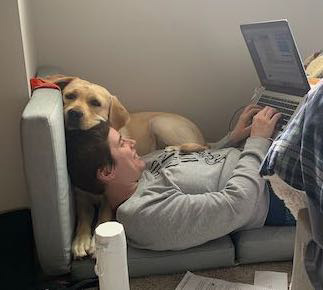
Erin Chapman
Computer Scientist and Data Scientist
Where did you grow up?
I grew up in Beaverton, Oregon.
Where did your interest in statistics/data science come from?
I decided I wanted to be a mathematician in second grade. There are so many ways you can apply math that I knew I’d never be bored, which I absolutely hated. My interest in data—whether that be statistics, probabilities, or modeling—stems from a deep desire to understand the world around me. Sometimes, math was the only way I understood things. I think my interest also comes from all the teachers and programs that supported me growing up. My elementary school teachers let me do math as an independent study, so I was learning algebra in 4th grade. My middle school math teacher came in before school every Monday and during the summer to teach me. My high school teacher let me skip a year of math as long as I took an online trigonometry course before going into calculus. The local university had a program for gifted students to attend classes as needed, so I was a high school junior taking college junior-level courses (which made for some awkward moments). These were also the teachers who ran all the math competitions and associated clubs that showed me how fun math could be. Because I had their support, when someone told me girls shouldn’t do math, it didn’t affect my interest in math or drive to learn more. If I hadn’t had that support, I probably would have gotten bored and found something else to be interested in because that’s how my brain works.
Would you share information about your disability?
I have multiple intersecting disabilities. This has been my life, so to me, this is normal. Most people will notice that I’m neurodivergent (autism spectrum, disorder level II with obsessive-compulsive disorder tendencies and ADHD combined type). Physically, I don’t have full use of my right arm/hand and I have a musculoskeletal condition in my legs that causes regular ankle sprains and trips and falls. I’m also diagnosed with chronic PTSD with dissociative symptoms, an unspecified dissociative disorder, an unspecified mood disorder, two different hearing conditions, significant disfigurement, and several chronic health conditions. I’ve learned the “unspecified” qualifier doesn’t convey the severity of symptoms to most people. I can happily say the structural abnormalities to my aorta I was born with didn’t end up impacting me as an adult! I’m also partnered with a wonderful multi-purpose service dog, who helps me manage all my disabilities.
How has your disability affected your work as a statistician, if at all?
Several of my disabilities face significant discrimination, and I had to start dealing with that a few months into undergrad. The medical director didn’t think someone like me belonged at that school and I faced medical expulsion, which is unfortunately more common than it should be. I was allowed to continue under specific conditions. In the workplace, getting the correct job accommodations I need is difficult because of my complex, cross-disability needs. Employers tend to consider one disability’s needs at a time without accounting for how other disabilities impact accommodations for that disability. For example, I’m a part-time augmentative and alternative communication, referred to as AAC, user because I don’t have reliable access to speech. At home, I have an adaptive keyboard I use to type. Employers often offer me talk-to-text software as an accommodation for my arm, but that doesn’t account for when I don’t have reliable access to language and am using AAC. Without those accommodations, I can’t work as effectively or at all, depending on the work function.
I sometimes feel like I’m forced to share more about myself than I’d like to when I first join a team. Some things, like my communication differences, do need to be shared up front. I find people don’t expect an AAC user in our field and can react oddly when I first use AAC if they’re not warned. They also usually don’t know the etiquette for talking with an AAC user. While I usually have an accommodation to be late to meetings (time for medications, my service dog alerted me that I really should eat some food, etc.), people are not always understanding, which has been reflected in past review ratings. If I explain all the reasons I might be a few minutes late, I don’t see that reflected as much in my reviews. Because some of my accommodations seem odd unless people understand how my brain works, I must explain how my brain thinks and operates. The time spent explaining every time I have a new manager or teammate also affects my work because I’m not doing my actual job—I’m justifying the accommodations I have.
What message would you share with your younger self about life as a statistician with a disability?
There’s a lot I would tell myself. I think the most important thing I would tell myself is that being a statistician will allow you to learn and understand more about yourself than you would otherwise. You’re going to be involved in research into your own conditions. When you learn something new about yourself, you’ll be able to read and understand many of the papers that have been published. You’re going to get better medical care because you can talk to your treatment team in terms of statistics and probabilities. You’re going to use math to make hard decisions easy because you understand the data. More than one genetic counselor will be relieved they’re talking to someone who understands probabilities and will say that out loud. There will be good and sometimes funny moments, not just the hard ones you see now.
What would you like people to know about working with others with your kind of disability?
Be flexible. Don’t see less; see different and how that difference can be brilliant. Don’t ask the person with a disability to make all the changes. Try to meet in the middle. Often, we have to change to fit how things are already done—how we communicate and how we work. One manager I had stands out against all the others. When I joined their team, they made it clear I wasn’t expected to learn how to communicate like them, nor were they expected to learn how to communicate like me. Instead, we’d find a middle ground as a team. Work was assigned based on skills and preferences. Instead of being resentful of how my weekly medical appointments interfered or slowed down the normal review processes, we had two sets of processes to account for the appointments.
Which of your achievements are you most proud of and why?
From a mathematical perspective, the achievement I’m most proud of is working to advance the protection of people’s information. A few key applications come to mind. One application is extending databases to support secure multiparty computation, like private set intersection, which is key to consumer protection in modern advertising. For example, two or more companies can compare their mailing lists to find shared consumers without exposing the actual email lists to each other, using private set intersection. This prevents your email address from being shared with more companies than you intended.
Another common application is tracking who saw an ad on a third-party site and who made a purchase and for how much, all without sharing consumer information. You could use the same techniques to compare the average salary or pay raise on your team without sharing individual salaries or raises. We’ve applied similar techniques to machine learning to build encrypted models. Privacy-preserving machine learning keeps sensitive information private, such as medical, financial, or personal data. A variety of methods such as federated learning, differential privacy, homomorphic encryption, and secure multi-party computation allow for different levels of privacy depending on the needs of the particular application.
From a disability perspective, the thing I’m proudest of is being public about my disabilities and the need for change. As a mathematician, one of the things I’ve researched in my personal time is disability employment. Within the larger category of Persons with Disabilities is the subset Persons with (Specifically) Targeted Disabilities, a group defined by the US Equal Employment Opportunity Commission. The PWTD group faces significantly more employment barriers than the PWD group, often due to myths, fears, and stereotypes about their disabilities.
As someone in the PWTD group, I was told, and learned early on, to avoid disclosing my disability. However, I realized years ago that I don’t want the next generation to grow up thinking they need to hide themselves or fear the implications of disclosure, so I chose to start sharing my experience. Initially, this was limited to those I worked with. Then, the ASA gave me the opportunity to reach others and share awareness over the years. I’ve seen the conversations and work done grow over the past several years, which makes me hopeful that the work we’re doing now will make a lasting change.
Is there anything else you’d like to share about your experiences as a statistician with a disability?
“Is there anything that would make this work better for you?” is one of the best questions I’ve learned to ask people I work with or been asked myself. Not only does it signal openness to accommodations, but also flexibility most people need at some point in their lives. By asking this question of an intern I was working with, they shared they needed workplace accommodations, but they didn’t know how to start that process. For a candidate I was interviewing, I learned they needed a 30-minute break when their child came home from school, so the interview could run smoothly the rest of the day. When I’m asked that question or something similar, it signals this is an employer or manager I’d be more interested in working with and have a better working relationship with.
Leave a Reply