
Caroline Birdrow, Jamie Joseph, Karen Childers, Jamie Roberman, Sunita Ghosh, and Soo Shin
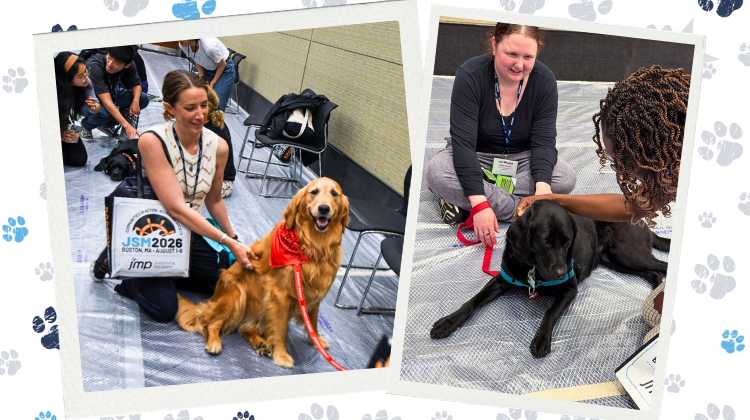
With everything going on in the world of scientific research, sometimes you just need a dog to love you unconditionally. That’s what ASA GivesBack was thinking in the early stages of planning the annual Joint Statistical Meetings Impact Project, a philanthropic-based activity put together every year in conjunction with the host city.
While the conference is an annual highlight for many to connect and re-connect with colleagues, friends, and peers, it’s also jam-packed with activities and presentations. This requires attendees to be “on” for up to 14 hours each day, which can be stressful. And what better way to fix stress than to hug a dog?
The idea was barked into reality by the Caring Canines Visiting Therapy Dogs Association in Boston. While many of the dogs had not worked events as large as JSM—and the organization wasn’t accepting new facility visit requests at the time—they came anyway. And so did JSM attendees—to cuddle therapy dogs over their lunch breaks. Many hope the therapy dogs will become a JSM tradition.
The therapy dogs’ visit to JSM is just one example of the many ways ASA GivesBack supports the member community. Other annual projects have included the Thank a Mentor program, which recognizes individuals who’ve made a difference for a mentee, the ASA Virtual Science Fair for K–12 students, the Fall Data Challenge for high school and undergraduate students, and the fall meme/haiku contest. Throughout the year, the group also hosts craft nights and other virtual meet ups, creating additional opportunities for ASA members to connect.
ASA GivesBack is always looking for new members and ways to support the statistics and data science community. Interested in getting involved? Email them at asagivesback@gmail.com. You can also follow them on LinkedIn and Facebook.
And if you enjoyed the Caring Canines visit to JSM—or even if you just resonate with their mission—consider donating to their organization.
View more Caring Canines photos at the ASA’s Flickr page in the JSM 2026 Monday and Tuesday albums.
Q&A with Therapy Dog Owner Jamie Joseph
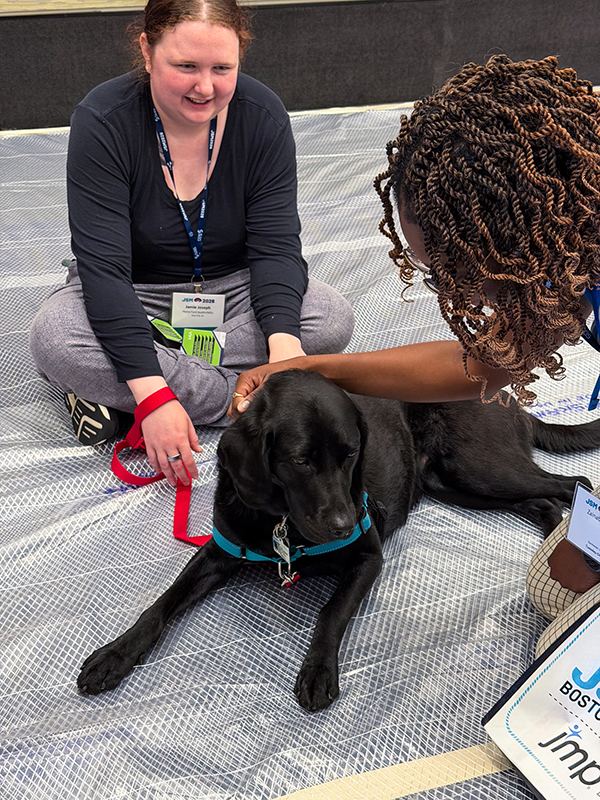
Jamie G. Joseph, a biostatistician at Henry Ford Health, knows first-hand the joy a therapy dog can bring. She brought her certified therapy dog, Mia, to JSM, where they spent two days visiting with attendees. We asked Joseph about Mia and their work together.
Tell us a little bit about you, your background, and how long you’ve been a member of the ASA.
I’m originally from New Jersey, but I got my PhD in biostatistics from Vanderbilt in 2024. I honestly don’t remember when I officially joined the ASA, but I’ve been going to JSM/ENAR since close to my first year of graduate school. I’ve been with the ASA GivesBack community for a year or so at this point. I absolutely love working within my community, so I was delighted to learn from my cohort-mate, Caroline Birdrow, that a committee like this existed. I now work at Henry Ford Health in the department of public health sciences, where I get to do a ton of collaborative team science, especially in the women’s health space, which I adore.
Tell me about Mia, your certified therapy dog. How old is she, what breed, and what is her personality like?
Mia is a 3-year-old black labrador retriever, and she’s one of the three loves of my life, along with my non-therapy dog, Bernoulli, and my husband. She is an absolute angel. There are very few thoughts in her brain, but all of them are some version of “Hi, I love you!” or “Please kick the ball again!”
Mia was raised through Leader Dogs for the Blind to be a guide dog. But she got pulled for their breeding program and had nine puppies for the organization. My husband and I volunteered to host her and her puppies.
After Mia had her litter, Leader Dogs retired her, so we were able to adopt her. I learned how to get her certified as a therapy dog, and the rest is history.
What was it like bringing Mia to JSM? How did she respond to all the people?
It was exciting. I bring Mia to Henry Ford Hospital, so it’s not like my volunteering is completely separate from my work life. But it’s fun to bring your dog into a room full of professional colleagues.
She loves people, and I think she was thrilled to have so many folks loving on her. She was definitely wiped by the end of the second day. She usually only works one day per week, so the two-plus-hour shifts for two days in a row were a lot! But she was so happy. Anytime I take out her work harness and go, “Do you want to get to work?” she explodes with happiness.
What do you think people get from spending a few minutes with a therapy dog?
I think it’s most often a few moments of joy, a smile in the middle of the day, or a distraction from other things going on in life. Especially at hospitals, but also at a stressful professional conference during a time when there is so much uncertainty in the scientific community. But sometimes, it means a lot more. There have been times when someone who hasn’t been able to see their own dog for months gets to cuddle with Mia or times when a family is going through a loss or when a clinician has had a really hard case and just needs to hug a fluffy silly creature with no agenda other than to get pets. You can’t always know what people are going through, but there are times when the encounter is so obviously meaningful and important.
Can you share a favorite memory from a therapy dog visit—at JSM or elsewhere?
Dogs aren’t really allowed on the beds in hospitals, except for special cases. There was one time when Mia jumped on the bed without permission, and I was horrified. I was apologizing to the patient, trying to get Mia off, when the person started crying and said, “No, she could tell I really needed this!” and then proceeded to just snuggle Mia silently for a really long time. It’s honestly amazing what therapy dogs can pick up on.
What is something people might not realize about having a therapy dog?
They are very different from service dogs. Mia doesn’t provide any services to me. She isn’t allowed anywhere that dogs aren’t allowed (without special permission/planning), and she isn’t trained as such. Her only job is to love the people who want loving and to be (relatively) well-behaved while on duty. My main job is to be her chauffeur really. The hardest part for me is monitoring Mia’s emotional state and well-being while we do visits. Therapy dogs get tired quicker than you’d expect. Visits are typically under one to two hours, or three at most. She is too sweet and well-trained to ever act mean or hide when someone wants her attention, but there are subtle body language changes and signs of her feeling done for the day that I look out for. We do this for the people, but the dogs come first; after all, this work doesn’t exist without them.
Leave a Reply