
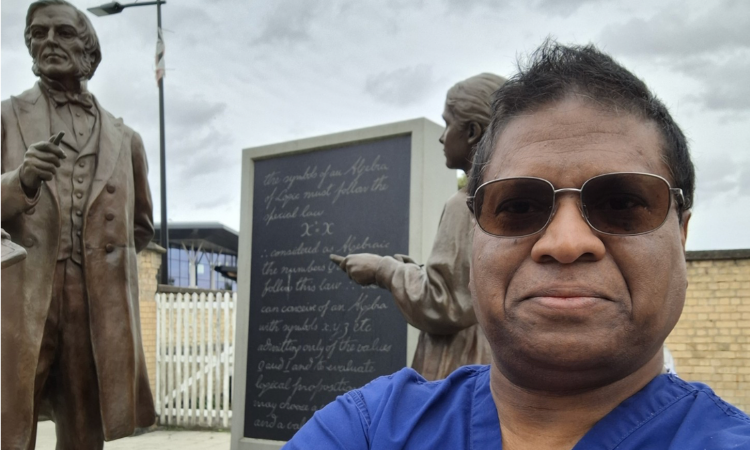
Arun Chind is a statistical consultant, legal scholar, occupational health physician, applied economist, and expert witness for regulatory investigations. He is the current awards chair for the American Statistical Association’s Statistical Computing and Statistical Graphics sections. We caught up with him to learn more about his career, work, and experiences.
You’ve worked across occupational health, economics, statistics, and law. How did these different areas come together in your career?
Medical school involves a curriculum of around 13 subjects, and I found each one riveting. Needless to say, the labor market conditions—both in India and the UK—have influenced my many career trajectories. I worked in many surgical (general surgery and urology) and medical specialties (emergency medicine, psychiatry, intensive care medicine, medical, and radiation oncology) before moving to occupational medicine, for which I passed exit exams in 2015. Given my unique background with formal training in several scientific specialties—and an inexplicable, curious, and incurable malady of #FindingEverythingFascinating—I can often communicate with clients in their lingo. And since I deliver sterling service worth more than the nominal dollar value, I have established myself as a consultant in independent practice.
How did you become involved with the ASA’s Section on Statistical Computing and Section on Statistical Graphics?
I was a peer reviewer for medical journals for more than 20 years before I gained the GStat credential. For several ASA sections, I volunteered as a reviewer for the student paper awards. The computer and graphics sections needed a volunteer for awards chair. So, I did what I’ve been doing since primary school all the way through medical school (where I even got to assist in two forensic autopsies) and my professional life—step up to the challenge and serve as well as I can.
As awards chair of the Statistical Computing and Statistical Graphics sections, what are your duties? What did you gain from the experience that you didn’t expect?
My appointment as awards chair was like leaving a kid in a candy store. There is no job description, so I read every single submission and tested software packages like a person possessed. For standout submissions, I mentor applicants to bring out the best in themselves, which can include offering suggestions for improving software packages. I liaise with colleagues on the awards committee to ensure fairness in the selection process (a concept drawn from economics and law). Since there are many worthy submissions and only a few awards to hand out each year, I have the painful duty of writing to those we’ve had to disappoint. If I had realized beforehand how much I didn’t know about being the awards chair for the sections, I might have thought twice. Still, the sheer complexity, beauty, challenge, and intellectual reward of it continues to captivate me.
What has been one of your biggest professional achievements?
Formally qualifying as a statistician—even if things fell into place only a few years ago—was a landmark event for my career and helped boost my self-confidence. Some of my work deals with sensitive and confidential matters. One project I can acknowledge is a subcontract worth £6,000 ($7,200) with the Institute of Occupational Medicine for providing data analysis, policy impact analysis, and policy advice to the UK’s Rail Safety and Standards Board in 2025. To the best of our knowledge, this was the world’s first project to provide evidence-based policy advice data on recall intervals for fitness-for-work medicals of rail workers in safety-sensitive roles (train drivers, dispatchers, etc.). This work is likely to be cited in other jurisdictions. Anyone who’s made a safe journey by train to anywhere may have me to thank.
What career advice do you live by, and who gave it to you?
I’ve led a very nontraditional career. I revel in intellectual challenge. Although I preach work-life balance to others, I have given myself #WorkWorkBalance that suits me just fine. As to who gave me this strange/extraordinary/terrible career advice? I believe the Creator should take the blame—God Almighty it is! I appreciate the ASA’s International Christian Statisticians group, whose table (many thanks, Tabitha Peter) I stopped by at the Boston JSM.
What is the biggest career challenge you’ve had to overcome?
My clients do their research and nowadays use AI before consulting with me. (Thank you, Google Gemini!) So, I’ve had to up my own game. My patients and clients include those who deal with genetic conditions and rare diseases, so I’ve been attending wet lab training to complement my work in statistical genetics. It has been humbling to realize that pipettes, electrophoresis gels, and practical experiments with genetic code are far more messy and less forgiving than raw data and computer code. But the pain has been worth the gain.
Can you tell us a little more about your educational background? What degrees have you earned, and where did you study?
After high school, I joined an undergraduate program in statistics, which was almost all algebra, no computers, and minimal graphics—all work and no play—so I dropped out. After medical school, I enrolled in computer programming and studied more biostatistics than the curriculum required. I completed core surgical training in Chandigarh, India, where I earned a Master of Surgery degree. Then, I qualified as a fellow of the Royal College of Physicians and Surgeons of Glasgow. After moving to the UK, I did summer schools in mathematics, practical physics, and astronomy at the Open University. I have since earned graduate-level degrees and diplomas in quantitative finance, with a focus on economics and econometrics, from the University of London; medical statistics from the University of Leicester; public health from the University of Florida; and public economics and data analysis—including mathematics, statistics, econometrics, and machine learning—from Purdue University.
Using my 16-hour workdays, I also completed undergraduate modules in economics, including a capstone project from Colorado State University. Most recently, given my interest in policy impact analysis, I graduated with a Master of Laws from Leeds Beckett University, with an empirical analysis of labor law and market outcomes for the dissertation.
I am very respectful of the courts, but a judge in the UK once effectively ruled that I could not possibly be walking (working) and chewing (doing academic training in law) gum at the same time. Regardless of dissenting opinions, I plead guilty to continuing to do more than a few things at a time—despite stumbling blocks and sneaking in a smirk or three.
As a consultant, what types of problems do clients typically bring to you, and how do you draw on your background in medicine, economics, statistics, and law to address them?
I get varied problems flung at me in my occupational health private practice. Many have to do with occupational exposures (lead, ionizing radiation, asbestos, blood-borne viruses, chemicals, ergonomics, job stress, suicide risk, etc.) and causation. I do a lot of second opinions. Especially when they disagree with me, my favorite phrase to use with clients is: “Allow me to help you.”
I draw on my training in medicine, economics, mathematics, physics, statistics, and law. I have worked at or visited client sites (Tata Steel, Nissan, London Zoo, railways, fire services, veterinary hospitals) to understand their processes and people and to provide evidence-based professional advice. I was recently approached by Instats, with whom I’ll offer a course in medical statistics called Master of Medical Statistics. My other clients for strictly quantitative services include medical, health economics, and epidemiology journals; the International Society for Pharmacoeconomics and Outcomes Research; and the ASA. As part of the scientific peer-review process, they expect—and receive—hours of research and study on my part.
What is something you’d like people to know about you that we haven’t asked?
I am very solution focused. (I’m not a don’t-want-to-get-involved type.) It’s a quality that helped me as a surgeon, in public service, and as an expert witness. I describe myself as a latter-day gentleman scientist. Resolved to boldly go where most would dread to tread. I nurture, mentor, and facilitate—but don’t receive any grants and keep going despite being taken for granted.
Given my learning and experiences, I am understanding and empathetic toward human (and lately AI) follies and foibles. I realize I can’t deliver a perfect service all the time, but I continue to work with colleagues and stakeholders, providing a wholesome and fulfilling experience to my clients in my paid and voluntary roles. Just as difficult people can be the bane of public service, bugs in code remain the bane of statistical computing. Debugging is definitely not my favorite chore. #DeliverUsFromWeevil.
Leave a Reply