
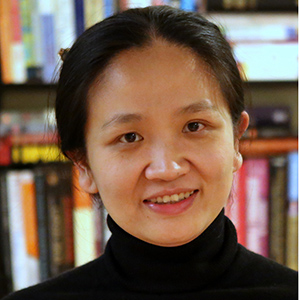
Affiliation
Professor, Department of Statistics, and Associate Director for Education, Data Science Institute, Columbia University
Educational Background
Columbia University: PhD, Statistics (2002)
B.S. in Applied Mathematics, with minor in Computer Science, Tsinghua University (1998)
About Tian
I grew up in a family of academics on the beautiful campus of Tsinghua University in Beijing China. My interest in statistics stemmed from my keen curiosity in complex patterns and trends in all kinds of natural and social phenomena. In my junior year in college, I did a summer internship to process data for a medical study on hypertension. I was fascinated by all the different variables in the data set that had been collected to identify the risk factors of this complex disorder. That was when I decided to become a statistician.
I enjoy developing novel methods for exploring and understanding patterns in complex data from different application domains such as biology, psychology, climatology, neural science, sociology etc. I believe that statistical modeling and data analysis leads to scientific insights, which promotes generative/structural models and interpretable feature learning. My current projects are in the fields of statistical machine learning, spatiotemporal modeling, image analysis and social network analysis. I especially love the aspect of being an applied statistician that you get to start working in a new area almost at any time, drawing upon my prior experience with complex data while learning new things. My most recent project involves developing a data science workflow for wide-field ecological forest surveys using data collected by current remote sensing techniques such as Light Detection and Ranging (LiDAR) and stereo photos. In doing so, we are hoping to quantify key factors that mediate a storm’s impacts on forest systems. In this project, working with my collaborators, I develop innovative methods for extracting feature using deep representational learning tools, and building models for tree species classification at the pixel level.
I have also been interested in innovative pedagogies (such as flipped classroom, online learning, collaborative teaching) for data science education, especially those to encourage transparent and responsible practices. It is my belief that computational efficiency, transparency, and reproducibility are essential for statistical methods to have a practical impact. In 2015, I created a project-based data science skill course primarily designed for statistics students. The course employs the project-based learning approach and a “common task framework” model that is often seen in public data science challenges and hack-a-thons, where the students were tasked to work in teams towards a common data set or topic. Through five well-designed tasks, this course provides the students with deep experiences in many areas of data sciences such as exploratory data analysis, visualization and presentation, controlling overfitting in predictive analytics, teamwork, collaboration and version control, etc. Also, through peer review and project presentations, students get to appreciate first-hand the importance of transparent data analysis and reproducibility. Recently, I have been looking to curriculum development for data ethics.
I was honored to be recognized by the 2008 Outstanding Statistical Application Award from the ASA. I became an ASA Fellow in 2014 and received Columbia’s Presidential Award for Outstanding Teaching in 2017.
Great!!!! Five stars! I tried to “vote” 5, but accidentally hit 1. No way to fix it, apparently. Better not to vote;(