
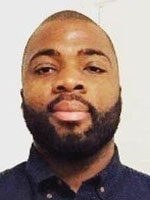
Affiliation: Genentech, Senior Data Scientist
Education: Master’s, Epidemiology, Columbia University; PhD, Statistics, Stanford University
Christophe Tchakoute grew up in Cameroon—a small country in West Africa—during the peak of the HIV/AIDS epidemic, which is how he became interested in STEM. His interest was reinforced when he attended the University of Cape Town in South Africa. There, he became curious about the chemistry and cell biology of HIV and how the virus can hijack the immune system for its own benefit. Shortly after, he interned in the HIV/AIDS department at the World Health Organization headquarters in Geneva, Switzerland, where he was first exposed to epidemiology and biostatistics. Following his time there, he moved to New York City to complete a master’s in infectious disease epidemiology at Columbia University.
Tchakoute says his time in New York City was an amazing human experience and he was pretty sure he wanted to complete a PhD at the same institution. However, to his surprise, he received a full PhD scholarship from Stanford University and eventually chose to go there because of the interdisciplinary nature of the university.
At Stanford, Tchakoute had the opportunity to take more courses in statistics, computer science, and operational research and truly fell in love with statistics and how statistics can be used to answer important scientific questions. He was able to continue doing HIV research but discovered a new love for statistical methods, especially causal inference.
During the last two years of his PhD, the concept of transportability kept Tchakoute up at night. Transportability allows researchers to generalize causal effects across different populations. By understanding the causal structure of the data, researchers can estimate the effects of interventions in a target population based on the observed data from a source population. This is particularly useful when conducting experiments in the target population is not feasible or ethical. Although he left academia a couple years ago, Tchakoute is still interested in different applications of transportability and its implications for trial design and prediction models.
Tchakoute briefly joined 23andMe after completing his PhD and was involved in building disease prediction models combining genetic and nongenetic data. He now works at Genentech and leverages statistics and real-world data to inform clinical trial design for different oncology programs.
Tchakout’s proudest moment was at JSM 2022, where he had two papers presented within 24 hours—one on transportability and trial design and the other on model diagnostics tools for nongenetic associations in large-scale data sets. “It was a reminder of what one can achieve when curiosity, initiative, and opportunity collide,” he says.
While reflecting on his scientific journey, Tchakoute says he is filled with gratitude for all the mentors he has met along the way. “I would certainly not be here if they did not believe in me, and I am looking forward to paying it forward.”
Leave a Reply