
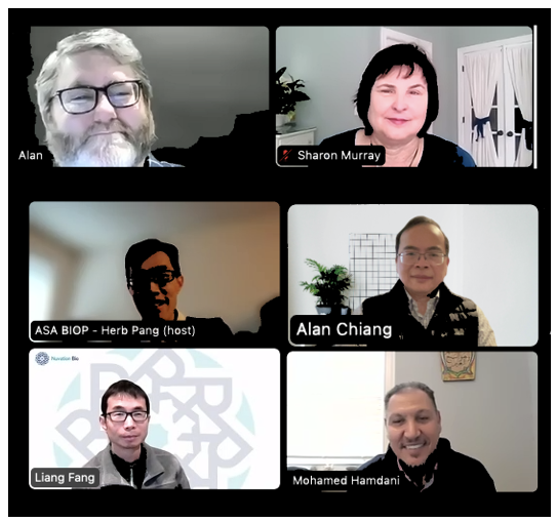
Biopharmaceutical Section Zoom panel discussion host Herb Pang with panelists Alan Hartford, Sharon C. Murray, Alan Y. Chiang, Mohamed Hamdani, and Liang Fang
Members of the Biopharmaceutical Section Distance Learning Committee hosted a webinar titled “Don’t Go It Alone: Benefits of Joining Our Community of Statisticians in Small Biotechnology Companies” December 1, 2023, to discuss the benefits of joining the Statisticians in Small Biotech community. The webinar, hosted by Herb Pang and moderated by Alan Chiang, included the following panelists:
- Alan Y. Chiang, Lyell Immunopharma
- Liang Fang, Nuvation Bio
- Mohamed Hamdani, Larimar Therapeutics
- Alan Hartford, Clene Nanomedicine
- Sharon C. Murray, BioCryst Pharmaceuticals
- Jingtao Wu, Carmot Therapeutics
With the rapid growth of biotechnology in the last half century, new drug discovery and development have reached an inflection point, where hundreds of emerging small biotech companies are progressing into the clinical development stage. These companies employ a growing number of statisticians, and an increasing number of statisticians are taking the leap into the small biotech world.
There are challenges and opportunities when working in a small biotech company. For example, there may only be one or a few statisticians/programmers working there, which means there is heavy reliance on contract research organizations for statistics and programming work. Consultants may be required for advice or to review documents. On the other hand, statisticians will have many opportunities for growth while helping to advance human health through innovation.
Statisticians will need to wear many hats, perhaps working on multiple phases of clinical trials, preparing for audits, answering analysts’ questions related to statistics, developing departmental standard operating procedures and working instructions, participating in regulatory discussions and/or advisory committee meetings, and overseeing outsourcing.
Resources are limited, and forming a partnership strategy is key. Part of that strategy involves determining the level of contractor oversight, selecting preferred vendors, deciding what work to do in-house versus outsourcing, acquiring statistical software, and liaising with other departments as the company grows. The strategy will need to be revisited on a regular basis.
The discussion during this webinar focused on the following four key questions:
- Considering the many ways in which the statistics field adds value in drug development, what are the unique career opportunities in a small biotech company?
- What are the main challenges one needs to overcome in interdisciplinary collaboration?
- How has the application of statistics played a key role in innovation, decision-making, and clinical advances in a small biotech company?
- How could members benefit from being part of the ASA community for statisticians working in small biotech companies?
Here, the panelists answer those and other questions.
Mohamed [Hamdani] and Alan [Hartford], could you give a brief background introduction to the Statisticians in Small Biotech community?
Hamdani: I was asked by Alan Hartford to join the community of statisticians in small biotech. I didn’t hesitate because I saw the need for this kind of initiative, as there is a growing number of small biotechs and startups. Often, statisticians who make the transition from mid- to large companies into a small biotech find themselves isolated and confront many challenges we don’t want them to navigate alone. We identified a gap in the topics discussed in the ASA Biopharmaceutical Section events and we would like to grow this supporting community.
Hartford: We started our community to battle all the challenges of working isolated from other statisticians. We all need someone to talk through problems. We all bring something to the table but can’t be expected to know everything. The main areas we designed all this for are processes, insights into regulatory practices, and statistical methods. These are areas we can discuss without fear of sharing corporate secrets.
Many of you have worked in large pharmaceutical companies previously. Could you tell us what drove you to join a small biotech company and the unique career opportunities the company has provided for you?
Murray: I spent the bulk of my career at GlaxoSmithKline, a large pharmaceutical company. However, I had opportunities while I was there to see what it was like to work at a small biopharmaceutical company. I worked on a project that was a partnership with a small company. We had a joint development committee and met once per month. The partnership was to proceed this way until the company achieved the proof-of-concept milestone, at which point GSK had the option to acquire the product.
In addition, I participated on several due diligence teams, where GSK was considering purchasing a product from a small company. This gave me the opportunity to go onsite.
… [S]mall biotech is where I can spend most of my time doing what I enjoy the most while limiting my time spent on the things I don’t enjoy as much.
-Liang Fang
I’ve been interested in small biotech companies for a while, and I saw some small companies have tremendous success while others failed. It wasn’t until I was laid off from GSK that I made the leap, and I haven’t looked back. Some of the opportunities in working at a small biopharmaceutical company are the chance to work on all phases of drug development and on multiple disease types, as well as interacting with regulatory agencies like the FDA [US Food and Drug Administration]. I feel like I make a big contribution to the bottom line by working at a small company.
Fang: I jumped into the small biotech world almost six years ago and have loved it since then.
What motivated me was the opportunity to take on a broader role with many more responsibilities and the small and intimate working environment. After 12 years of working for three large multinational pharmaceutical companies, it was clear to me that what I enjoyed most in my job was problem-solving and what stressed me most in my job was that I had to navigate through complex organization structures to get things done in large pharma. So, naturally, small biotech is where I can spend most of my time doing what I enjoy the most while limiting my time spent on the things I don’t enjoy as much. This has been my experience in the last six years.
Hartford: For me, it’s the desire to have a seat at the decision-makers’ table without giving up working directly on the science. I still enjoy working on protocols and calculating power. In big pharma, the higher you get, the more removed you are from the science and projects. Also, my work location is very important to me. For years, I’ve wanted to work from my hometown in the Midwest, but the jobs have been on the east or west coasts. Small biotech seems more open for senior leaders to work remotely.
Hamdani: After spending almost 20 years in mid- to large companies, I was approached to build a biometrics group in a small biotech, which is an opportunity I would otherwise not have a chance to realize. I liked the challenges of building teams and processes and being a hands-on statistician. It is a rewarding chance to be involved in decision-making and get to see the journey of product from preclinical to clinical stages. You have opportunities for impact like providing input for analyst calls and press releases and interacting with top KOLs [key opinion leaders], especially in rare diseases.
Small biotech companies have been responsible for a significant portion of newly approved medicines, especially for rare diseases. The success lies, in part, in their focus: innovative therapies for niche indications. Could you give an example of how you applied novel or lesser-known statistical applications to your organization’s decision-making and clinical advances, and how did it go?
Hartford: We’re at the end of the phase 2 stage and working through many prespecified and ad hoc analyses. One fun analysis was using the rank-preserving structural failure time model to estimate the treatment effect if the control arm had not switched to active at the end of our phase 2 double-blind period. We included this work in our briefing but we’re not sure the FDA will lend much credence to it.
We also work with ordinal response variables. I’ve had the pleasure of working with a consultant to learn about the adjusted win ratio and U statistics. We’ve calculated power for a phase 3 study using this as a primary analysis. We haven’t finalized anything yet. Both efforts were new to me and interesting. I’m glad I had access to external statisticians to discuss them.
Murray: I agree that innovative methods can be very helpful, especially for rare diseases. I will say that for Orladeyo, our primary product, we had a very traditional development program with dose ranging in the POC [proof of concept] study and a pivotal trial with two doses and placebo without an interim analysis. Where I think innovation can be very helpful is in making the POC decision. We are using Bayesian posterior probabilities to help us determine when the POC milestone has been met. In addition, for an ultra-rare disease where we can’t spare any patients, we are considering an adaptive phase 2/3 design, where we can drop a dose at an interim analysis. We won’t be able to have a traditional dose-ranging study due to the rarity of the disease.
Fang: In one of the companies I worked for, we had a phase 3 trial for a rare cardiovascular disease. It’s a serious disease and very hard to treat. Our trial was the first phase 3 trial in the space. My manager, who was the only statistician before I joined the company, came up with this new composite endpoint, which ended up being accepted by the FDA as the primary endpoint for the phase 3 trial. Because of that endpoint, we were able to design a trial with 200 patients and ran a phase 3 trial in two years to gain FDA’s approval. The company was acquired after the success of this phase 3 trial.
Hamdani: In my previous small biotech position as the head of biometrics, I started as the sole statistician and helped with the design of two phase 3 studies in a therapy with unmet need and a phase 2 in rare disease using a noninferiority trial, which was a bold move. Both indications got the drug approved and we hired 19 staff members. In my current role, we are in phase 2 for a rare disease indication using RWD [real-world data] to supplement the control group.
Small biotech companies have a lean organizational structure by design. They also face many challenges, including limited resources and budget constraints. Could you share an example of how and what you had to overcome to stay productive and effective?
Fang: Budget is always a constraint for small biotech. That’s the reality we have to live with. We have to understand how finance works in a small biotech and plan our growth according to it. For example, if you work for an oncology company that is still in phase 1, you will soon realize you won’t get any headcount before the drug has shown a promising response rate but, at the same time, upper management demands reviewing data almost in real time.
Yes, budget is a constraint, but educating management about the need for resources and the benefit gained is always helpful.
-Mohamed Hamdani
For example, for an open-label oncology trial, every tumor response in phase 1 could lead to a different business decision. So, what do you do? You don’t have the budget to license an expensive software platform like Spotfire or Tableau. You don’t have the headcount to hire SAS programmers and, even if you do, can they turn around results in real time? So, what I ended up doing was to develop a set of R code myself or with my statistician (when I was lucky enough to have one) and produced a set of plots such as swimmer plots, waterfall plots, and so on to keep our management updated on a weekly basis. The code took data from EDC [electronic data capture] and transferred lab data directly and didn’t rely on CDISC [Clinical Data Interchange Standards Consortium] data, resulting in skipping a step in the process to save time and resources.
The key here is that we must understand the priorities of the company and be creative to overcome the resource constraint.
Murray: Yes, this is one of the most challenging aspects of working at a small biopharmaceutical company. Prior to approval for Orladeyo, we did not have enough money to support R&D [research and development]. The company raised money through sale of stock and by getting investment from mutual fund holders. In addition, BioCryst had a bank loan.
I would have liked to hire more people soon after I started, but it was not possible. My strategy was to partner closely with a CRO and engage consultants who could help with study design and do things like review responses to regulatory requests.
One thing I’ll say is you have to prioritize. I had to make choices on what I could do.
Hamdani: Yes, budget is a constraint, but educating management about the need for resources and the benefit gained is always helpful. You always want to lay down the consequences of lack of resources. The emphasis should be on quality and timelines.
Hartford: I was lucky to be able to hire a contractor for a limited time to help with the overflow work for an impending deadline. We have to know when to ask for help and be clear about reasonable timelines.
In some companies, it could be difficult to get this extra help, so you need to have this discussion at the time you’re interviewing to align expectations regarding hiring contractors. You might not want to work at a company that won’t be able to provide contract support from time to time.
Small biotech is a vital part of the broader health care ecosystem, and we just discussed its lean biometrics and biostatistics organizational structures. Forming a great partnership is key to efficiency. Could you tell us what you see as the biggest benefits of joining the Biopharmaceutical Section’s community for statisticians working in small biotech?
Hamdani: There are many benefits of being in this community. As I mentioned before, there is a growing number of biotech companies, as this is the new way to bring therapies to market. Some large companies are cutting down on their discovery business units. This community will be there to support an incoming statistician to small biotech from processes, SOPs, and even having someone to check with regarding design and methodology issues and/or questions.
Hartford: Being connected with other statisticians is the most important benefit. We must have people we trust to ask questions and share problems with. Discussing FDA and ICH guidance documents with others is much better than reading them all on your own. This can lead to a better prioritization of SOP development and sharing of which papers to read for specific topics.
For those of us already in our Statisticians in Small Biotech [committee], we have several examples where someone has sent out an email asking if anyone has experience with a particular method or process. Others have responded, and it’s been great to get more than one response for a better view and to get solutions under different circumstances.
Murray: It can be very isolating to work as the only statistician at a biopharmaceutical company. It’s important to reach out to others in similar situations. I was fortunate that I knew some other people previously from GSK who are now also working at small companies. We were able to bounce ideas off each other a bit. Participating in conferences like JSM or the Regulatory-Industry Statistics Workshop can be very helpful. In fact, I met Mohammed at the RISW in September and that’s how I got involved with this committee. It’s important to build a network.
Fang: When I decided to join small biotech six years ago, I asked myself what I would be missing the most. It’s the people. In large companies, I had hundreds of statisticians whom I could turn to and learn from. When you are in small biotech, you are likely there alone and expected to know everything. So, when you don’t know everything, when you need a sounding board, when you need a thinking partner, what do you do? This is why I initiated the idea of forming this community a couple years ago. We don’t have to go alone. We can help each other and leverage each other’s expertise and experience on this journey. I found this group has been extremely helpful.
Leave a Reply