
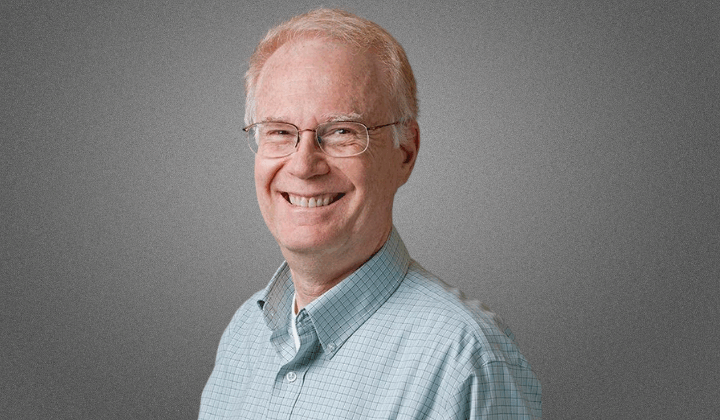
A longtime American Statistical Association member, Fellow, Founder, and mentor, Barry Graubard spent his career as a government statistician at the National Cancer Institute’s Division of Cancer Epidemiology and Genetics before retiring in 2024. At the NCI, he developed new statistical methods that helped researchers better understand cancer trends in populations.
Beyond his technical contributions, Graubard has been an exceptional mentor. His commitment to mentoring statisticians has been recognized with the NCI Mentoring Award, ASA Mentoring Award, and Jeanne E. Griffith Mentoring Award.
In 2025, Graubard received the ASA’s most prestigious honor—the Founders Award—recognizing, in part, his dedication to mentoring future statisticians.
We wanted to get to know him better, so we asked him to answer the following questions.
Background
Where did you grow up?
I was born in Washington, DC, and grew up in Fairfax County near Alexandria, Virginia.
What or who influenced you to become a statistician?
I always liked numbers and, as a child, pored over the numbers in the World Almanac. In high school, I was most interested in my science and math courses, but it was not until my last year as an undergraduate majoring in mathematics at the University of Maryland, College Park that I took my first statistics course. In fact, taking that course was the result of my mother basically suggesting it as an occupational backup to my plans to teach mathematics. Professor Piotr Mikulski in the UMD Department of Mathematics statistics program, who was my professor in graduate school, had the greatest influence on convincing me to switch from mathematics to statistics and probability.
Career Journey
You started your career in 1977 at the National Center for Health Statistics. Was this your first job out of college?
Yes, although, at that time, I left UMD with a master’s degree, intending to find a problem for a PhD thesis and then return to UMD to complete my PhD.
What did you work on there?
At NCHS, I worked directly for Monroe Sirken on applications and extensions of network sampling to estimating rare diseases or conditions in national household surveys and for potential use in estimating the undercount of the upcoming 1980 Population Census, a collaboration with the US Census Bureau.
You earned your PhD in 1991, more than a decade into your career. What motivated you to pursue doctoral studies at that point?
Well, that is a long story. As things went, I did not make much progress searching on my own for a good thesis problem. There were several people who kept encouraging me to work on my PhD thesis. Two of the most important ones were Mitchell Gail and Edward Korn, both at the National Cancer Institute, who suggested working with me on various topics that used my experience and knowledge in survey methods in conjunction with biostatistical methods. Also, at UMD, professors Grace Yang and Paul Smith kept encouraging me to return to finish my PhD work. Both Mitch and Ed served as unofficial PhD advisers on my thesis committee, and Paul was my official UMD adviser. Basically, my motivation to pursue my doctoral studies was simply my desire to complete the PhD degree, but this could never have happened without the support of these people and my family.
What drew you to the work at the National Cancer Institute? Looking back, what aspects of your research do you think made the most impact?
When I was a graduate student in the statistics program at UMD, Mitchell Gail gave a seminar about work he did on his PhD dissertation at The George Washington University while at the NCI. Gail’s presentation made a huge impression on me, so much so that I decided to eventually work at NCI as a biostatistician. Also, I was drawn to NCI because of the amazing contributions their biostatisticians like Gail were making in statistical methods to understand the causes of cancer and best treatments for cancer.
However, my journey to realizing that goal turned out to be a rather circuitous one. After nearly three years at NCHS, I took a position at the Alcohol, Drug Abuse, and Mental Health Administration, working with Robert Rawlings, my branch chief on discriminate analyses methods for identifying abusive drinkers using clinical markers. After several unsuccessful attempts at applying for statistical research positions at NIH, I was offered and accepted a position working with Howard Hoffman in the Biometry Branch, National Institute of Child Health and Human Development, on perinatal epidemiology. It was there that I began to learn more about biostatistics and how to collaborate as a statistician with epidemiologists.
My PhD was completed after being hired to work at my first job at NCI for Sylvan Green and David Byar, who was the branch chief in the Biometry Branch, Division of Cancer Prevention and Control. In 1997, Gail, chief of the Biostatistics Branch, Division of Cancer Epidemiology and Genetics, NCI, hired me as a senior researcher, and I continued to work until my retirement in 2024. I now have the position of scientist emeritus at NCI.
I think my research made its biggest impact by combining statistical methods from both survey research and biostatistics to develop new methods that contributed to improving the design and analysis of cancer and other chronic disease studies in epidemiology and surveillance. This work started with my PhD research thesis and, up to 1999, was summarized in our book, Analysis of Health Surveys, and has continued to this day. The impact of my research after 1999 has been mainly due to the work I have done with PhD students and postdoctoral fellows I supervised. Their contributions have been immeasurable.
What were some of the challenges you faced in your work at NCI?
I had challenges nearly every day that I worked at NCI. Rather than pick specific examples, let me say that encouraging NCI to make their epidemiologic and surveillance studies more population-based for scientific soundness through the use of random sample designs, national health and demographic survey data, and proper statistical methods for data analyses was my overriding challenge.
Mentoring
You have won numerous mentoring awards. In your opinion, what makes someone an effective mentor?
Wow, that’s a difficult question. I don’t have any formulas for this. My approach has been to respect my mentees in every possible way. I carefully listen to them tell me their goals, ideas, and concerns and help them in any way possible to be successful. As a mentor, I work to cultivate these strengths and provide advice and help to address their perceived weaknesses.
What has been the most rewarding part of mentoring for you?
Everything about mentoring is rewarding, and it has been truly an honor for me to be a mentor. I try to stay in contact with my mentees, and one of the most rewarding parts of mentoring is watching and hearing about the progress they have made in their careers.
What advice would you offer to aspiring statisticians just starting their careers?
I advise them to choose career paths and work that they are passionate about. As our professional environments are changing so rapidly, I advise young and older statisticians to stay nimble in their profession, to continuously learn new skills and subject area applications.
ASA Leadership
You have served in an array of ASA leadership roles, including chair of the Biometrics Section, Committee on the Outstanding Statistical Application Award, Committee on Fellows, and Task Force on Replicability. How did you first become active in the ASA?
In 1994, I agreed to be ASA Biometrics Section program chair and, that same year, Gail, who was the ASA president-elect, asked me and I agreed to serve as member of the JSM Continuing Education Committee.
Would you encourage other statisticians to get involved with the ASA? If so, why?
Absolutely. Becoming involved in the ASA gave me the opportunity to meet members who worked in different areas of statistics and to make suggestions on various committees that I felt could help enhance the ASA to benefit our profession.
You proposed the David P. Byar Young Investigator Award for the Biometrics Section, which inspired similar awards by other ASA sections. What’s the story behind creating this award?
I recall that when I attended my first Biometrics Section executive committee meeting as the program chair, Ronald Brookmeyer, chair of the section, spoke about a young investigator award and wanted suggestions for naming it. I suggested the award be named after David Byar, who had recently died. Ron knew Dave had been especially interested in mentoring young statisticians at NCI. The members of the board approved the naming of the award, and it has been successful in attracting large numbers of nominations over the years.
Can you share a memorable moment from your years of volunteering with the ASA?
The one such moment that comes to mind is when I served on the JSM Continuing Education Committee. At my first planning meeting, I proposed professor Martin Tanner be asked to give the two-day invited course at the upcoming ASA annual meeting, which would be based on his highly cited work with Wing Hung Wong on Bayesian inference and computational methods that was published in the Journal of the American Statistical Association. Martin enthusiastically agreed but wanted to include his hands-on software for the students to use during the course. This required access to laptop computers loaded with S-Plus. The ASA staff told me the cost of renting the laptops with S-Plus would be too expensive. I suggested the ASA contact the S-Plus company to ask if they would provide their software and laptops with Martin’s programs in exchange for advertising their role in the course. This worked out beautifully, as S-Plus was completely accommodating and the course was entirely sold out with excellent participant reviews and a large financial saving for the ASA.
Beyond Statistics
What are some of your favorite hobbies or pastimes?
My main hobby is working in statistics, which explains why, since my retirement, I continue to work without pay in an emeritus position at NCI. Other hobbies include regularly seeing art exhibits and attending lectures at various galleries—including the National Gallery of Art and the Phillips Art Gallery in Washington, DC—listening to music, and reading about various science topics. My major pastime is taking care of my three-year-old grandson on an as-needed basis.
Is there a quote or philosophy that inspires you?
I usually don’t like using quotes, and I am not a philosophical type.
What goals are you looking forward to pursuing in the next few years?
Basically, I want to continue what I am presently doing as long as I can, particularly helping and promoting young statisticians with their careers.
Leave a Reply