
Jerry Lawless and Mary Thompson
Agnes Margaret Herzberg died in Kingston, Ontario, on June 2, 2026, at the age of 87. She made important and wide-ranging contributions as a researcher, a promoter of statistics in science and public policy, and in professional service. In 1991–1992, she served as the Statistical Society of Canada’s first female president.
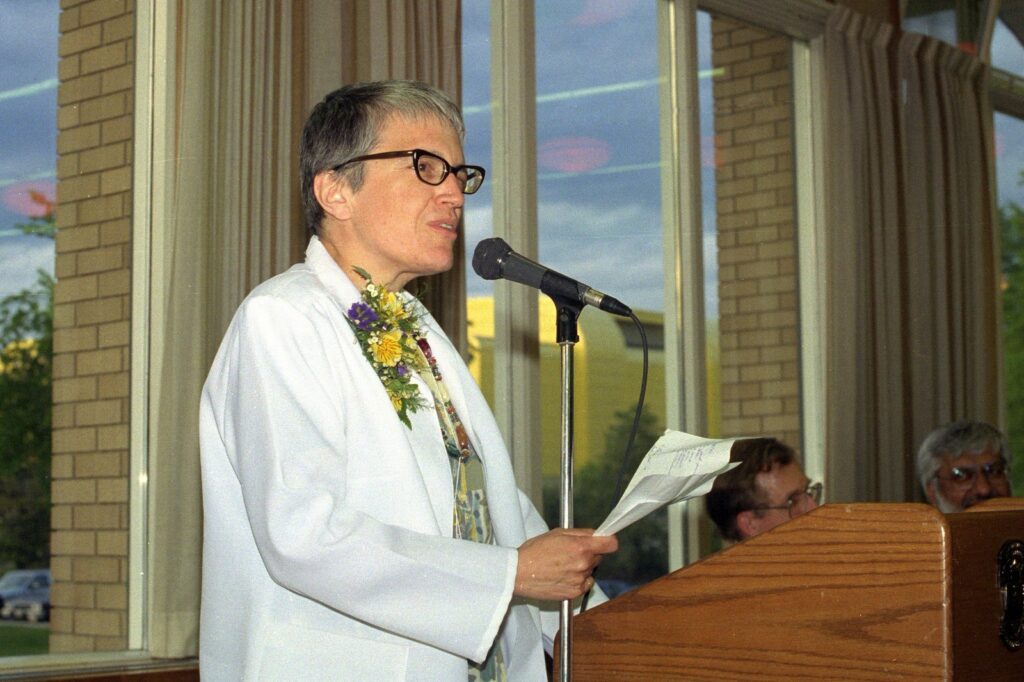
Agnes was born on December 12, 1938, in Saskatoon, Saskatchewan. Her parents, Gerhard Herzberg and Luise Oettinger, were physicists who emigrated to Canada from Germany in 1935 to escape Nazi persecution. In 1971, while working at Canada’s National Research Council in Ottawa, Gerhard was awarded the Nobel Prize in Chemistry for his work in spectroscopy.
Following high school in Ottawa, Agnes completed her undergraduate studies in mathematics at Queen’s University in Kingston and then moved to the University of Saskatchewan for graduate school, earning her PhD in 1966. Her thesis on response surfaces and rotatable designs resulted in three papers in The Annals of Mathematical Statistics. Experimental design remained a major area of research for her whole career.
In February 1966, Agnes began a postdoctoral fellowship with David Cox at Birkbeck College in the University of London. In September 1966, Cox moved to the department of mathematics at Imperial College London as a professor of statistics, and Agnes accompanied him. Then, in March 1968, she joined the department as a lecturer. Statisticians from all over the world visited ICL, and Agnes forged collaborations with many of them, including David Andrews, Peter Bickel, Norman Draper, and Valerii Fedorov. Beyond her experimental design work, a particularly notable achievement was her widely cited 1985 book with David Andrews, Data: A Collection of Problems from Many Fields for the Student and Research Worker. The book provided datasets and backgrounds on their sources in an era when such data was not widely available. In 1988, Agnes returned to Canada as a professor in the department of mathematics and statistics at Queen’s University, retiring in 2004. While at Queen’s, she continued working in experimental design but also found inspiration from mathematics colleagues. One notable publication was a 2007 paper with Ram Murty on the mathematics of Sudoku, “Sudoku Squares and Chromatic Polynomials.”
One of Agnes’s major achievements at Queen’s was her creation of a series of meetings on statistics, science, and public policy. In 1992, Queen’s acquired Herstmonceux Castle in southern England through a donation. This motivated Agnes to organize the initial meeting, which was held at the castle in April 1996. For all but five years, these meetings continued annually to 2024 and included statisticians, scientists of all types, historians, journalists, high-ranking public servants, diplomats, high court judges, and legislators. Agnes remained the driving force behind each meeting, organizing the program and dealing with fundraising, logistics, and editing and publishing the proceedings.
Professional service was important to Agnes. In addition to numerous roles in the SSC, she served on the Royal Statistical Society’s council. She was an associate editor for Biometrika, The Annals of Statistics, Journal of Statistical Planning and Inference, and Canadian Journal of Statistics. From 1980–2006, Agnes was editor of the International Statistical Institute’s Short Book Reviews. She was a tireless promoter of books on statistics, and during this period, around 2,500 books were reviewed.
Agnes received numerous honors, including elected fellowships in the American Statistical Association, the Institute of Mathematical Statistics, and the American Association for the Advancement of Science. In 2008, she was named a Specially Elected Fellow of The Royal Society of Canada. She was awarded the International Statistical Institute’s Henri Willem Methorst Medal for service, and in 1999, she received the Statistical Society of Canada’s Distinguished Service Award. In 2007, the SSC named her an honorary member. In 2014, she won the SSC’s Lise Manchester Award for annually “bringing together statisticians, scientists, politicians, and public servants from Canada and around the world” since 1996 to tackle problems at the intersection of statistics, science, and public policy.
Agnes struck up friendships in myriad ways, and her circle went far beyond statisticians and academic colleagues—from children of statisticians and taxi and bus drivers to hairdressers and shopkeepers. She was close friends with musicians and was generous in supporting their artistic endeavours. She always stayed in touch with friends, who would often receive books that she thought would interest them. She loved donuts and was known to give them to her favorite bus drivers.
Agnes Herzberg was a major international contributor to the statistical sciences and to other facets of science and society. For this and her friendship and loyalty to so many, she will be greatly missed.
Leave a Reply