
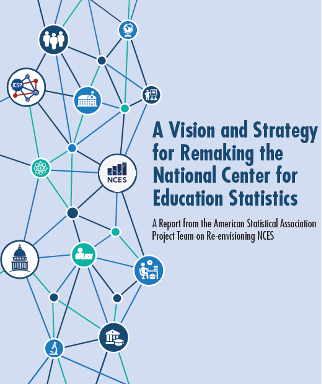
In August, the American Statistical Association released A Vision and Strategy for Remaking the National Center for Education Statistics, a report from the ASA’s project on re-envisioning NCES. Written by Shelly Martinez and Stephen Provasnik, the report draws on roundtable discussions, broad stakeholder engagement, and the team’s expertise in federal statistics to lay out a vision and strategy for rebuilding the agency. It also invites broader input from the community to help shape a roadmap for its future.


NCES is the nation’s principal source of education statistics, producing data that informs decisions by states, school districts, colleges and universities, researchers, and families. It also provides essential leadership and coordination of the education data infrastructure across the nation. The ASA has noted for years an inadequate staffing issue and has advocated for changes to address systemic barriers to NCES efficiency and effectiveness. In early 2025, the agency’s staff was cut from 103 to three, its commissioner was removed, and roughly three-quarters of its contracts were canceled, effectively halting many of its statistical collections and partnerships.
“There’s near-universal agreement, across the political spectrum, that NCES’s work is essential and must continue,” said ASA Executive Director Ron Wasserstein. “But simply rebuilding NCES to what it looked like in 2024 would mean rebuilding the same weaknesses that left it so vulnerable. This is a once-in-a-generation opportunity to do better.”
The Report’s Key Findings
- Broad consensus on NCES’s value: Stakeholders across sectors and the political spectrum agree NCES is uniquely positioned to play an essential and trusted federal role that cannot be replicated by states or the private sector alone in producing objective, comparable education statistics and anchoring the nation’s education data ecosystem.
- The pre-2025 model was not working well enough: Even before last year’s disruption, NCES’s in-house capacity was insufficient for its mandated portfolio, and stakeholders agreed its products needed to be more timely and accessible.
- A rare opportunity for change: Rebuilding NCES with its former structure and operations would recreate the same structural weaknesses that left the agency vulnerable. The report calls for a fundamentally different approach.
- Real costs to reduced capacity: With NCES’s statistical work and its partnerships with states and other data users largely stalled, the report warns gaps in the nation’s education data infrastructure will become increasingly apparent the longer the disruption continues.
- The keys to modernizing are well within reach: NCES’s distinct combination of responsibilities positions it at the intersection of two sets of critical infrastructure—the vertical education data system and the horizontal federal statistical system. Pursuing its three sets of responsibilities—reporting on the condition of US education, maintaining the education data ecosystem, and carrying out the fundamental responsibilities of a statistical agency under 2018’s new national statistical law—in an integrative way, the authors argue, has the potential to significantly elevate NCES’s value to the nation and the public good.
A Vision and Strategy
The report envisions a future in which states, schools, colleges, communities, and families have access to relevant, timely, and objective education statistics. As the authors write, achieving that future “requires a strengthened, revitalized National Center for Education Statistics that anchors and enables a healthy national education data ecosystem, partners seamlessly with states to improve education data, and is respected for improving decision-making and debate about education in the United States.”
The report’s strategy centers on shifting NCES from a survey-centric model to a curation-centric one, in which the agency draws more heavily on data its partners already collect, reserving surveys for essential circumstances. Done well, the authors argue, this is a win-win: NCES gains a more resilient path forward and the broader education data ecosystem gains a stronger partner. Realizing it will require strengthening data governance and coordination with states, growing NCES’s capacity for data curation, and plugging NCES into federal statistical system innovation efforts.
Calls to Action
The report calls on Congress, the administration, the Department of Education, and the broader stakeholder community to each play a role in advancing this vision, including the following:
- Congress providing sufficient resources and conducting vigorous oversight to protect and empower NCES
- The administration launching a modernization effort for the federal statistical system
- The Department of Education implementing the Evidence Act’s trust regulation to support NCES’s rebuilding
- Stakeholders across the education and statistical communities building consensus around NCES’s future and bringing additional voices into the conversation
An Invitation to the Community
The report’s authors describe it as an invitation to join the “NCES revitalization village.” Over the coming weeks, the project team will organize presentations and discussions on the paper and welcomes ASA members interested in joining. The ASA is also inviting feedback from the broader community—including a form embedded directly in the report—to help shape the details of a fuller roadmap.



The project has been informed throughout by advisers Peggy Carr, NCES commissioner from 2021–2025, and James “Lynn” Woodworth, NCES commissioner from 2018–2021. In addition to Martinez and Provasnik, the project team includes Michelle Crosby, Gail Mulligan, and Steve Pierson.
The report either implicitly or explicitly draws on work by Mulligan on NCES’s foundational data collections, its collaborative relationships to provide better statistics, and insights on K–12 education from the perspective of educators and administrators. Read the full report and learn more about the project.
Supporting Materials
Leave a Reply