

ASA President Jeri Mulrow shares a JSM TV conversation with President’s Invited Address speaker Peggy Carr in this month’s President’s Corner.
NCES
2024–2025 Degree Data: Awarding of Statistics, Biostatistics Degrees Steady Amid Staggering Growth for Data Science, Analytics Degrees

This summer’s release of the 2025 degree completion data from the National Center for Education Statistics shows the awarding of statistics and biostatistics degrees holding steady and continued strong growth for data science and analytics degrees.
Reenvisioning NCES to Build a Stronger Education Data Ecosystem
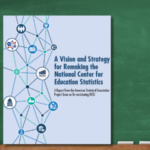
In August, the American Statistical Association released “A Vision and Strategy for Remaking the National Center for Education Statistics,” a report from the ASA’s project on re-envisioning NCES. Input and feedback from the ASA community is encouraged.
NCES: Perspectives, Insights, and Recommendations from Former Leaders

Former NCES leaders explain how chronic staffing, contracting, and bureaucratic barriers undermined the agency’s ability to produce timely education statistics. They offer practical recommendations for rebuilding a stronger, more agile NCES.
Fourth ASA Survey of Bachelor’s Graduates Tracks Rapidly Evolving Job Market

With the emergence of data science, machine learning, and AI, much has changed in the job market since the American Statistical Association’s first follow-up survey of bachelor’s graduates in 2017. This fourth survey of the graduating class of 2023 covers many changes, as well as considerable consistency.
Data Science, Analytics Degrees See Explosive Growth
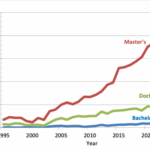
This summer’s release of the 2023 degree completion data from the National Center for Education Statistics shows incremental to solid growth for statistics and biostatistics degrees and doubling and tripling for data science and analytics degrees.
Administration Releases FY23 Budget Request as Congress Finalizes FY22 Budget
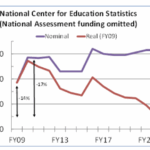
Congress wrapped up its funding for the federal government for fiscal year 2022 in March, the sixth month of the fiscal year. With the Biden administration releasing its fiscal year 2023 within a few weeks, Congress had to almost immediately start the process again. The National Institutes of Health and National Science Foundation both received 4 percent increases. Several statistical agencies also received 3–6 percent increases.
Meet Peggy Carr, Commissioner for Education Statistics

On August 24, 2021, President Joe Biden announced the appointment of Peggy G. Carr as commissioner of the National Center for Education Statistics in the Institute of Education Sciences at the US Department of Education.
Undergraduate Statistics Degrees Up 474% Since 2010

The increase in the number of universities granting statistics and biostatistics degrees also continues steadily.
State of the Education Data Infrastructure: What Three Experts Have to Say About the National Center for Education Statistics

For the state of the data infrastructure series, the ASA Count on Stats team spoke with three experts on the National Center for Education Statistics: James L. Woodworth, Jack Buckley, and Felice J. Levine.