
Marta Shore and Sarah Samorodnitsky at the University of Minnesota spearheaded UMN’s Biostatistics Community Outreach and Engagement Committee and created collaborations with local high schools. Here, they tell us about two of them.
biostatistics
Leah Jager
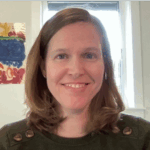
Leah Jager was born and raised in Grand Rapids, Michigan. Her dad was a college mathematics professor and her mom taught middle-school math and English. From a young age, she liked playing school and hoped to someday be a professor like her dad. Jager’s first encounter with statistics occurred during a summer internship in a food lab within the R&D division at Amway Corporation. The goal of her project was to improve the taste of a beverage using varying concentrations of a flavor additive. She never succeeded in making the drink taste better, but she did become interested in statistics. Today, as a statistics and biostatistics professor at Johns Hopkins, she is inspired when she sees a student realize the relevance statistics has in their life.
Becky McNeil
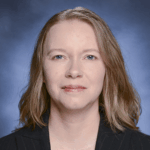
Becky McNeil’s enchantment with statistics and mathematical modeling began during her undergraduate studies, when she learned about ecological models and population dynamics. After completing her undergraduate degree in mathematics and biology, she took a job in billing at a pharmacy that served long-term care facilities. This was her first exposure to raw data—the stories of health told by billing records—and those stories sparked a deep interest in using mathematical tools to improve health. Eventually, McNeil earned her graduate degree in biostatistics and additional training in epidemiology and bioinformatics. She is now a research statistician at RTI international.
Knashawn H. Morales
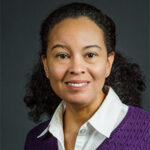
Knashawn H. Morales is one of two daughters born and raised in North Carolina to loving and supportive parents. From an early age, she developed an appreciation for science and public health. Having a mother and father who were trained as a chemist and an architectural engineer, respectively, likely influenced her. After earning her doctorate, Morales became a research scientist at the New England Research Institutes. Within two years, she joined the University of Pennsylvania, where she collaborated with investigators on research focusing on mental health services and behavioral modification interventions for asthma, insomnia, weight management, and HIV/STD risk reduction. She enjoys mentoring students and noted, “I am blessed to have had wonderful mentors along my journey and can only hope to pay it forward by being a positive influence for others.”
Felicia R. Simpson

Felicia R. Simpson has enjoyed mathematics since she was in elementary school but was inspired to study biostatistics by her mentor, Zephyrinus Okonkwo. She loved the idea of combining mathematics and helping people. She wanted to study biostatistics to understand health disparities from a statistical point of view, especially after losing her mother to a stroke. After earning her PhD in biostatistics, Simpson she started her career at the FDA but transitioned to teaching because she wanted to expose under-represented students to statistics and biostatistics. She is currently an associate professor of statistics and chair in the department of mathematics at Winston-Salem State University.
Felicity T. Enders
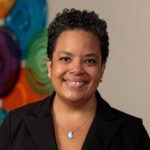
Felicity Enders fell in love with data and statistics while she was earning her Master of Public Health degree at Johns Hopkins Bloomberg School of Public Health. As a result, she landed in the PhD biostatistics program there, as well. Formerly head of the section of clinical statistics at Mayo Clinic, her proudest moment thus far has been her transition from teaching statistics focusing on health equity, workforce diversity, and inclusion as director for the Mayo Clinic Office for Research Equity, Inclusion, and Diversity “It’s always scary to jump into something new without knowing whether it will work,” she wrote. “I am incredibly thankful for all the people who have supported me in this transition. I believe there is a great deal to be done in this space, both statistically and otherwise, and I am excited to help move the field forward.”
Talithia Williams

Growing up in a small town in Georgia, Talithia Williams loved playing pretend, but in all her imagining, she never saw herself as a statistician. She knew those people existed, but no one who looked like her did those things, so it never occurred to her it was something to aspire to. Fortunately, her high-school AP Calculus teacher, Mr. Dorman, told her she should major in math in college. His affirmation planted a seed that changed her trajectory. She was accepted to Spelman College and awarded a NASA Women in Science and Engineering scholarship. There, she was exposed to African American women with PhDs in STEM and consequently went on to earn her PhD in statistics from Rice University. Today, she is an associate professor of mathematics and mathematics clinic program director at Harvey Mudd College.
Ching Tian Joins Emmes as Chief Innovation Officer
Emmes Chief Executive Officer Christine Dingivan said, “Ching brings a wealth of data and digital experience, which will be immediately useful as we accelerate our transition to decentralized trials …”
My ASA Story: Alexandra L. Hanlon, Professor of Practice, Center Director, and Collaborative Biostatistician

Alexandra L. Hanlon says the ASA has been instrumental to both her personal and career growth and is excited to see a continued shift toward team science and practicing statisticians.
The 2023 Challenge List: Most Important Questions in Data for Good
David Corliss starts the year off with a challenge list that shines a light on exciting new opportunities and is meant to encourage the D4G community to tackle overlooked or under-resourced concerns.