
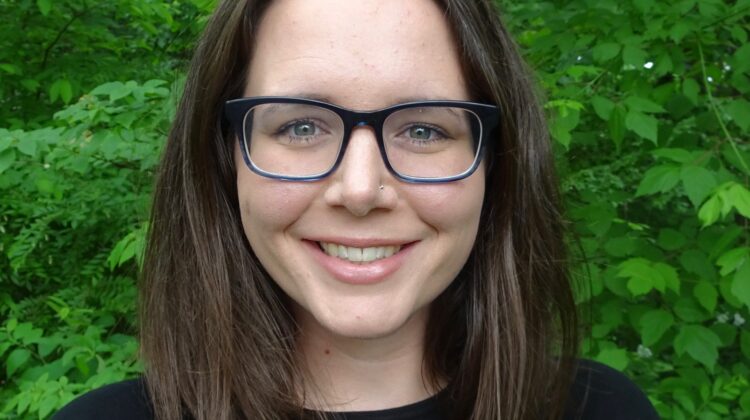
Kelly McConville is an assistant professor of statistics at Reed College and was program chair for the 2019 Symposium on Data Science and Statistics. She is a survey statistician who collaborates with the US Forest Inventory and Analysis Program and the US Bureau of Labor Statistics. At Reed, she teaches a variety of statistics and data science courses.
I left SDSS 2019 excited, invigorated, and just a little bit tired. And as I reflect on my experience at SDSS, many of the usual reasons I love conferences—informative sessions and chances to make and strengthen connections—also hold true. But instead of ruminating on the usual gems, I want to focus this reflection article on the pieces of SDSS that make it unique.
[slideshow_deploy id=’56565′]
For starters, I was delighted by the level of engagement by conference participants. If you think I am being hyperbolic, please understand that this program chair’s reoccurring, pre-conference nightmare included a sparsely filled room and the deafening sound of silence when the session chair asked, “Any questions for the speaker?” Fortunately, participant involvement exceeded my expectations. Beyond jam-packed sessions, 34 people in 11 teams competed in the Data Challenge, 27 mentors and 27 mentees interacted at the 8 a.m. speed mentoring session, large crowds participated in the optional lunch meet-ups, and e-poster presenters found themselves with an eager audience. As poster presenter (and first-time conference goer) Miranda Rintoul put it, “During my poster presentation, I was engaged in so many back-to-back interesting conversations about my work that I had to quickly sneak off and grab a glass of water before I lost my voice!”
I was quite pleased my nightmare did not reflect reality. Instead of hearing crickets at the end of sessions, I saw audience members raising their hands and asking thoughtful questions, so much so that they often lined up at the end of sessions to continue talking with speakers.
Another unique feature of SDSS is the diversity of speakers. If you look at the 2019 conference program, you will find speakers who identify as statisticians, software engineers, biostatisticians, computer scientists, mathematicians, data scientists, computational folklorists (okay, maybe only one of those), astronomers, and I could keep going but I think you get the idea. Hearing from people from a variety of disciplines and career paths helps us see data and how to learn from data in compelling new ways. It can also remind us of the similarities that exist across fields and help us forge new, interesting collaborations.
To this end, I would be remiss if I didn’t acknowledge the hard work of the program committee in putting together such a vibrant program that really showcased the diversity of folks thinking about data.
If you missed the symposium or attended but want to revisit a talk, you are in luck. You can find many of presentations in the online program. Also, Zhi Yang, one of our participants, put together a GitHub repo that links to many of the slides and conference materials. I know I will be coming back to these materials when my data work needs some inspiration.
Planning for SDSS 2020 is already well underway. Next year’s conference will take place in Pittsburgh, Pennsylvania, from June 3–6. To receive conference updates, visit the SDSS website.
SDSS Conference Committee Members
Kelly McConville (Program Chair), Reed College
Silas Bergen, Winona State University
Mine Çetinkaya-Rundel, Duke University and RStudio
Eric Chi, North Carolina State University
Jim Harner, West Virginia University
Stephanie Hicks, The Johns Hopkins University
David Hunter, The Pennsylvania State University
Alicia Johnson, Macalester College
Albert Kim, Smith College
Heather Kitada, Reed College
Stas Kolenikov, Abt Associates
Thomas Lee, University of California, Davis
Amelia McNamara, University of St. Thomas
Miles Ott, Smith College
Brad Price, West Virginia University
Julia Silge, Stack Overflow
Dennis Sun, Cal Poly, San Luis Obispo and Google
Raymond Wong, Texas A&M University
Kara Woo, Sage Bionetworks
Leave a Reply