
Demissie Alemayehu, Pfizer, and David Madigan, Northeastern University
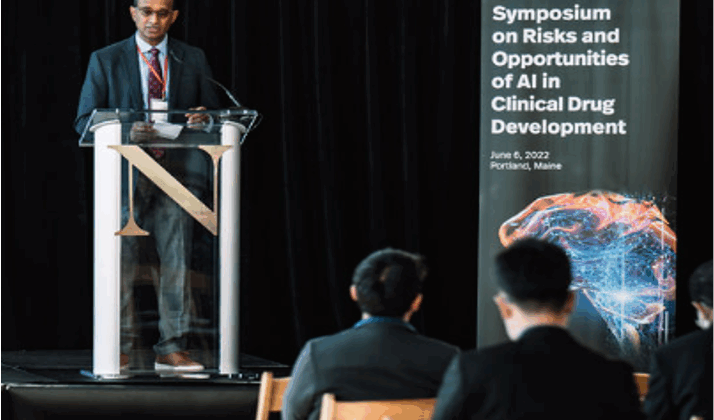
The Symposium on Risks and Opportunities of Artificial Intelligence (AI) in Clinical Drug Development—cosponsored by Pfizer, the Roux Institute at Northeastern University, the American Statistical Association, and Columbia University—was held on June 6 at the Roux Institute in Portland, Maine. The goal of the symposium, which attracted participants from the US Food and Drug Administration, pharmaceutical industry, and major academic institutions, was to provide a forum for major stakeholders to discuss pertinent issues with policy implications for proper implementation of this emerging technology. View the program (PDF).
Kannan Natarajan, senior vice president and head of Pfizer GBDM, set the stage by emphasizing the need for collaboration among interested groups to optimize the potential of AI in drug development while safeguarding the welfare of patients against unintended consequences that may result from deploying technology solutions. In addition, David Madigan, Northeastern University provost, and Ron Wasserstein, ASA executive director, wished participants a successful conference.
A major attraction of the symposium was the keynote address by Khair ElZarrad, director of the Office of Medical Policy at the Center for Drug Evaluation and Research, titled “Regulations in the Age of Exponential Innovations.” He focused on the potential of real-world evidence to support decision-making and the role of AI across therapeutic development, with particular reference to the policy and operational implications, regulatory considerations, and current FDA activities.
Speakers from various institutions—including the Broad Institute of MIT and Harvard, University of Pennsylvania, Rutgers University, Columbia University, and Northeastern University—gave insightful presentations, through which many great ideas were shared and valuable lessons were learned. Industry practitioners from major pharmaceutical companies highlighted the states of AI in their respective organizations, while the online and in-person attendees posed questions that made the events lively and interactive.
The formal portion of the symposium concluded with a panel discussion on ethical issues with AI in drug development and medical research. Moderated by Marinka Zitnik of Harvard University, the panelists—which included Prasanna Rao of Pfizer, Robert Truog of Harvard University Medical School, Usama Fayyad of Northeastern University, and Robert Vandersluis of GlaxoSmithKline—debated critical issues ranging from patient privacy to the role of regulations in mitigating untoward consequences of the ubiquitous AI algorithms.
The symposium also provided networking opportunities for the in-person participants, both at the conference venue and during an evening reception held at the Roux Institute. Following the reception, Natarajan and Madigan closed the symposium with a commitment to fostering collaboration among stakeholders in the use of AI to advance medical research.
Leave a Reply