
Amanda Koepke, SDSS Program Chair
Forging connections across academic fields and exploring innovative research in both data science and statistics can present an opportunity for learning and growth. This desire to cultivate connections inspired the theme for the 2024 Symposium on Data Science and Statistics, “Beyond Big Data: Bridging the Gap.”
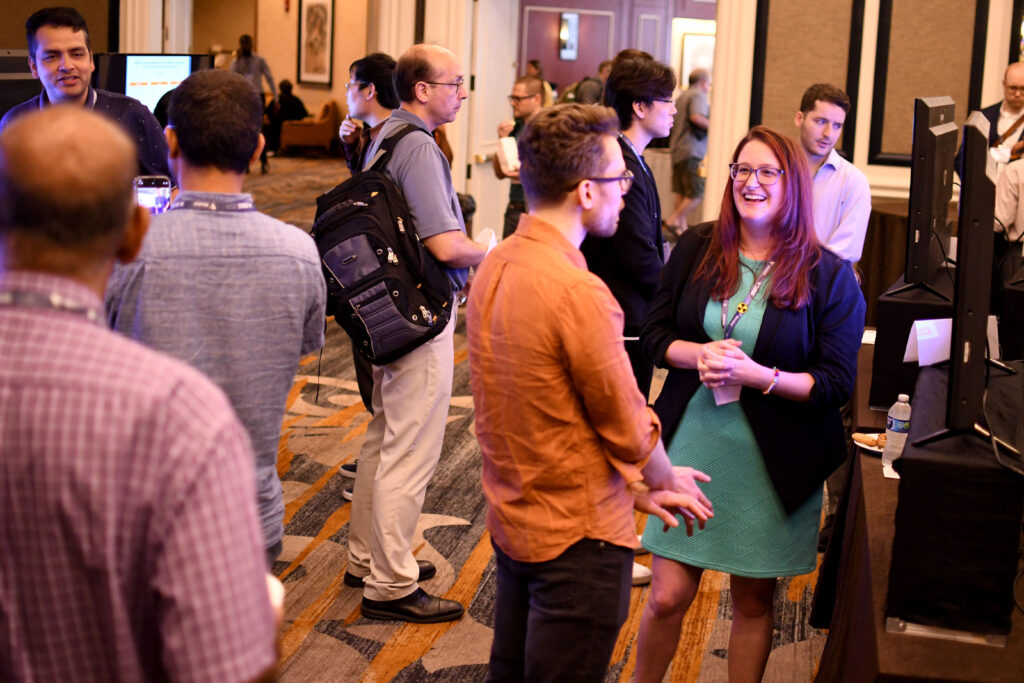
The more than 300 attendees in Richmond, Virginia, took short courses; gave and attended paper, poster, and panel sessions; mingled and made new friends between sessions; and immersed themselves in the city’s historic neighborhoods.
The conference began with a series of short courses spanning a variety of topics and offering participants the opportunity to expand their technical toolkits and enhance their expertise. These sessions were well attended, reflecting the high level of interest and engagement from participants eager to deepen their understanding of and skills in Bayesian computing, data visualization, generative AI fundamentals, and Julia.
Alyssa Fowers from The Washington Post kicked off Day 1 with a presentation on data journalism. On Day 2, Dilma Da Silva of the National Science Foundation Directorate for Computer and Information Science and Engineering gave a peek into research horizons for AI and CISE. The final plenary session on Day 3 was a panel discussion, “Ethics and Fairness in Statistics and Data Science,” that featured Matthew D. Rotelli of Eli Lilly and Company, Elham Tabassi of the National Institute of Standards and Technology, and Caitlin Wylie of the University of Virginia.
The refereed sessions showcased a diverse array of presentations, and lightning talks provided previews of topics that sparked thought-provoking discussions during the subsequent poster sessions. The posters attracted strong attendance, with conversations extending beyond the scheduled session times.
From informal meetups to structured sessions, networking opportunities were plentiful, offering many chances for attendees to connect, exchange ideas, and build professional relationships.
Speed mentoring made a return this year and facilitated connections between mentees and mentors from various fields and backgrounds.
In response to feedback from previous conference participants and to enhance the symposium’s social and networking offerings, the program committee introduced a new role this year—activity and outreach chair. In this role, Kristine Gierz researched local activities and compiled them into a document accessible via QR code. She also implemented a new online sign-up system to connect interested participants for nightly outings.
The chair for SDSS 2025 is Stephanie Shipp, research professor in the department of statistics at Iowa State University. The symposium will take place April 29–May 2 at the Hilton Salt Lake City Center in Salt Lake City, Utah.
Leave a Reply