
This is Mathematics and Statistics Awareness Month, and we are celebrating the origins of the symbols we use for the four main mathematical operations: addition; subtraction; multiplication; and division. For centuries, mathematicians had to explain what they were doing in words. It was several millennia before notation stabilized into the formats we recognize today.
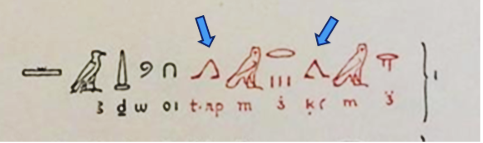
For much of human history, numbers were a mark or glyph representing quantities of physical objects. Number systems were invented for counting them. Since about 1650 BCE, the ancient Egyptian Rhind Papyrus presented a type of shorthand for addition and subtraction that looks like little pairs of legs (the literal meaning of the glyphs is “to go in” and “to go out”).
The Crafte of Nombrynge (1300) is the first practical text in English providing instructions and examples for the four operations it refers to as addicioñ or agregacioun, ablacioun or subtraccion, multiplicacioun, and dyvysioun. However, without symbols, everything had to be explained in words. Crafte shows how to subtract 2 from 4 as follows:
Lo, as an example: draw 2 out of 4. Then 2 remain. Cross out the 4 and write there 2, and let the lower figure stand still. And so go through the other figures until you come to the end; then you have done.
Clearly, a more convenient system was needed.

The plus sign + first appears as a contraction of the Latin word et (for “and”). French philosopher and mathematician Nicole d’Oresme (c.1320–1382) may have used something like it as early as 1350. Pure mathematicians were apparently unbothered by questions of standardization and tended to develop their own notations. For example, Gerolamo Cardano (1501–1576) was one of the first European mathematicians to use plus and minus operators systematically, but he represented them with ~p and ~m in his 1545 Ars Magna.
Symbols started gaining traction in the Renaissance with the increase in international commerce and the need to make paperwork understandable. The first printed versions of both + and – signs are credited to Johannes Widman (c.1460–ac.1498) in his 1489 book Behennde vnd hüpsche Rechenung auff allen Kauffmanschafft (Nimble and neat Calculation in all Trades). Widman was writing for merchants using arithmetic for business purposes, and the symbols indicated trade surplus and deficits, not operations.
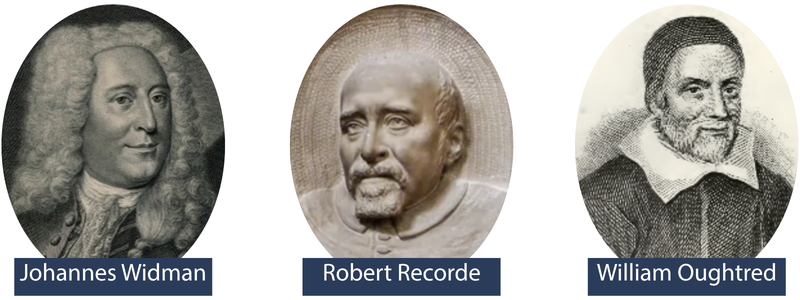
Henricus Grammateus (1495–c.1525)—who also went by Henricus Scriptor, Heinrich Schreyber, or Heinrich Schreiber—was one of the earliest mathematicians to adopt + and – signs, which he presents in Ayn new Kunstlich Buech (A New Skill Book). Later, the Welsh physician and mathematician Robert Recorde (c.1510–1558) introduced + and – to the English-speaking world in his 1557 book The Whetstone of Witte. His version of the plus sign was soon widely adopted, but there were a few holdouts. Christiaan Huygens and Pierre de Fermat persisted in using the Latin cross †, and Edmund Halley used the fancier Maltese cross ✠.
William Oughtred (1574–1660), inventor of the slide rule, argued successfully for the use of symbols over text in his influential 1630 book Clavis Mathematicae (Key of Mathematics). The symbols he invented, still in use today, are the combined plus-minus symbol ± and X for multiplication (sometimes called the St. Andrew’s or saltire cross).

However, in a 1698 letter to Johann Bernoulli, Gottfried Leibniz (1646–1716) complained that he hated X because “it is easily confounded with x (an unknown quantity).” Instead, he preferred to “simply relate two quantities by an interposed dot and indicate multiplication by way of it.” The asterisk * was first used in 1659 by Johann Rahn (1622–1676) and is still used today in computer code.
Division was the last mathematical operation to become standardized. The horizontal fraction bar — was first used in Arabic math, then introduced to Europe by Fibonacci in the 13th century. The obelus ÷ is credited to Rahn, but it may have been the brainchild of John Pell (1611–1685), an English mathematician and political agent of Oliver Cromwell. He edited Rahn’s book and may have had more to do with the crafting of symbols in the book than Rahn himself.
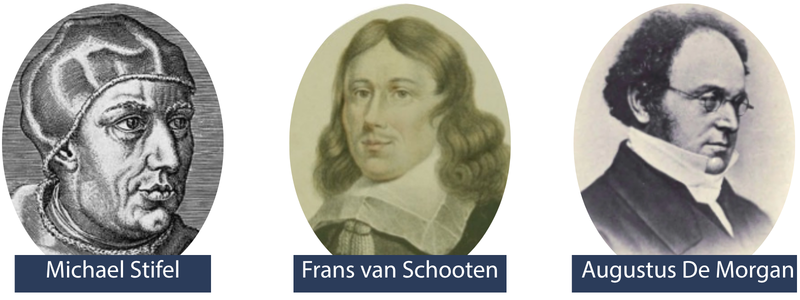
Confusingly, Leibniz used the colon : for division and ratios in his 1684 text Acta Eruditorum. Michael Stifel (1487–1567) suggested the right bracket ) in 1544, and as late as 1884, long division was still represented by a series of brackets in instructional texts, such as James B. Thomson’s Complete Graded Arithmetic. The vinculum was originally introduced by Dutch mathematician Frans van Schooten (1615–1660) as a horizontal line grouping terms in a mathematical expression.
Much later, long division was indicated by a bracket with a vinculum placed on top ⟌ ; this shows up in G. A. Wentworth’s 1888 text The Elements of Algebra.
In 1845, Augustus De Morgan (1806–1871) introduced the backslash /, which is still used in linear formats.
And where would we be without the equals sign =? It was invented by Robert Recorde “to avoid the tedious repetition of the words ‘is equal to.’” In The Whetstone of Witte, he explained his reasoning: “I will set, as I often do in practical work, a pair of parallel, or twin, lines of equal length, thus: =, because no two things can be more equal.”

Leave a Reply