
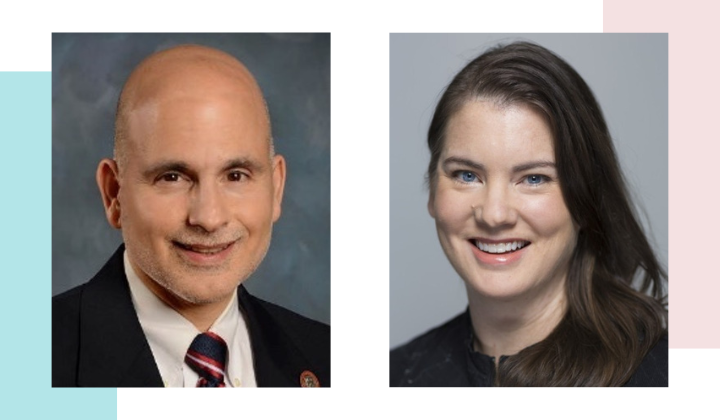
The Caucus of Industry Representatives works to promote statistics and data science in the private and public sectors. Both Joseph Cappelleri and Ginger Holt currently serve on the governing board and bring extensive experience from their careers in industry. In this Q&A, they share what drew them to volunteer for ASA leadership, reflect on their career journeys, and discuss how they stay engaged as the profession continues to evolve.
Joseph C. Cappelleri is executive director of biostatistics in the Statistical Research and Data Science Center at Pfizer, where he received the Craig A. Saxton Clinical Development Excellence Award. He is an ASA Fellow and a recipient of the Long-Term Excellence Award from the Health Policy Statistics Section.
What drew you to serve on the ASA governing board of the Caucus of Industry Representatives?
It is a natural next step from my previous role as a non-board member of CIR. Kelly Zou, who chairs this caucus, encouraged and invited me to serve on the board, given what she said was my success in leadership positions and receiving awards from ASA and other organizations as a medical researcher and author in the pharmaceutical industry. As such, serving on the board allows me to extend and amplify my influence in service to others.
What experiences or influences early in your statistical career shaped the way you approach your industry statistician job today?
I was inspired by the wonderful training received from teachers, advisers, and provided resources that forged my passionate and resolute commitment for continuous, multidimensional growth and development. This commitment has provided me the breadth and depth to capitalize on the multifaceted, interdisciplinary nature of my job, which covers biometrics, econometrics, psychometrics, and epidemiology … along with being a people manager.
When you look across your professional journey, what themes stand out as most meaningful?
The most important theme has been cultivating a culture of collaboration with medical breakthroughs and patient care—with treatment being the centerpiece. My resource, or “secret sauce,” for cultivating a culture of collaboration begins with taking ownership of myself. By continuing to learn, relearn, and build on my academic training, I’ve empowered and trained myself to relish and, in some cases, master whatever skill sets were being sought for their own intrinsic value—especially skills related to biopharmaceutical research. Other themes include the power of networking, bringing out the best in others, and having them bring out the best in me. Please see my Amstat News article for a more detailed response to this question and those that follow.
What skills—technical or otherwise—do you think will increasingly be important for statisticians in your industry?
The successful 21st-century statistician in the pharmaceutical industry should develop and refine first-rate quantitative skills through dedication, habitual study, and regular practice. Technical preparation is required through competency in general areas and mastery in particular areas. Substance reigns with precision and correctness as the hallmarks of analytical virtue. That said, being technically smart—to use a statistical phrase—is a necessary, but not sufficient, condition. Strong and persuasive communication skills, especially with colleagues not versed in the language of statistics, are paramount regarding the methodological strengths and weaknesses of a particular strategy or position. Have empathy by putting yourself in the position of others and helping colleagues resolve their issues in building a solid connection of trust and camaraderie.
How do you stay curious and motivated as the field you represent continues to evolve rapidly?
The nature of the pharmaceutical industry—with a premium placed on ongoing innovation and research aimed at optimal patient care—makes it stimulating, rewarding, and challenging. I welcome the internal and external challenges that fuel stimulation and reward. I embrace the expectation to challenge myself to work with others in the most efficient manner and to adapt effectively in an evolving and competitive environment. This expectation motivates me to elevate myself to be the best medical researcher possible because the ultimate objective and reward transcend personal ambition and have much higher stakes. It is about improving the quality and quantity of life for millions of patients worldwide—and to do so with integrity, honor, and distinction.
What piece of professional advice do you wish you received earlier in your career?
Stellar question. In addition to developing a strong foundation in common areas of statistics, I learned later in my career (shortly after my student years) to specialize in at least one area based on my passion for the subject, while considering the demand and supply of talent in that subject. My advice here is to seek out specialized areas where there is higher demand, yet a low supply of talent (or at least, where demand exceeds supply)—especially on the quantitative side—and fill that void with gusto. I eventually achieved this objective through trial and error and hard-fought experience.
Ginger Holt is a senior staff data scientist at Databricks. She develops forecasting and predictive models for revenue, sales, capacity, and other business planning needs. She has also worked at Meta, Walmart Labs, and HP, forecasting capacity needs and demand.
What drew you to serve on the ASA governing board of the Caucus of Industry Representatives?
My previous adviser and mentor Kathy Ensor created this caucus to help statisticians and data scientists in industry get more support from the ASA. And who can say no to Kathy? Seriously, though, having been a part of the ASA since the early 2000s, it has been much easier to find the support you need within ASA as an academic or researcher versus a statistician or data scientist in industry.
What experiences or influences early in your statistical career shaped the way you approach your industry statistician job today?
Luckily, my company Databricks was created by academics, and I began my statistical career in academia. Working on hard, research-level problems is important to me, and I’m able to do that in my current position.
When you look across your professional journey, what themes stand out as most meaningful?
I have worked in forecasting for over 20 years now, and developing an explainable model is just as important as developing an accurate model. If the business doesn’t understand what’s driving a forecast, they won’t adopt it.
What skills—technical or otherwise—do you think will be increasingly important for statisticians in your industry?
Automation of data engineering and data science tasks is advancing, but you can still be irreplaceable as a statistician or data scientist by being able to translate (automated or otherwise) data insights into actionable business decisions. We are well-positioned to interpret the behavior and decisions of autonomous systems to human stakeholders.
How do you stay curious and motivated as your field continues to evolve rapidly?
My role has typically been a subject matter expert in forecasting, but I have worked across many different domains (energy, finance, retail, technology, academia), where I always learn new things. My strategy for learning new methodologies and technologies in statistics and data science is to volunteer to teach on a topic (at a future date) that I need to learn more about. It is a great forcing function to prioritize learning.
What piece of professional advice do you wish you’d received earlier in your career?
Creating clarity is very important. Defining a clear problem statement is usually half of the solution. Also, when a stakeholder is very prescriptive about a solution, it’s often the wrong one—or even the wrong solution to the wrong problem. Use your expertise to recommend the right solution to the right problem.
Leave a Reply