
Mark C. Otto and MinJae Lee
Annie Duke took an unconventional path to becoming one of poker’s most accomplished players. When her academic career stalled, her brother encouraged her to try poker at a hole-in-the-wall bar in Wyoming. What she intended as a year-long break stretched into 20 years. Those small, slightly better decisions over the years earned her $4 million at the tables. Now, with a PhD in cognitive psychology, she applies that extensive experience to teaching decision-making and consulting with venture capital firms.
Duke advocates a simple life principle: Treat decisions as bets. This mental shift aligns naturally with how statisticians think probabilistically. Yet, most people, even many of us in statistics, resist probabilistic thinking in our personal and professional lives. We want certainty—to be right, not just approximately right.
This probabilistic thinking is exactly what Duke means by treating decisions as bets. You may have to make binary choices but treating them as 100% or 0% is naïve. More often, you make choices under uncertainty, succeed or fail partly because of factors outside your control, and then iterate.
Philip Tetlock’s forecasting research shows ordinary people trained in probabilistic thinking and systematic methods outperform subject matter experts by 30%. The secret? Superforecasters don’t rely on domain expertise alone; they use disciplined probabilistic reasoning, seek base rates in historical data, and continuously refine their estimates.
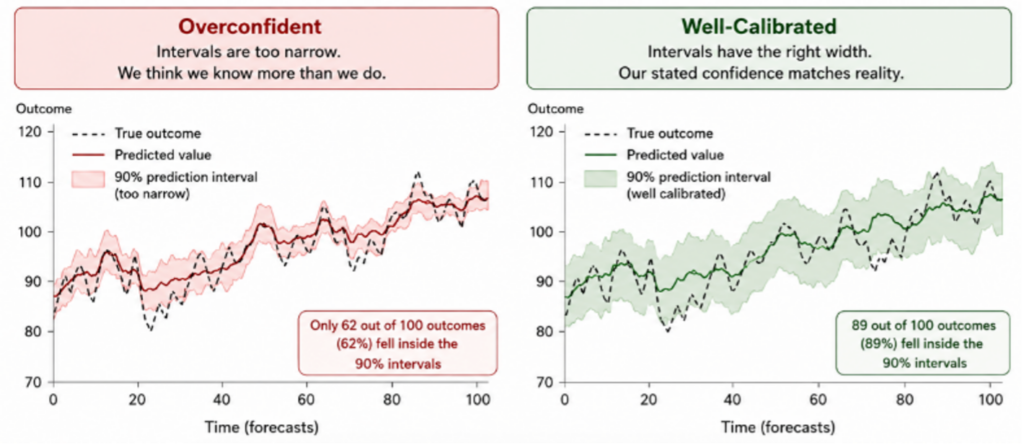
Weather forecasters exemplify this well. They continuously gather satellite, radar, and weather station data, then run simulations with slightly perturbed initial conditions to generate a distribution of possible forecasts. Crucially, they calibrate their predictions: A 30% chance of rain should occur on roughly 30% of the days they issue that forecast. This calibration—aligning stated confidence with actual frequency—is how you improve predictions over time. Like Tetlock’s superforecasters, meteorologists refine their estimates throughout the day as new data arrives, rather than committing to an initial forecast.
To make this concrete, imagine a disagreement with a colleague about a workplace decision—say, whether to adopt a new analysis tool. Your colleague is convinced; you are skeptical. Duke’s practical suggestion is to ask, “How much would you bet it will improve the trial analysis?” If your colleague claims 100% certainty, he should be willing to risk any amount—he’ll get it back. But in practice, people hesitate. The bet highlights the gap between stated confidence and actual conviction. This simple exercise opens the door to a thoughtful conversation about what could go wrong and what evidence would change minds.
Following Tetlock, you might go further: Instead of “likely” or “confident,” ask for specificity. Is it 60%? 70%? 80%? Making the distinction concrete forces harder thinking and reveals overconfidence. You could use probability statements to model the practice and change your decision framing.
We can quantify these bets using confidence intervals. A 90% confidence interval widens as you become less sure. Building a culture where colleagues estimate and calibrate their confidence—even when doing so subjectively—changes how both you and your teams work. Try these exercises to calibrate your predictions. Most people score 2 or 3 out of 10 on the first try. With practice, Mark now averages 70%. Tetlock’s research confirms this: Calibration is a trainable skill. His superforecasters in tournaments weren’t smarter; they practiced regularly, received feedback, and adjusted. The skill transfers: You notice when you are overconfident, consider tail risks (extreme events), and account for Secretary Rumsfeld’s “unknown unknowns.”
Stanford professor Tina Seelig reframes this as “feeling lucky.” The lucky person is not blessed—they’re alert to unexpected opportunities and prepare for surprises. This mindset is not luck. It follows naturally from thinking probabilistically. When you acknowledge that your predictions are bets—best guesses, not certainties—you plan for contingencies. When your assumptions prove wrong, you’re ready to pivot.
Outside views, often grounded in base rates, offer more realistic perspectives. Tetlock calls this “reference class forecasting.” The idea is straightforward: Find similar past cases (your reference class) and ask what the base rate of success was. “In 100 similar projects, how many succeeded on time and on budget?” This grounds your forecast in data, not intuition. Daniel Kahneman and Amos Tversky documented the planning fallacy: Our inside view (how long we think our task will take) diverges wildly from the outside view (how long similar projects take). When Kahneman and his colleagues wrote a textbook, they estimated two to three years. An experienced editor in the group, looking at comparable projects from other groups, guessed eight years. The group took seven years, with many members dropping out and the publisher losing interest by the time the manuscript was finished. The inside view did not have the scoop on the truth.
Rather than estimate a whole project at once, Tetlock’s superforecasters decompose the problem. Instead of asking “How long will this analysis take?”, break it into components: “How long for data gathering? For cleaning? For analysis? For drafting results? For revision?” Estimate each separately, then sum. This is harder than a lump estimate, but more accurate—and it surfaces hidden assumptions.
A colleague of mine systematically pads her project estimates by a factor of 1.5 to 2, without disclosing the adjustment, to ensure on-time delivery. She is unconsciously applying this wisdom: Break processes into components, examine actual histories, actively hunt for what might go wrong, and adjust accordingly.
Mark uses his father’s crude rule: “Things always take three times as long as you think—but don’t include that in your estimate.” (Both approaches sidestep the premortem, a structured technique we’ll explore in a future article.)
Tetlock’s research also emphasizes continuous adjustment. Superforecasters don’t set a forecast and stick with it. They seek new information, update their estimates, and track their track record. This habit of iteration—making small, deliberate adjustments based on feedback—mirrors what James Clear calls “compound improvement.” Over time, these small refinements add up to significantly better judgment.
Treat decisions as bets, calibrate your confidence, seek outside views (i.e., base rates), decompose complex estimates, and continuously refine your forecasts. When you make explicit predictions and track outcomes—like weather forecasters and Tetlock’s superforecasters do—your perspective and judgment improve. If better predictions help you make better decisions, then next time we should ask: What does “better” even mean? The answer: values, objectives, and rationality.
Mark Otto

MinJae Lee
Deciding Factors, a column by Mark Otto, explores decision analysis and how statistical scientists can apply their expertise to make better choices in their careers, communities, and personal lives.
Leave a Reply