
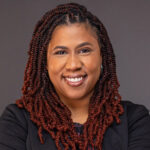
Stephanie Cook was interested in math and science as a girl, but math did not come easy for her because she has mild dyscalculia—a disability that impairs a person’s ability to learn number-related concepts. Even though it took her longer to do math, however, she excelled at it. Consequently, she went on to earn an MPH and DrPH in sociomedical science at Columbia University with a focus on research methods and statistics. Currently, she is a New York University James Weldon Johnson Professor in the department of social and behavioral sciences and department of biostatistics.
A Statistician's Life
Knashawn H. Morales
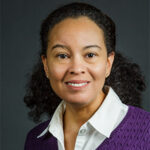
Knashawn H. Morales is one of two daughters born and raised in North Carolina to loving and supportive parents. From an early age, she developed an appreciation for science and public health. Having a mother and father who were trained as a chemist and an architectural engineer, respectively, likely influenced her. After earning her doctorate, Morales became a research scientist at the New England Research Institutes. Within two years, she joined the University of Pennsylvania, where she collaborated with investigators on research focusing on mental health services and behavioral modification interventions for asthma, insomnia, weight management, and HIV/STD risk reduction. She enjoys mentoring students and noted, “I am blessed to have had wonderful mentors along my journey and can only hope to pay it forward by being a positive influence for others.”
Calandra Tate Moore

Calandra Tate Moore was always drawn to the mathematical sciences. She recalls regularly pretending to be a math teacher as a child and being excited about timed math skills tests. By the time she reached her senior year, she had taken all the mathematics classes available at her high school. Eventually, her love for math impelled her to pursue three degrees and spend her career evolving what it means to “do math” and manifesting what you can do with a math degree. With more than two decades of experience in academia and the federal government, Moore has conducted research on a wide range of mathematical and statistical applications. Currently, as a technical leader in video, image, speech, and text analytics research for the US Department of Defense, her work focuses on human language technology.
Felicia R. Simpson

Felicia R. Simpson has enjoyed mathematics since she was in elementary school but was inspired to study biostatistics by her mentor, Zephyrinus Okonkwo. She loved the idea of combining mathematics and helping people. She wanted to study biostatistics to understand health disparities from a statistical point of view, especially after losing her mother to a stroke. After earning her PhD in biostatistics, Simpson she started her career at the FDA but transitioned to teaching because she wanted to expose under-represented students to statistics and biostatistics. She is currently an associate professor of statistics and chair in the department of mathematics at Winston-Salem State University.
Felicity T. Enders
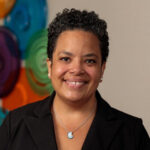
Felicity Enders fell in love with data and statistics while she was earning her Master of Public Health degree at Johns Hopkins Bloomberg School of Public Health. As a result, she landed in the PhD biostatistics program there, as well. Formerly head of the section of clinical statistics at Mayo Clinic, her proudest moment thus far has been her transition from teaching statistics focusing on health equity, workforce diversity, and inclusion as director for the Mayo Clinic Office for Research Equity, Inclusion, and Diversity “It’s always scary to jump into something new without knowing whether it will work,” she wrote. “I am incredibly thankful for all the people who have supported me in this transition. I believe there is a great deal to be done in this space, both statistically and otherwise, and I am excited to help move the field forward.”
D. Anthony Miles
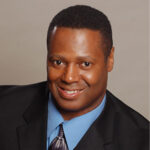
During college, D. Anthony Miles played in a rock-and-roll/heavy metal band that tried to get a record deal. That did not happen. Life happened. Instead, he graduated with a degree in marketing from The University of Texas at San Antonio and went into the banking industry. It was while working as a marketing analyst at Wells Fargo Bank that Miles discovered he had an interest in statistics. His passion for the profession, however, was encouraged by his uncle—the late Ralph E. Miles, a biostatistician. “It was my uncle who nurtured my love of the practice of statistics, and I credit all my accomplishments to him,” said Miles. He has presented his statistics research at conferences around the country and appeared on several major news networks and programs as a subject matter expert. Currently, he leads a nine-person research team.
Lester Mackey
Lester Mackey’s interest in statistics unfolded when he was a student immersed in the Ross Mathematics Program, an intense eight-week summer curriculum in number theory designed to expose teenagers to proof-based mathematics. His interest in machine learning was piqued, however, when he competed for the million-dollar Netflix Prize during his senior year in college. His team lost by twenty minutes, but the experience opened the door to his future. “Every day,” Mackey noted, “I reflect on my good fortune at finding a field (machine learning) and a job (researcher) that I truly love. My work scarcely seems like work, as it’s exactly what I would be doing even if no one was paying me.”
Sean Simpson

Sean Simpson grew up in Richmond, Virginia, and attended majority Black public schools throughout his childhood. Simpson’s parents supplemented his education through programs such as the Richmond Area Program for Minorities in Engineering and Center for Talented Youth. However, it was when he watched a presentation about biostatistics during his junior year at Harvard University that his career path became clear to him. He is now a biostatistics professor at Wake Forest University and was elected an ASA Fellow in 2022—an honor that served as a culmination of his contributions to the field.
Talithia Williams

Growing up in a small town in Georgia, Talithia Williams loved playing pretend, but in all her imagining, she never saw herself as a statistician. She knew those people existed, but no one who looked like her did those things, so it never occurred to her it was something to aspire to. Fortunately, her high-school AP Calculus teacher, Mr. Dorman, told her she should major in math in college. His affirmation planted a seed that changed her trajectory. She was accepted to Spelman College and awarded a NASA Women in Science and Engineering scholarship. There, she was exposed to African American women with PhDs in STEM and consequently went on to earn her PhD in statistics from Rice University. Today, she is an associate professor of mathematics and mathematics clinic program director at Harvey Mudd College.
Q&A with Statisticians and Data Scientists Working to Improve Our Communities
These statisticians and data scientists have been working on the front lines to improve our communities, so we asked them to talk about their current projects; who inspired them; and how to get started supporting where we each live, work, learn, and play.