
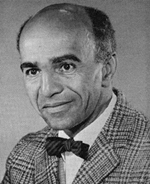
David Blackwell
David Blackwell, the first African American elected to the National Academy of Sciences, died July 8. He was 91 years old.
The oldest of four children, Blackwell grew up in Centralia, Illinois, and considered himself fortunate to attend an integrated school. At 16, he began his mathematics degree at the University of Illinois and earned his bachelor’s in three years by taking summer classes.
Of 105 applications, Blackwell received three job offers. He chose Southern University in Baton Rouge, Louisiana.
In 1944, Blackwell went to teach at Howard University in Washington, DC, which he called “the ambition of every black scholar.” It took only three years for Blackwell to become a full professor and head of the department of mathematics.
Blackwell remained at Howard until 1954, when he was offered a professorship at the University of California, Berkeley. He became chair of Berkeley’s department of statistics in 1956, but the administrative role was not fulfilling. For about a year after stepping down, he said, “My first thought was, ‘I’m no longer chairman,’ and it made my day.”
Blackwell was a longtime member and former vice president of the ASA. He served as president of the Institute of Mathematical Statistics, the International Association for Statistics in Physical Sciences, and the Bernoulli Society. Prior to retiring, he published 80 papers.
Click here to read more about Blackwell.
Bishnoedath Leo Raktoe
Submitted by Hosh Pesotan and Radhey S. Singh
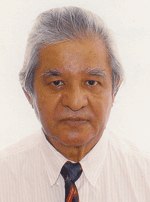
Bishnoedath Leo Raktoe, a former professor of statistics in the department of mathematics and statistics at the University of Guelph in Ontario, Canada, passed away on November 13, 2009, in Singapore, where he lived since 1997.
Raktoe was born in Paramaribo, Surinam, on August 2, 1932. He received his preliminary education in Paramaribo and then went on to study at the State College for Tropical Agriculture in Deventer, The Netherlands, where he earned a diploma in tropical agriculture in 1952. From 1953 to 1960, he worked as an agricultural technical officer in the Ministry of Agriculture in Paramaribo.
In 1961, he undertook postgraduate study in statistics at Cornell University, earning a doctorate in 1964, with a major in biometry and minors in economic and social statistics.
In 1967, after a two-year appointment with the FAO/UN in Colonia, Uruguay, Raktoe joined the department of mathematics and statistics at the University of Guelph as an associate professor of statistics and embarked on a teaching and research career. He was promoted to full professor in 1970 and he continued his tenure at Guelph until 1980. At Guelph, he helped develop the undergraduate and master’s programs in statistics.
From 1980 to his retirement in 1997, Raktoe traveled extensively throughout Saudi Arabia, Singapore, Thailand, Malaysia, Jamaica, Trinidad, and South Africa, teaching and carrying out collaborative research at
various universities.
While Raktoe had research interests in many areas, his principal research activity was in design and analysis of experiments—an area in which he authored or coauthored more than 60 papers. He published in leading journals, including Annals of Mathematical Statistics, Annals of Statistics, Journal of the Royal Statistical Society, Journal of the American Statistical Association, Annals of the Institute of Statistical Mathematics, and Journal of Statistical Planning and Inference. Raktoe also coauthored two books: Basic Applied Statistics and Factorial Designs.
Raktoe was a Fellow of the American Statistical Association, Royal Statistical Society, and Institute of Mathematical Statistics and an elected member of the International Statistics Institute. He was a great mentor, teacher, and researcher. Above all, he was a great colleague and friend. He will be sadly missed.
Leave a Reply