
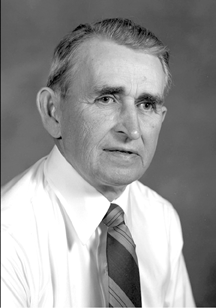
Franklin Arno Graybill
Prepared by Duane Boes, Jay Breidt, and Hari Iyer
Franklin Arno Graybill, professor emeritus and founding chair of the department of statistics at Colorado State University (CSU), died February 17, 2012, at the age of 90.
Frank was born to Arno and Lula Graybill on September 23, 1921, in Carson, Iowa, a farming community of about 600 inhabitants. He attended Carson Consolidated School and then attended two years of college at Tabor Junior College.
In September of 1941, he enrolled at William Penn College and completed one semester of coursework before joining the Army Air Corps.
After the war, Frank attended summer school at Colorado State Teachers College. However, the college would not accept his course credits from Tabor Junior College, which had gone out of business during World War II, so he returned to William Penn College and completed his bachelor’s degree in education in May of 1947, with mathematics and physics as his main subjects. It was during this period that Frank met Jeanne Bunting, whom he married on May 24, 1947.
In September of 1947, Frank and Jeanne moved to Stillwater, Oklahoma, where Frank earned his master’s degree in mathematics at Oklahoma A&M. In the fall of 1949, he went to Iowa State University to do his PhD in statistics, where he would work under the direction of Oscar Kempthorne. Frank wrote his dissertation, titled “Quadratic Estimates of Variance Components,” and graduated with a PhD in 1952. He then went back to Oklahoma A&M as an assistant professor of statistics and stayed until 1960.
In 1959, Frank attended the IMS meeting in Laramie, Wyoming, where he met Elmer Remmenga from the department of mathematics at CSU. Remmenga informed him that the dean of faculty at CSU, Andrew Clark, and the head of the mathematics department, Les Madison, were interested in creating a graduate program in statistics and looking for a suitable candidate to lead this effort. Shortly thereafter, Frank interviewed for the position and received an offer to join the department. In August of 1960, he began his tenure at CSU, where he stayed for the next 37 years.
Soon after Frank’s arrival, the department of mathematics changed its name to department of mathematics and statistics. During his initial years at CSU, Frank created the statistical laboratory and initiated the PhD program in statistics. In 1971, the department of mathematics and statistics split and Frank became head of the new department of statistics. He served as department head until 1975.
Frank was president of WNAR of the International Biometric Society in 1967. In 1968, he served as an associate editor of the Annals of Mathematical Statistics; he was editor of Biometrics from 1972–1975. He was president of the American Statistical Association in 1976.
Frank taught graduate courses in linear models, experimental design, and matrix theory. He advised 33 MS and 26 PhD students during his tenure at CSU. Frank also published a number of books, both theoretical and applied, including Theory and Application of the Linear Model, Matrices with Applications in Statistics, Introduction to the Theory of Statistics, An Introduction to Statistical Models in Geology, and Confidence Intervals on Variance Components.
In 1981, Frank began working part time, but continued to teach and advise until he retired in 1997.
The success of the statistics program at CSU is in a large part due to Frank’s efforts, astute hiring during the 1960s, vision for the department, creation of the statistical laboratory (which now bears his name), and leadership and hard work over the years. To thank him for his many contributions to the development of statistics at CSU, the department annually presents a graduate student with the Graybill Award for Excellence in Linear Models and hosts the Graybill Conference Series.
Frank will be remembered by his students and colleagues not only for his professional achievements, but also as a warm, kind man with great devotion to his family and a wonderful, down-home sense of humor.
Paul Levy
Paul S. Levy, a prominent biostatistics educator and researcher, died in a convalescent center in Durham, North Carolina, from consequences of a spinal cord injury he suffered following a fall three years ago. He was 75.
Paul was an outstanding leader in public health and medical research. During his career, he authored more than 200 publications and 30 book chapters and monographs in the fields of biostatistics and epidemiology. His expertise in sampling methods allowed him to affect a broad range of topics.
Early in his career, he developed methods to measure the effectiveness of the Illinois Trauma System in getting severely injured patients to trauma centers. As part of this work, he pushed the science in new directions, most notably in devising measures of injury severity that would allow surgeons to compare outcomes across hospitals.
Paul was principal investigator for the Patient Registry for Primary Pulmonary Hypertension (PRPPH). His work on survival of patients with primary pulmonary hypertension was published in highly prestigious medical journals and has been cited by thousands of researchers. His co-PI, Stuart Rich, recently commented that the registry is considered a gold standard for information about PPH. Paul was instrumental in developing data collection and analysis tools for the Centers for Disease Control and Prevention’s Behavioral Risk Factor Surveillance System, the largest ongoing telephone health survey in the United States. As part of his research, he proposed a simple software tool designed to measure the use of dietary supplements in the United States population. In parallel, he was one of the first to document the widespread use of dietary supplements in children from national data. His textbook, Sampling of Populations: Methods and Applications, is one of the most widely cited books in this field.
In recognition of his achievements in the development, evaluation, and dissemination of sample survey methodology and for the design and implementation of surveys of major public health importance, Paul was selected as a Fellow of the American Statistical Association. In addition, he was named a Senior Fellow at Research Triangle Institute (RTI) International in 2006. This designation represents the highest scientific honor RTI bestows on its own researchers.
In addition to a thriving career, Paul demonstrated excellent physical endurance and stamina. Between the ages of 60 and 70, he competed frequently in ultra-marathon events that involved running for distances of 50 miles. When he was 66, he climbed 96 floors in Chicago’s John Hancock Building in 15 minutes.
Paul was a beloved colleague, professor, and mentor throughout his illustrious career. He approached his life and his profession with precision, excellence, and a great sense of humor.
“Paul gave me my first job. His advice was to work hard and fast, before people discovered I was around. I did,” said Northwestern University professor Borko Jovanovic, a former colleague. “His second piece of advice was, ‘Focus on problems useful to other people.’ I did, and I have done well in my career ever since. His third suggestion was, ‘If it is not fun, it is probably not worth doing.’ He was the best boss I ever had.”
“He had a unique way of getting to the heart of a problem. Paul had a gift for finding simple solutions to knotty statistical problems that stumped others,” noted University of Washington professor Jack Goldberg, one of Paul’s former students. “I remember how he would always say that if you went back to the basic tools of biostatistics and epidemiology, you could usually find an answer to your problem without having to do anything too complicated.”
Paul earned a doctorate in biostatistics from The Johns Hopkins University, a master’s degree in mathematical statistics from Columbia University, and a bachelor’s degree in mathematics from Yale University.
He was a founding faculty member of the school of public health and the first director of the division of epidemiology and biostatistics at the University of Illinois at Chicago (UIC). Prior to his career at UIC, he was a faculty member at the Harvard Medical School, as well as the University of Massachusetts School of Public Health, an epidemic intelligence officer at the Centers for Disease Control and Prevention, and a mathematical statistician at the National Center for Health Statistics. Most recently, Paul was employed by the RTI, where he focused on the development and dissemination of statistical methodology, particularly in the areas of sample survey methodology and epidemiology.
Paul served as president of the ASA Chicago Chapter and won the award for Teaching Excellence at the University of Illinois School of Public Health in 1978.
In lieu of flowers, the family requests contributions be made to the UIC School of Public Health, where a fund in Paul’s name has been established to assist students in the division of epidemiology and biostatistics. Checks should be made out to the University of Illinois Foundation/Paul Levy Fund and sent to the UIC School of Public Health, 1603 W. Taylor, Room 1189, Chicago, IL 60612.
Leave a Reply