• Skip to main content
  • Skip to secondary menu
  • Skip to primary sidebar
  • Skip to footer
  • Homepage
  • About Us
  • Advertising
  • Submission Instructions
  • Editorial Calendar
Amstat News

Amstat News

The Membership Magazine of the American Statistical Association

  • Printed Issues
  • Practical Significance Podcast
  • Additional Features
  • Columns
  • Member News
  • Departments
You are here: Home / Featured Stories / Bachelor’s Degrees in Statistics Surge Another 20%

Bachelor’s Degrees in Statistics Surge Another 20%

September 1, 2014 1 Comment

Number of universities granting statistics degrees also growing

This column is written to inform ASA members about what the ASA is doing to promote the inclusion of statistics in policymaking and the funding of statistics research. To suggest science policy topics for the ASA to address, contact ASA Director of Science Policy Steve Pierson at pierson@amstat.org.

Pierson-color copySteve Pierson earned his PhD in physics from the University of Minnesota. He spent eight years in the physics department of Worcester Polytechnic Institute before becoming head of government relations at the American Physical Society.

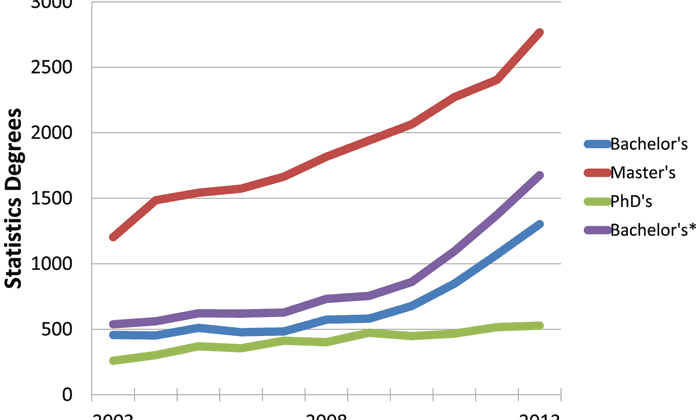
The recently released 2013 statistics and biostatistics degree data from the National Center for Education Statistics show continued robust growth for bachelor’s degrees, with a 21% jump over the 2012 number and a near doubling since 2009. As shown in Figure 1, master’s degrees saw a 15% increase over 2012; PhD’s 2%. Figure 2 shows the master’s and doctoral data for only biostatistics degrees.

Figure 1. Statistics degrees at the bachelor's, master’s, and doctoral levels in the United States. These data include the following categories: statistics, general; mathematical statistics and probability; mathematics and statistics; statistics, other; and biostatistics. The asterisked bachelor's data include statistics degrees categorized as a second major. Both sets of bachelor's data are included here for comparison with analogous charts from previous years. Data source: NCES IPEDS.
Figure 1. Statistics degrees at the bachelor’s, master’s, and doctoral levels in the United States. These data include the following categories: statistics, general; mathematical statistics and probability; mathematics and statistics; statistics, other; and biostatistics. The asterisked bachelor’s data include statistics degrees categorized as a second major. Both sets of bachelor’s data are included here for comparison with analogous charts from previous years. Data source: NCES IPEDS.
Figure 2. Biostatistics degrees at the master's and doctoral levels in the United States. Data: NCES IPEDS.
Figure 2. Biostatistics degrees at the master’s and doctoral levels in the United States. Data: NCES IPEDS.

Accompanying the growth in the number of degrees is a growth in the number of universities granting such degrees. As shown in figures 3 and 4, the number of universities granting bachelor’s degrees in statistics has increased 50% from 2003 to 2013; master’s degrees in statistics, 20%; master’s degrees in biostatistics, 85%; doctoral degrees in statistics, 20%; and doctoral degrees in biostatistics, 75%.

Figure 3. Number of universities granting statistics (statistics, general; mathematical statistics and probability; mathematics and statistics; statistics, other) and biostatistics PhDs. Compiled from NCES IPEDS data.
Figure 4. Number of universities granting statistics (statistics, general; mathematical statistics and probability; mathematics and statistics; statistics, other) and  biostatistics master’s and bachelor’s degrees. Compiled from NCES IPEDS data.
Figure 4. Number of universities granting statistics (statistics, general; mathematical statistics and probability; mathematics and statistics; statistics, other) and
biostatistics master’s and bachelor’s degrees. Compiled from NCES IPEDS data.

The 10 universities granting the most bachelor’s degrees in statistics over the last three years are listed in Table 1. (Click here [PDF download] for the complete list of 129 universities that have granted bachelor’s degrees in statistics.)

Table 1—The 10 Universities Granting the Most Bachelor’s Degrees in Statistics for 2011–2013

In biostatistics, only five universities actively grant bachelor’s degrees. The University of North Carolina at Chapel Hill has granted a total of 87 such degrees from 2003–2013 (26 over the last two years); Brigham Young University, 53 (9); University of Scranton, 31 (7); Emmanuel College, 5 (2); Simmons College, 5 (5).
To see the universities granting master’s and doctoral degrees in statistics and biostatistics, follow these links to ASA Community blog entries: master’s; doctorates. For more information about the categorization of statistics degrees and to see the growth of statistics-related degrees (i.e., bioinformatics, computational math, applied math), see the ASA Community blog.

Filed Under: Featured Stories, Science Policy Tagged With: bachelors degree, graduate degree, science policy, statistics degrees

Reader Interactions

Comments

  1. Celia Rowland says

    September 6, 2014 at 9:53 am

    As an AP Statistics teacher with a master’s degree in statistics, I preach to my students every year about the demand for statisticians, biostatisticians and biomathematicians. For as long as I’ve been teaching AP Statistics (9 years now), I have a couple of students jump into the field each year. But more importantly, I try to relate to my students how much they will use statistics throughout a variety of careers.

    Reply

Leave a Reply Cancel reply

Your email address will not be published. Required fields are marked *

Primary Sidebar

Search

More to See

Jennifer L. Green: The Collaborative Life of a Statistics Professor and Teacher Mentor

September 1, 2026 By Megan Murphy

Meetings, Manuscripts, and Meows: Spend a Day with Charlotte Walsh

September 1, 2026 By Megan Murphy

Students’ Statistical Thinking When Using Generative AI

September 1, 2026 By Megan Murphy

What Students Taught Me About Teaching Statistics

September 1, 2026 By Megan Murphy

STATAcorp. Efficiency matters. Stata is easy to use, so you spend less time learning software and more time focusing on your research
Data Science Certification

ASA HOME

American Statistical Association

Communications from the Executive Director

ASA Leader Hub

ASA Career Connect

ADVERTISERS

STATA
SIAM

Archives

Categories

Footer

Editorial Staff

Managing Editor
Megan Murphy

Graphic Designers / Production Coordinators
Olivia Brown
Meg Ruyle

Communications Strategist
Val Nirala

Advertising Manager
Christina Bonner

Contributing Staff Members
Kim Gilliam

American Statistical Association
277 South Washington Street, Suite 370
Alexandria, VA 22314-3646
Phone: (703) 302-1857


Copyright © 2026 · Magazine Pro on Genesis Framework · WordPress · Log in