
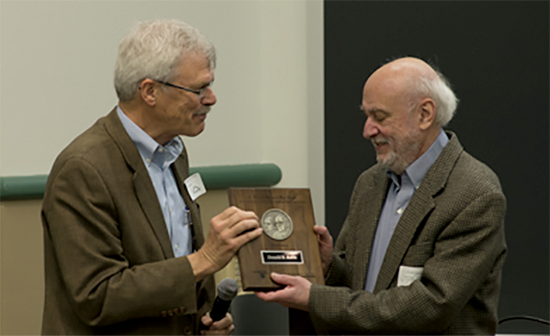
Donald B. Rubin
The Penn State Department of Statistics honored Donald B. Rubin, John L. Loeb Professor of Statistics at Harvard University, with the 2017 C. R. and Bhargavi Rao Prize during the Rao Prize Conference on May 12. Also honored were Paul R. Rosenbaum of The Wharton School and Satish Iyengar of the University of Pittsburgh, who gave the 2017 C. G. Khatri Lecture and 2017 P. R. Krishnaiah Lecture, respectively.
2017 C. R. and Bhargavi Rao Prize to
Donald B. Rubin.
Rubin is one of the most-cited authors in both mathematics and economics, according to ISI Science Watch and Highly Cited Economists. He is an elected fellow/member/honorary member of the Woodrow Wilson Society, John Simon Guggenheim Memorial Foundation, Alexander von Humbolt Foundation, American Statistical Association, Institute of Mathematical Statistics, International Statistical Institute, American Association for the Advancement of Science, American Academy of Arts and Sciences, European Association of Methodology, British Academy, and National Academy of Sciences. Additionally, he has received the Samuel S. Wilks Medal, Parzen Prize for Statistical Innovation, Fisher Award and Lectureship, and George W. Snedecor Award.
Rubin, Iyengar, and Rosenbaum gave the plenaries at the conference, which also featured invited speakers Samuel Kou of Harvard University, Kari Lock Morgan of Penn State, Joseph Schafer of the US Census Bureau, and Dylan Small of The Wharton School.
The C. R. and Bhargavi Rao Prize is awarded in odd years and was established to recognize outstanding and influential innovations in the theory and practice of mathematical statistics, international leadership in directing statistics research, and pioneering contributions by a recognized leader in the field of statistics. The C. G. Khatri Memorial Lectureship and P. R. Krishnaiah Memorial Lectureship honor the memory of C. G. Khatri and P. R. Krishnaiah by inviting outstanding researchers in statistics to deliver lectures at Penn State.
Joanne Wendelberger
The Statistics Division of the American Society for Quality (ASQ) recently honored Joanne Wendelberger with the 2017 William G. Hunter Award.
The award was established by the Statistics Division in 1987 to recognize the many contributions of its founding chair at promoting the use of applied statistics and statistical thinking. The attributes that characterize Bill Hunter’s career—consultant, educator for practitioners, communicator, and integrator of statistical thinking into other disciplines—are used to help decide the recipient.
Wendelberger joined the Statistical Sciences Group at Los Alamos National Laboratory in 1992 as a technical staff member. She served in multiple leadership roles as a research and development manager for the Statistical Sciences Group and Computer, Computational, and Statistical Sciences Division prior to her current position as a senior-level scientist. Prior to working at Los Alamos National Laboratory, Wendelberger worked as a statistical consultant at the General Motors Research Laboratories.
Earning her PhD in statistics in 1991 from the University of Wisconsin-Madison, Wendelberger was influenced by quality leaders Bill Hunter, George Box, and Brian Joiner. Her research has been motivated by the need to develop solutions to complex interdisciplinary problems, with a growing focus on the interface between statistics and computer science. Her current research interests include statistical experimental design and test planning, statistical bounding and uncertainty, materials degradation modeling, sampling and analysis in large-scale computation and visualization, probabilistic computing, and education modeling. She has published on these topics extensively.
Wendelberger is a Fellow of the American Statistical Association and a senior member of the ASQ. She was selected as the W.J. Youden Memorial Address speaker for the 2016 Fall Technical Conference and has served as an associate editor for Technometrics and ASQ representative for the Technometrics Management Committee.
In addition to her professional career contributions, Wendelberger has sought opportunities to inspire the use of statistics in her local community. Following the lead of Hunter, she has encouraged the use of statistical concepts and effective problem solving techniques for a number of community organizations and forums, including a cooperative preschool, a gymnastics school, a soccer league, a scholarship committee, a community discussion of alternative school calendars, and numerous educational outreach activities.
Leave a Reply