
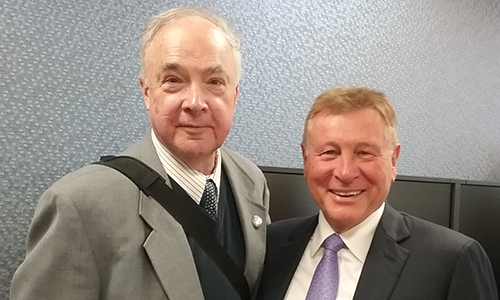
After nearly a year’s worth of President’s Corners devoted to training, encouraging, and honoring leaders, I am using this month’s column to profile a statistician who, in every sense of the word, has spent his life leading large. Dennis Gillings is described as a “British-born American billionaire statistician and entrepreneur” on Wikipedia. A graduate of Exeter University, he was professor of biostatistics at The University of North Carolina and the founder and former chair of Quintiles, the world’s largest clinical research organization. Among accolades too numerous to name, he was made commander of the Order of the British Empire in 2004. His career is nothing short of spectacular, and statisticians aspiring to be strong and impactful leaders would do well to take note of his leadership story.
I had occasion to sit down with Dennis and talk about his views on statistics, data science, and drug development, catching him during an October visit to Chapel Hill to honor Gary Koch. Gary was celebrating 50 years as a biostatistics faculty member in the Gillings School of Global Public Health at UNC—a school named for his close friend and colleague.
In 2000, Mike O’Fallon was ASA president and invited Dennis to give the JSM President’s Invited Address in Indianapolis. I was then Quintiles vice president of biostatistics for North America, and my job was to make sure Dennis—and his PowerPoint presentation—made it to the podium on time.
I don’t think anyone in the audience was prepared for the message delivered that day. Dennis challenged the audience to consider changing our profession’s name from statistics to information science, arguing we were at risk of losing out on the bioinformatics revolution taking place at the intersection of statistics, computer science, and genetics. We were too narrowly focused and needed to be more inclusive and accepting of other scientists interested in quantitative evaluation of information.
Dennis’ address took place on the Monday afternoon of JSM, and for the next three days, it seemed all anyone was talking about was his challenge. Not everyone agreed with our taking a new direction as a profession, much less a new name. But everyone heard the challenge and was reacting to it. If the purpose of a JSM address is to get people thinking, his was a tremendous success!
My first question during our interview was to ask how—18 years later—he viewed the data science movement relative to the field of statistics in terms of training, skill sets, and job markets. Here are a few of his comments in response:
- Big data are ever more important—the driving force behind the actions of many large companies today. Quintiles’ 2016 merger with IMS and the formation of the combined venture, IQVIA, is an example of this phenomenon.
- Companies are interested in recruiting workers with data management skills, computer search skills, and expertise in descriptive data analysis and regression methods. There is a need to be able to report what the data are telling us, going beyond tests of prespecified hypotheses. Skills in cluster analysis and pattern recognition, as well as data visualization, are important for this purpose, as are model building and sensitivity analyses.
- The use of big data brings with it the need to assess generalizability and data quality. Requiring a protocol prior to initiation can help, but findings may still need to be validated through other data sources and/or research.
- Real-world data studies offer an opportunity to impose design structures on the data at hand, particularly if they are longitudinal. Bias assessment/reduction are important, and the analytical skills required may be more aligned with the field of epidemiology. Dennis alluded to the relevance of a 1966 lecture he attended while at the University of Cambridge contrasting randomization and matching as argued by R.A. Fisher and others. Just as clinical trials rely on randomization, real-world data studies rely on matching—and statisticians need expertise in both.
- Big data are often deeper than data from controlled experiments, genetics data being one example, and their analysis requires us to rethink the multiple comparisons problem.
In summarizing his responses to this first question, Dennis commented that the traditional model of training statisticians to develop methodology and identify data sets for illustration purposes needs to be expanded. Statisticians today must be able to apply a broad array of analytic methods that can clarify problems in big data and identify possible solutions, with the ultimate goal of capitalizing on the vast amounts of information in these complex and deep data sources.
My second question to Dennis concerned his view of the state of drug development—what improvements are needed, especially in difficult-to-study areas such as Alzheimer’s disease? I was interested in his views based not only on his Quintiles experience, but also on his appointment in 2014 by UK Prime Minister David Cameron to be the world dementia envoy and chair of the World Dementia Council. Here are some of his comments in response:
- One lesson learned from his experience as world envoy came from interactions with early-onset patients. Knowing their life expectancy was short, and being fully aware of the quality of life they could expect, patients expressed to him their willingness to take risks with experimental drugs. Taking a patient’s individual benefit-risk calculation into account would be a departure from the current drug development paradigm, but perhaps it is time to explore that approach, at least for predictable diseases. I commented on the FDA’s current emphasis on patient-focused drug development as an example of a trend moving in that direction.
- Another lesson learned was that patients’ caregivers and family members can offer extremely valuable information. Involving them in daily diary data collection can allow subtle but persistent trends in individual disease trajectories to be detected, often more easily than from observations and interactions during regularly scheduled clinic visits. Speaking from personal experience in caring for his mother—who suffered from Alzheimer’s disease—Dennis noted day-to-day trends often gave a more consistent picture of the impact of the disease than did the highly variable responses at fixed data collection time points.
- The conventional phase 1 to 2 to 3 development paradigm is breaking down somewhat in rare diseases. Probationary approval of drugs has seen limited use, but should be expanded—especially when dealing with rare diseases or diseases with no good solutions. Pharmaceutical sponsors could move more quickly to a definitive study that would support probationary approval. The study could rely on biomarkers or intermediate outcomes, and here is where the caregiver/family member diaries might play a role. Once on the market, the use of big data could play an important role, particularly in evaluating the generalizability of earlier studies.
In summarizing our discussion, Dennis had this to say: “The way of the future for drug development in rare diseases will be a higher proportion of drugs subject to conditional approval, with real-world data studies providing valuable information post-approval.”
A theme of my JSM president’s address was the impact strong statistical leaders have had on my career and the need for the ASA to help grow more leaders for the future. By sharing these highlights from my recent conversation with Dennis Gillings, I hope you will be inspired as much as I have been by someone who has had a clear vision for making the world a better place through statistics!
Dennis Gillings had it almost right. We need a new name and new campaign to promote our science. He proposed piggybacking on the fad of the day – and suggested Information Science. Today, ASA seems to be trying to capitalize on the latest fad of Data Science. Rather than use the fad of the day, I think we should include in our name Analytical Science. “Analytical Science” is actually more relevant and representative of what we do, more enduring and a more clear shift from the data science nomenclature that dominates our time. I make these comments because I want to encourage ASA in its efforts to deal with this issue so that the discipline of statistics and the profession of statistician is not lost or displaced or does not continue to be relegated to the back office again and again.