
Rich Levine, JSM 2019 Program Chair
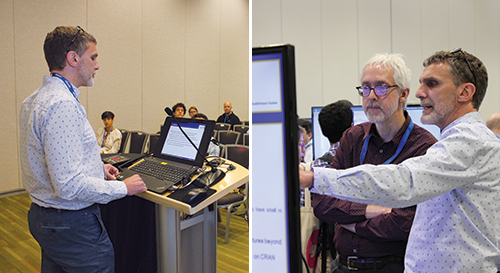
At left, Christian Léger of the University of Montréal presents the oral part of his speed session. At right, he discusses his poster with Steve McEachern of The Ohio State University at JSM 2018 in Vancouver, Canada.
One of the largest gatherings of statisticians will be taking place in Denver next summer: the 2019 Joint Statistical Meetings. The meeting theme, “Statistics: Making an Impact,” aims to place our discipline at the crest of the data science wave hitting this information age. Our contributions and leadership are critical in, for example, developing machine learning methods, spearheading efforts in statistics literacy and communication, paving the way for data science education, and inspiring data-informed decision-making in scientific inquiries and public policy discussions.
The JSM 2019 Program Committee has finished constructing the invited program of more than 200 sessions for the meetings. You will be able to enjoy a diverse array of talks and panel sessions that include presentations on astronomical data, Census 2020, deep learning and artificial intelligence, microbiome data science, optimal design in big data problems, and precision medicine, to name a few. Several sessions also target critical philosophical and policy issues relevant to our profession.
The competition for an invited session was fierce this year. We saw a bumper crop of proposals, consisting of across-the-board high-quality, hot-topic session ideas. In the end, fewer than half of the proposals were accepted, leaving many excellent sessions out of the invited program. The game is not over though, as there are many, I believe even better, opportunities to expose your work to the thousands of statisticians converging on Denver next August.
Now to my soap box: I am a huge proponent of poster presentations. A poster provides you the opportunity to interact one-on-one with your audience. This level of engagement stimulates research and concept discussions rarely afforded in traditional paper sessions. I thus strongly encourage you to consider a speed or poster session for dissemination of your work.
Below are the avenues for contributing to the JSM 2019 program.
Speed Sessions
The speed session allows you to take advantage of electronic poster (eposter) capabilities at JSM. The “speed” part of the session consists of a four-minute oral presentation to advertise a later session poster presentation. These oral presentations are packaged in sets of 20, with a five-minute break after the first set of 10. The eposter session is 45 minutes long. We make every effort to group the speed poster sessions by topic to attract the largest, most-focused audience possible.
A few words of wisdom learned from previous years’ speed sessions:
- The oral presentation is your elevator speech meant to pique interest in and market your coming poster presentation. The less information and bigger the picture, the better.
- The eposter is an extremely flexible modality within which you may include software demos, analysis animations, videos, and interactive statistical graphics or dashboards. We encourage you to be creative, moving outside the box of a traditional poster board presentation. And you are freed of the hassle and cost associated with printing and transporting a poster!
Poster Sessions
We will have traditional poster sessions: printed posters presented on large boards at the meeting site. The poster medium is the common presentation mechanism in many scientific fields. Poster sessions have the advantage of generating attention to your topic through effective visual display tools, encouraging extended and individualized topic discussions, networking with other professionals, and alleviating the distraction of time constraints.
Again, I strongly encourage you to consider a speed session or poster session format.
Contributed Sessions
The traditional JSM session is a contributed session consisting of seven papers presented in 15-minute intervals. As I am sure you can probably corroborate, the short duration of the talks, relative difficulty interacting with the audience, and large number of parallel sessions make the contributed sessions a less-than-ideal mode of presentation. Seriously consider trying a speed or poster session this year. Let us change the JSM tradition by making the “vast majority” of sessions the more intimate poster presentation.
Abstract Submission
To contribute to the JSM 2019 program in any of the above venues, submit an abstract and title online by February 4, 2019. (Note there is a different deadline for topic-contributed sessions; see below.) To ensure a well-organized program, speakers must register for JSM when they submit their abstracts. As part of the submission process, you must also specify the choice of the ASA section or JSM partner society most closely associated with the topic of your presentation. The system will be reopened for abstract editing from April 1–18, 2019.
Topic-Contributed Sessions
We are accepting proposals for the topic-contributed session competition. These sessions consist of five speakers organized around a common theme. Each speaker has 20 minutes of presentation time. The sessions are allocated on a competitive basis with each ASA section, committee, interest group, or partner society (ASA, CAS, ENAR, WNAR, IMS, SSC, ICSA, IISA, KISS, ISBA, RSS, or ISI) having a limited number of slots. We encourage interested organizers to campaign for a sponsor—contact the appropriate Program Committee member.
The selection process typically leads to cohesive sessions around high-quality papers. Organizers must select a theme, invite five speakers, and ensure speakers’ commitments prior to the online submission deadline of December 12. Decisions will be made and notifications sent in early January. Please make sure your session participants follow the strict rules for JSM participation. Finally, we emphasize that only online session proposal submissions will be considered for the topic-contributed program.
Call for Volunteers: Session Chairs
Every JSM session requires a chair. The duties include contacting speakers with session information pre-JSM and then introducing speakers and managing time during the session at JSM. The session chair position is a great opportunity for students and folks new to the profession to network and get a small taste of JSM coordination. And it provides an impressive-looking résumé line item! To volunteer, identify a section or society of interest and contact the Program Committee member.
#MakingAnImpact
The best way to make an impact on JSM 2019 is to contribute to the program! JSM’s success depends on your participation. I am open to any feedback through email.
Leave a Reply