
Christine Mauro and Samprit Banerjee
A group of statisticians, biostatisticians, and mental health researchers descended upon the windy city of Chicago to discuss the impending statistical challenges of mental health research during the 7th Annual Thomas R. Ten Have Symposium on Statistics in Mental Health June 8–9.
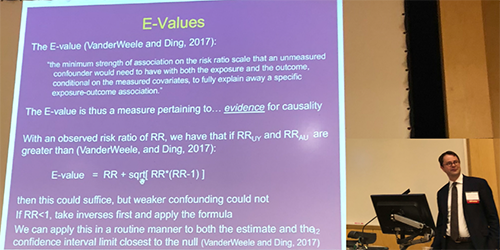
The keynote presentation by Tyler VanderWeele of the Harvard School of Public Health was discussed by Naihua Duan of Columbia University and focused on assessing mediation, interaction, and causation in the associations between religious service attendance and suicide. VanderWeele introduced a measure called the “E-value” that measures how robust an association is to potential unmeasured or uncontrolled confounding in observational values. The E-value is defined as the minimum strength of association that an unmeasured confounder would need to have with both the treatment and outcome to fully explain away a specific treatment-outcome association, conditional on the measured covariates. There was also speculation that the E-value had the potential of becoming a seminal statistical contribution and a tool to be widely used by the biomedical research community due to the ease of its interpretation and computation.
Other presentations on the first day were given by Danny Almirall of the University of Michigan, Susan Paddock of RAND Corporation, Haiqun Lin of Yale University, and Ian Barnett of the University of Pennsylvania and spanned topics in mixed-effects modeling in dynamic treatment regimes, causal inference for dynamic groups, multiple mediation analysis with latent groups, and change point detection in digital phenotyping.
The day ended with a joint poster session and happy hour. Several posters were presented by an eclectic group of emerging mental health researchers (graduate students and post-docs), established researchers, and faculty members. Dinner at the Beatrix restaurant and lively discussion at a local Irish bar wrapped up the evening.
The second day of the conference began with a group breakfast and networking. Presenters included Hendricks Brown of Northwestern University, Sherri Rose of Harvard University, Melanie Wall of Columbia University, and Mengling Liu of New York University and spanned presentations about the design of implementation trials, computational health economics and clinical informatics, empirical methods for detecting optimal diagnostic criteria, and mediation analysis with censored time-to-event mediator.
The symposium was hosted by Northwestern University Feinberg School of Medicine, cosponsored by the ASA’s Mental Health Statistics Section, and organized by Juned Siddique—former chair of the ASA Mental Health Statistics Section. This annual event was founded in 1999 by Thomas R. Ten Have and Eva Petkova as a forum for statisticians working in psychiatric research and, more generally, mental health research to discuss ideas about new statistical methodologies and challenges. Thomas Ten Have passed away in 2011. To honor his many statistical contributions to mental health research, the symposium was renamed the Thomas R. Ten Have Symposium on Statistics in Mental Health.
Leave a Reply