Contributed by Haim Bar and Dipak K. Dey, University of Connecticut
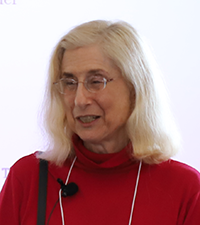
The 24th colloquium in the Distinguished Statistician Colloquium Series was held September 26–27 and featured Grace Wahba from the University of Wisconsin-Madison. Wahba is renowned for her work in statistical theory and the development of efficient numerical and statistical methods for large data sets. She has developed methods with applications in biostatistics, weather prediction, machine learning, and climate science.
The first day of the colloquium included a reception, interview of Wahba by Hao Helen Zhang from the University of Arizona and Yoonkyung Lee from The Ohio State University, and a banquet dinner. Introductions were given by Dipak Dey, UConn Board of Trustees Distinguished Professor of Statistics, and Kannan Natarajan, head of Global Biometrics and Data Management at Pfizer Inc. Xiao-Li Meng, professor of statistics at Harvard University and past president of the New England Statistical Society, delivered an entertaining speech and toast before dinner.
The colloquium and interview were filmed September 27 in UConn’s Dodd Research Center. The videos will be available on the Amstat News YouTube station.
Laura Freeman
Laura Freeman
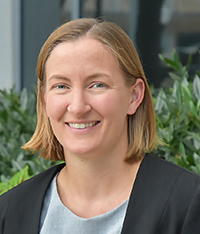
ASA member Laura Freeman was named the 2017 recipient of the Andrew J. Goodpaster Award for Excellence in Research. The award is presented annually to an individual demonstrating exceptional analytic achievement within the Institute for Defense Analyses research community.
James M. Lucas
James M. Lucas
The Statistics Division of the American Society for Quality (ASQ) named James M. Lucas the recipient of the 2018 William G. Hunter Award. The William G. Hunter Award was established by the Statistics Division in 1987 to recognize the many contributions of its founding chair at promoting the use of applied statistics and statistical thinking. The attributes that characterize Hunter’s career—consultant, educator for practitioners, communicator, and integrator of statistical thinking into other disciplines—are used to help decide the recipient.
Lucas is the principal at J. M. Lucas and Associates, a consulting firm in statistics and quality management. This firm implements business systems with statistical aspects. Before starting his consulting firm, Lucas was a senior consultant at DuPont’s Quality Management and Technology Center—where he conducted his early seminal work on applied statistics—for more than 20 years. Lucas’s research focuses on practical solutions to real-world problems, emphasizing the underlying science for the problem. He has successfully integrated statistical thinking with other disciplines throughout his career. For example, he was a major contributor to the development of statistical systems used throughout DuPont, including experimental design systems and statistical process control initiatives.
Lucas has been an adjunct professor at the University of Delaware and Drexel University. He has directed six PhD dissertations. He also is a fellow of the ASA and ASQ, an associate editor of Quality Technology, and a past associate editor of Chemometrics and Intelligent Laboratory Systems and Technometrics. He has more than 70 publications, and many are cited frequently. He authored the most-cited paper in two volumes of Technometrics and two volumes of the Journal of Quality Technology. He has won many awards, including the Shewhart Medal, Brumbaugh Award, H. O. Hartley Award, Ellis R. Ott Foundation Award, Don Owen Award, Shewell Award, and Youden Prize. Lucas holds a PhD in statistics from Texas A&M University, an MS in statistics from Yale University, and a BS in engineering from The Pennsylvania State University.
William R. Bell
William R. Bell, senior mathematical statistician for small-area estimation at the US Census Bureau, is the 2018 winner of the Roger Herriot Award. The award is conferred annually to a statistician who reflects the special characteristics that marked Roger Herriot’s career, including the following:
Dedication to the issues of measurement
Improvements in the efficiency of data collection programs
Improvements and use of statistical data for policy analysis
Bell is a distinguished statistician who is recognized around the world as a leader in small-area estimation and time series research. His work has had and continues to have an impact on the production of official statistics, most notably the production of poverty estimates for school-aged children.
Bell’s work was instrumental in the creation of the Small Area Income and Poverty Estimates (SAIPE) program. This was developed in 1997 to produce estimates of school-aged children in poverty as mandated by the Improving America’s Schools Act passed by Congress and further mandated in subsequent education bills. Bell’s contribution was to create a model-based framework that incorporated current survey data on child poverty—along with administrative records such as summaries of income tax data—to improve estimates previously based on only the last decennial census data.
In 2007, Bell spearheaded the work to incorporate data from the new American Community Survey (ACS) and adjust the methodology for the SAIPE estimates. The new survey was much larger in scale than the Current Population Survey. Using the new survey, the Census Bureau produced more accurate estimates of poverty for states and counties.
Before turning his attention to small-area estimation problems, Bell was a peerless researcher in time series analysis. He developed procedures for outlier identification and models for calendar effects in regARIMA time series. These models are still used today at statistical agencies and central banks around the world. His work with Mark Otto in developing a separate program for regARIMA model estimation forms the basis for the modeling module of the X-13ARIMA-SEATS seasonal adjustment software used in the United States and other countries for producing official seasonal adjustments.
Bell’s theoretical work in unobserved component models and signal extraction led to the development of the regCMPNT software, which estimates a time series. This model allows analysts to account for nonsampling error in survey estimates, which improves the estimates of seasonality and other components.
Bin Yu
Bin Yu is on a team of eight colleagues from the University of California, Berkeley; University of California, San Francisco; and Stanford who just received a highly selective Chan-Zuckerberg (CZ) Intercampus Research award for their proposal, “Multi-Scale Deep Learning and Single-Cell Models of Cardiovascular Health.” Only six awards were made from 83 applications. The CZ Biohub connects UC Berkeley, UCSF, and Stanford to conduct “research that helps solve big health problems” and “support the best and brightest biologists, scientists, engineers, and technologists.”
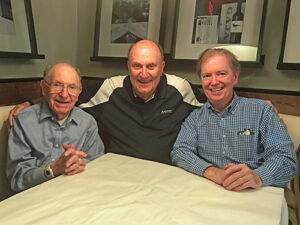
From left: John Neter, Michael Kutner, and Christopher Nachtsheim
Michael Kutner and Christopher Nachtsheim celebrated John Neter, a former ASA president, for his many contributions to the ASA and statistics profession on October 6 in Chapel Hill, North Carolina.


Leave a Reply