• Skip to main content
  • Skip to secondary menu
  • Skip to primary sidebar
  • Skip to footer
  • Homepage
  • About Us
  • Advertising
  • Submission Instructions
  • Editorial Calendar
Amstat News

Amstat News

The Membership Magazine of the American Statistical Association

  • Printed Issues
  • Practical Significance Podcast
  • Additional Features
  • Columns
  • Member News
  • Departments
You are here: Home / Featured Stories / (Bio)Statistics Bachelor’s Degrees Nearly Quintuple This Decade

(Bio)Statistics Bachelor’s Degrees Nearly Quintuple This Decade

December 1, 2019 Leave a Comment

Highlights from 2018 Degree Release

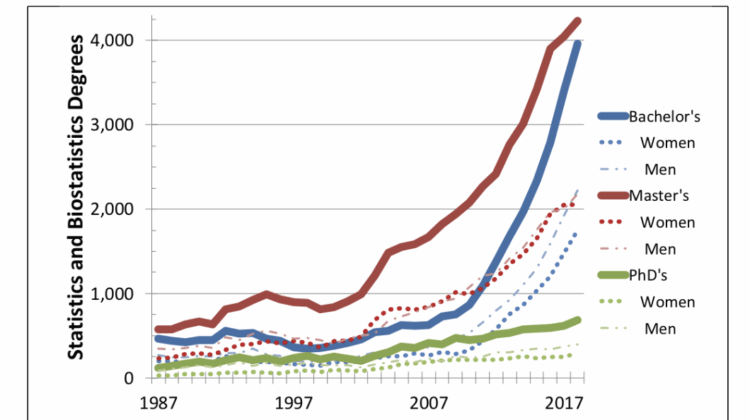
    The decade of statistics continues with strong growth in the number of statistics and biostatistics degrees awarded annually. According to the latest preliminary data release from the National Center for Education Statistics, bachelor’s degrees grew 17 percent from 2017 to 2018 to 3,964 (33 of which are for biostatistics) and master’s degrees increased 5 percent to 4,235 (720 for biostatistics). Doctoral degrees increased by 11 percent to 688 (206 for biostatistics), as seen in Figure 1.

    (Please click on the images to view the full-size figures.)
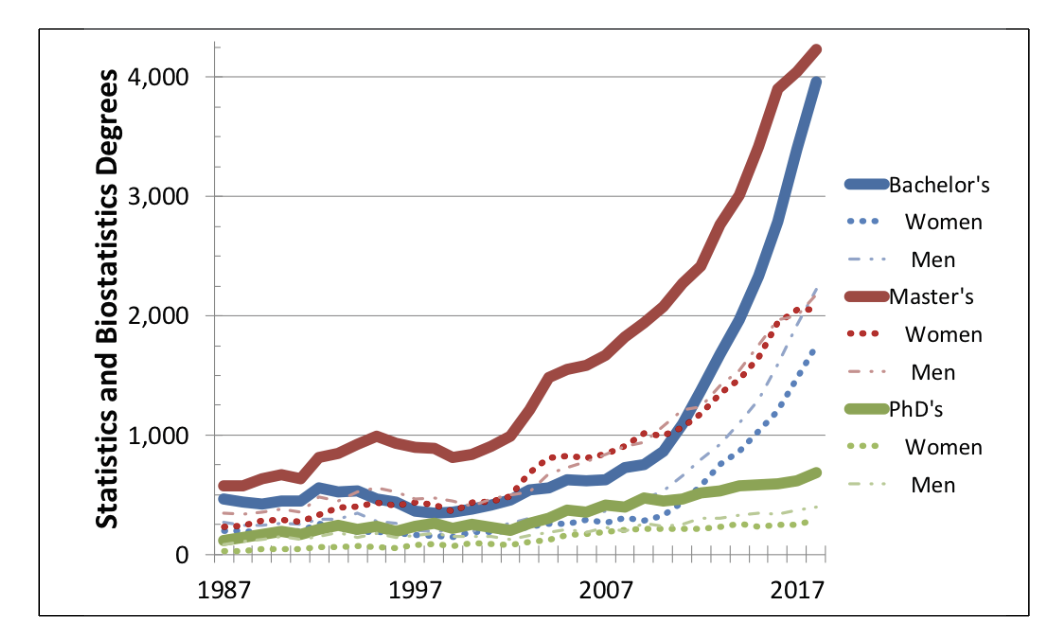
    Figure 1: Statistics and biostatistics degrees at the bachelor’s, master’s, and doctoral levels in the United States for 1987–2018. The dotted lines of matching colors are the number of degrees for that degree level earned by women. Source: NCES IPEDS

      The 2018 numbers for bachelor’s degrees are 4.6 times than that of 2010; for master’s, two times; and for doctoral, 1.5 times. Isolating on just biostatistics degrees, the growth for this decade has been a factor of 2.7 for bachelor’s (12 to 33), 2.2 for master’s, and 1.6 for doctoral, as shown in Figure 2. Isolating on statistics degrees, the number of annual bachelor’s degrees surpassed the number of master’s degrees for the first time since at least 1987 in 2017, as illustrated in Figure 3.
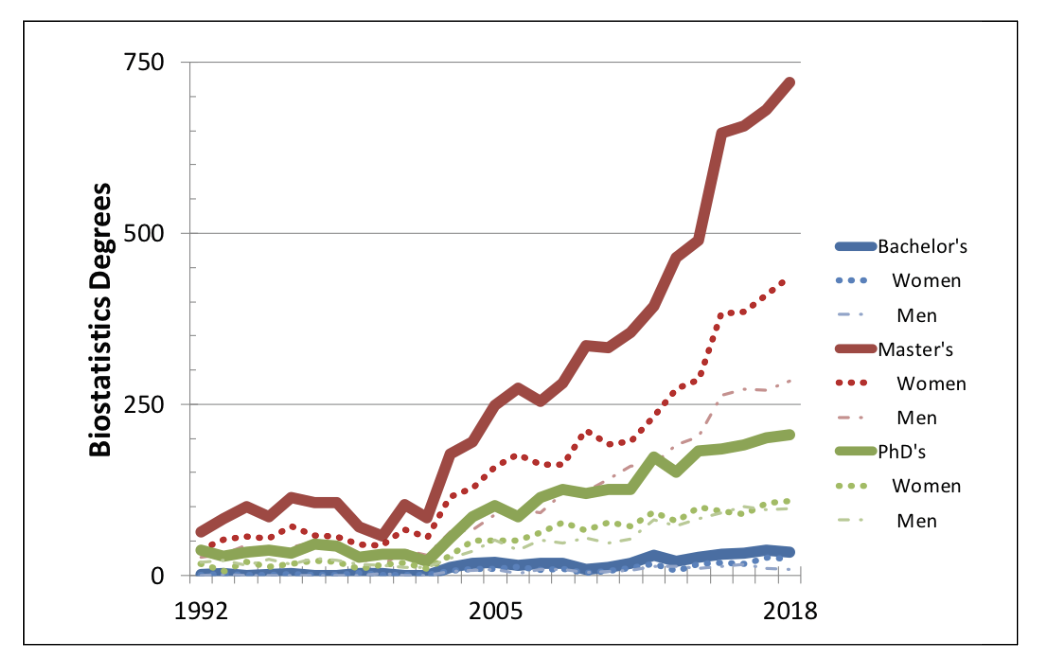
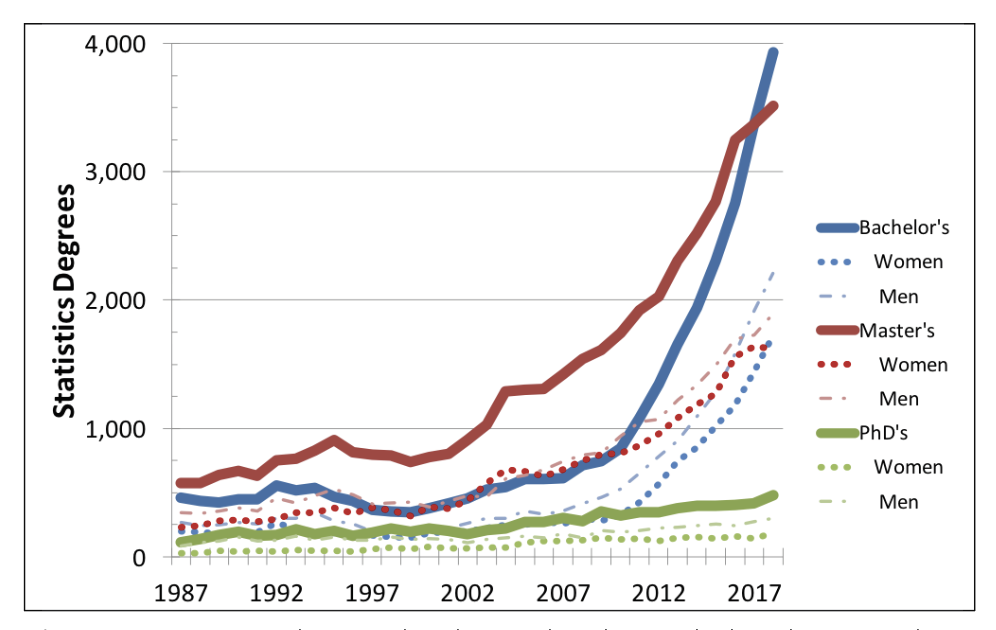
      Figure 2: Biostatistics degrees by degree level awarded in the United States. The dotted lines on matching colors are the number of degrees for that degree level earned by women.
        Figure 3: Statistics degrees by degree level awarded in the United States. The dotted lines on matching colors are the number of degrees for that degree level earned by women.

        The increase in the number of universities granting statistics and biostatistics degrees also continues steadily. For the period from 2017 to 2018, those granting bachelor’s degrees in statistics increased from 132 to 138, master’s degrees in statistics from 143 to 146, and doctoral degrees in statistics from 69 to 72, as seen in figures 4 and 5.
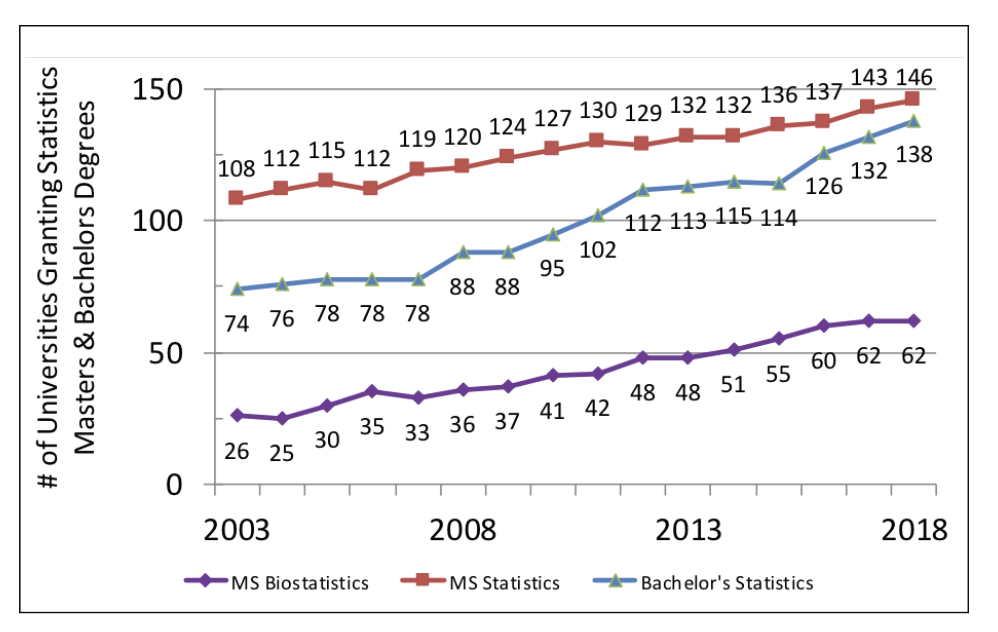
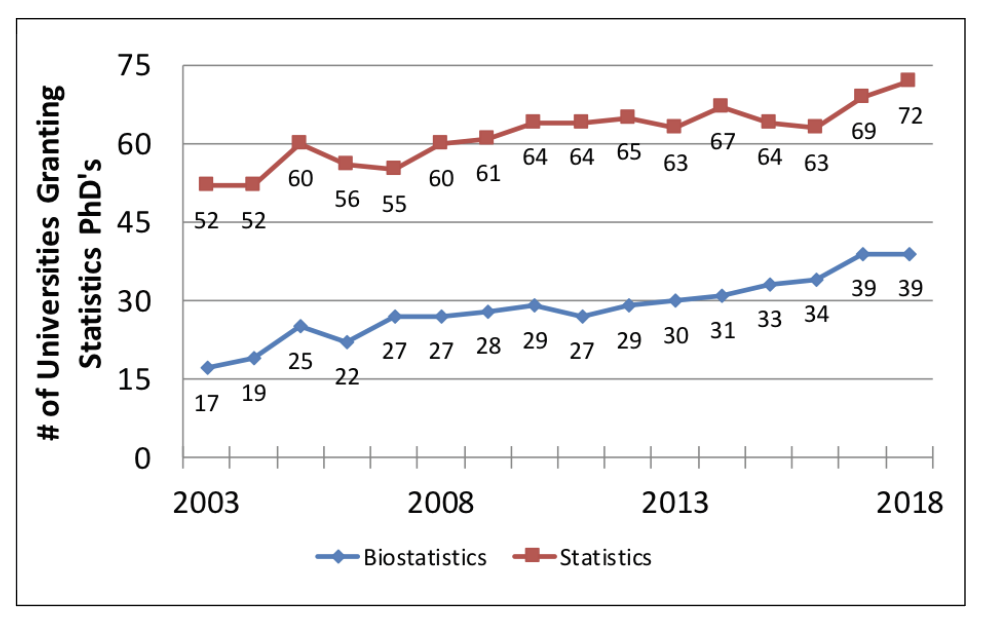
          Figure 4: The number of universities granting statistics and biostatistics master’s and bachelor’s degrees. Compiled from NCES IPEDS data.
          Figure 5: The number of universities granting statistics and biostatistics PhDs. Compiled from NCES IPEDS data.

            Twenty-three universities granted statistics and biostatistics degrees for the first time (at least since 2003) in 2018:

            • Bachelor’s degrees in biostatistics (1): Saint Louis University
            • Bachelor’s degrees in statistics (10): Arizona State University-Polytechnic, Jackson State University, Marquette University, The Pennsylvania State University-World Campus, Southeastern University, Texas A&M University, Truman State University, University at Buffalo, Ursinus College, Western Washington University
            • Master’s degrees in statistics (3): Wake Forest University, Western Illinois University, Claremont Graduate University
            • Master’s degrees in biostatistics (4): American University, Portland State University, University of California-San Diego, University of Miami
            • PhD in biostatistics (2): Southern Methodist University, University of Georgia
            • PhD in statistics (3): Central Michigan University, Indiana University, Washington University

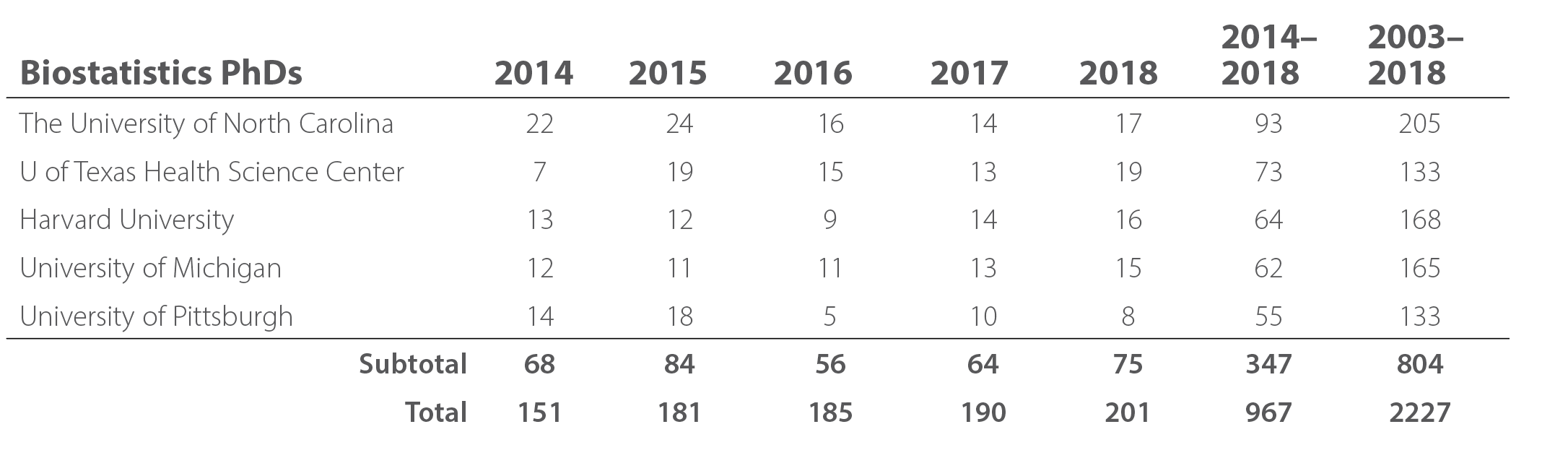
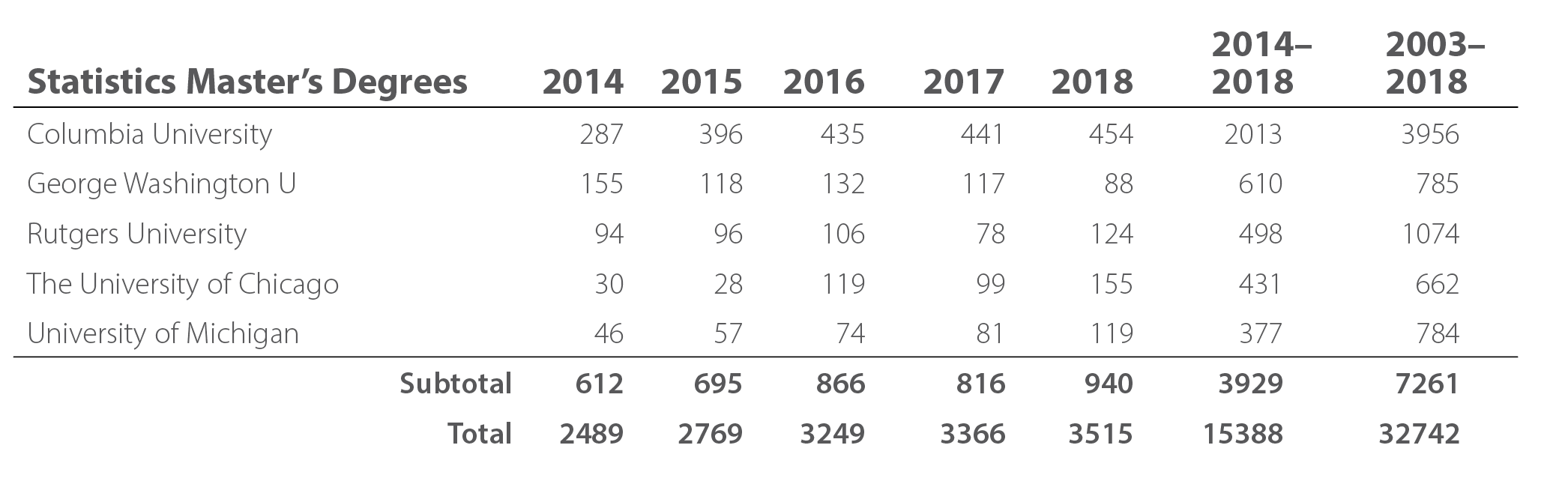
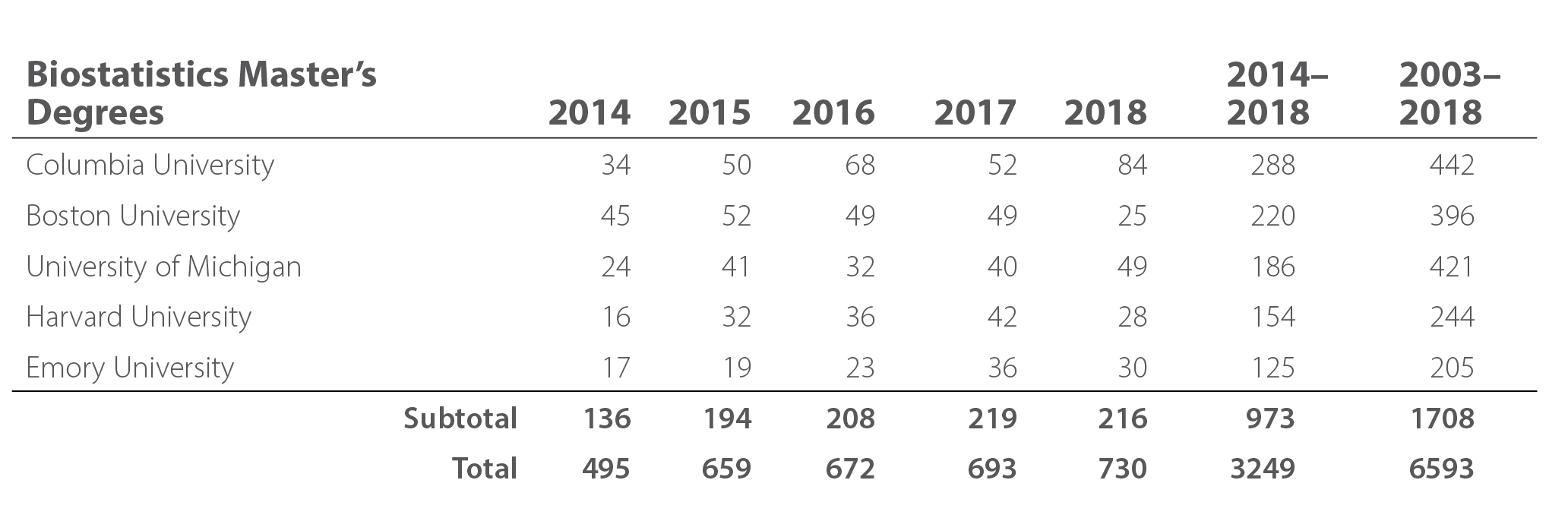
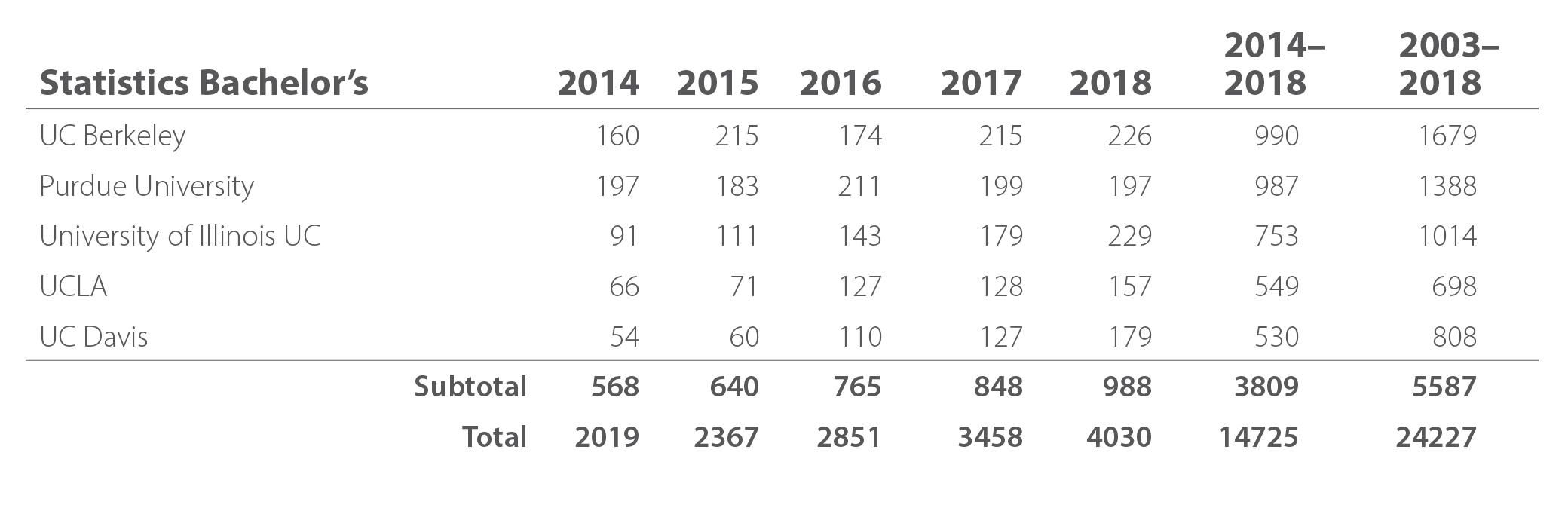
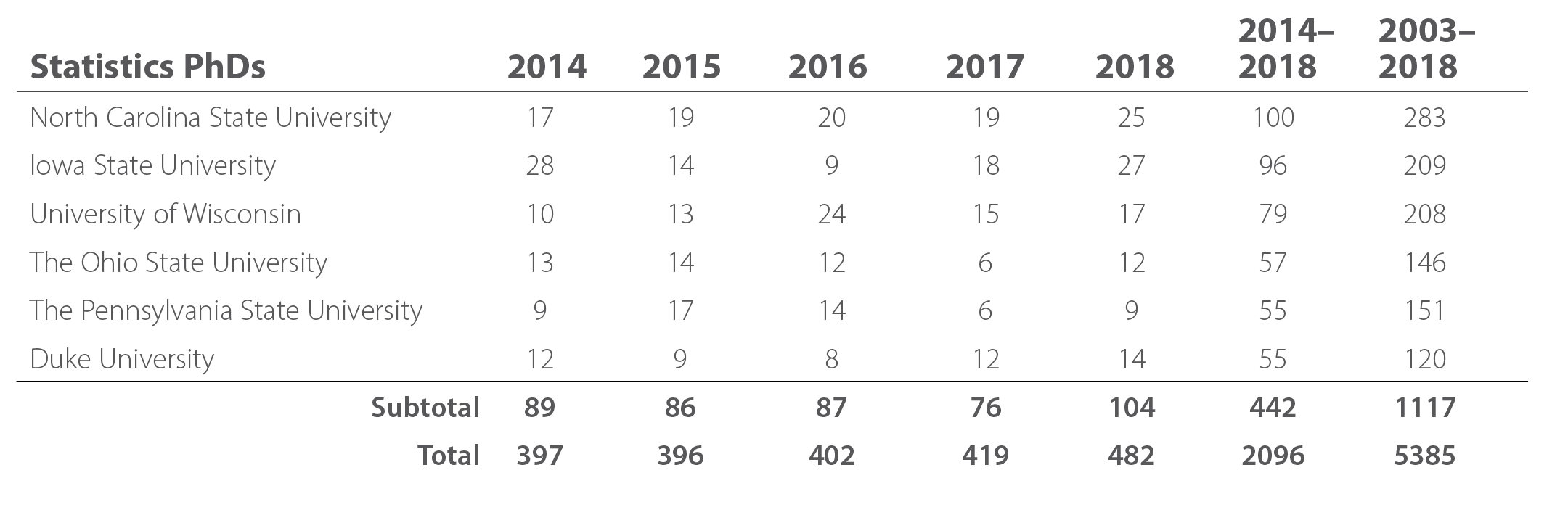
            The top degree-granting institutions over the last five years are in the following tables for all categories except biostatistics bachelor’s degrees. The comprehensive list is available.

            Tables 1–5: Top five universities granting statistics and biostatistics degrees for 2011–2015.
            (Please click on the images to view the full-size tables.)


            Demographics

            Following our practice to alternate demographics updates, we look at the breakdown of degrees earned by men and women this year. Last year’s update, which was based on 2017 degree data, had figures for the percentage of statistics and biostatistics degrees earned by nonresident aliens and for race and ethnicity data for the degrees granted to US citizens or residents. The race/ethnicity data has been updated with the 2018 data.
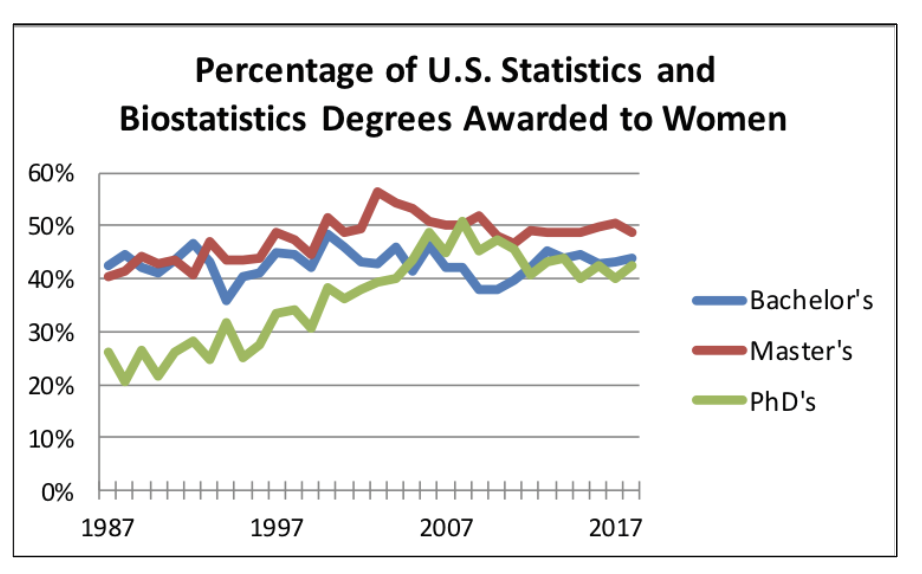
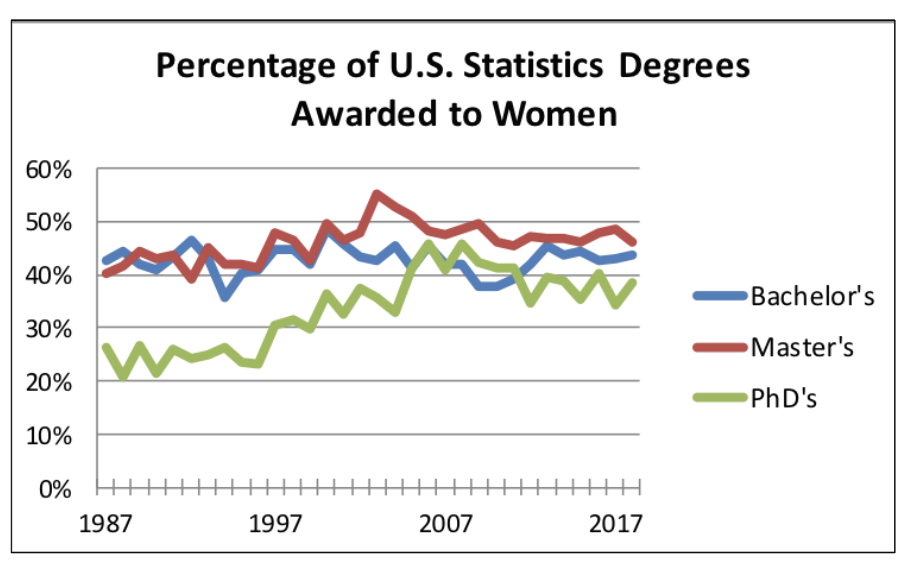
            Figure 6: Percentage of statistics and biostatistics degrees awarded to women by degree level for 1987–2018. Source: NCES IPEDS
              Figure 7: Percentage of statistics degrees awarded to women by degree level for 1987–2018. Source: NCES IPEDS
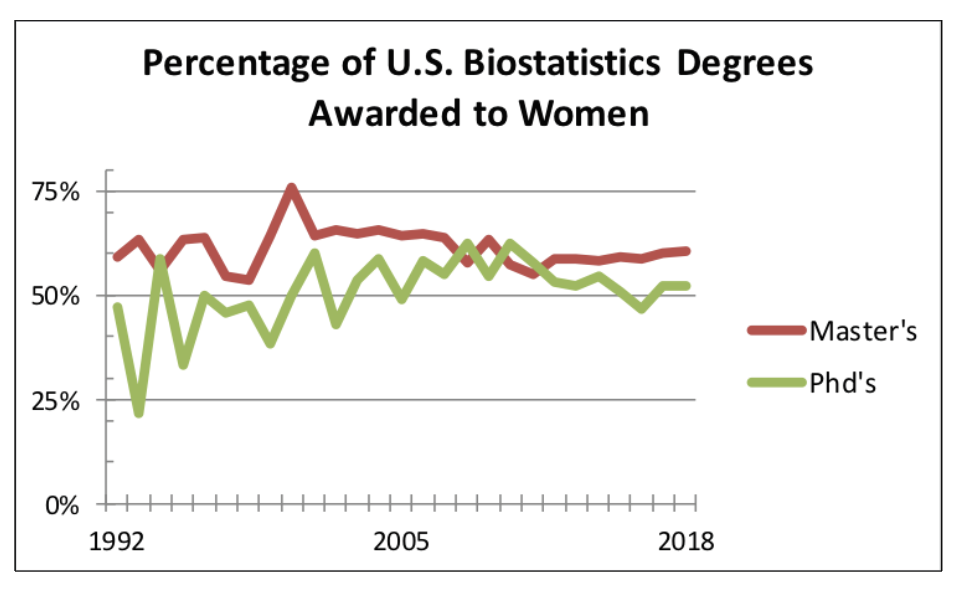
                Figure 8: Percentage of master’s and PhD biostatistics degrees awarded to women for 1992–2018. Source: NCES IPEDS
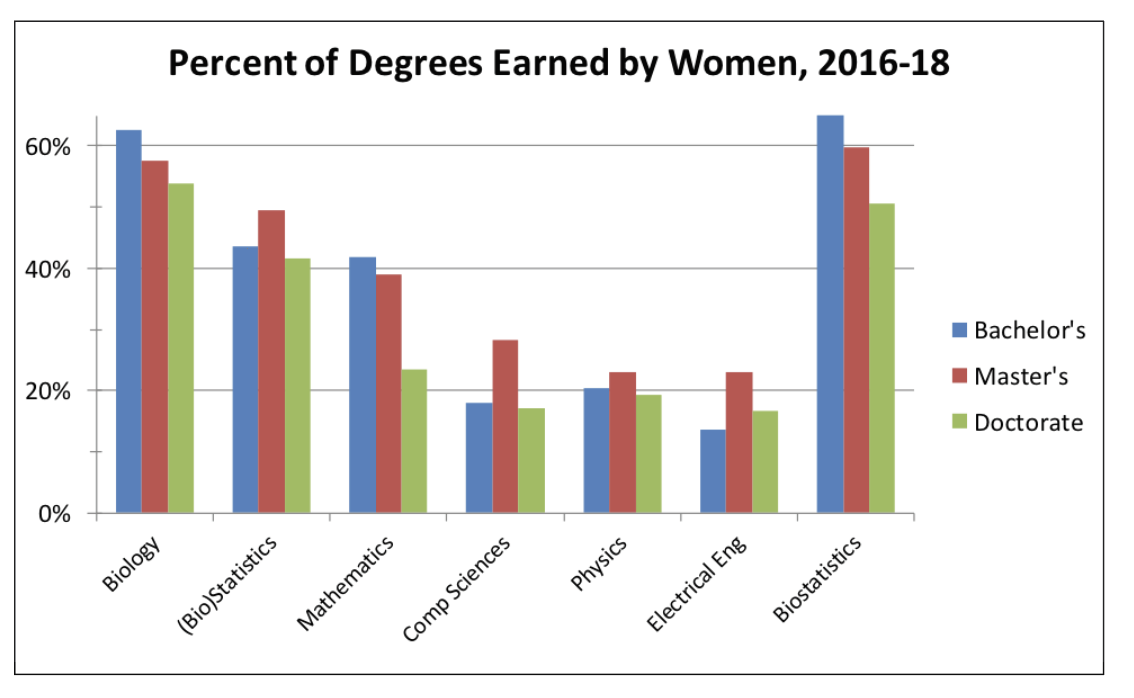
                  Figure 9: Percentage of statistics and biostatistics degrees earned by women compared with five much larger fields. “(Bio)Statistics” is both statistics and biostatistics. Source: NCES IPEDS using CIP code 11.07 for computer science, 14.10 for electrical engineering, 26.01 for biology, 27.01 for mathematics, and 40.08 for physics

                    Figures 6–8 show the percentage of degrees earned by women over time by degree level for combined statistics and biostatistics, statistics only, and biostatistics only. The percentage of women earning biostatistics degrees is higher than that of men for all degree levels. For statistics, the percentage of men earning degrees is higher at all levels. The percentage of PhDs earned by women has declined modestly over the last decade, while the same percentage for bachelor’s degrees has rebounded to prior levels. Nonetheless, the percentage of women earning statistics and biostatistics degrees is generally better than other quantitative STEM fields, especially at the graduate degree levels and for those in the physical, mathematical, and computer sciences, as illustrated in Figure 9.

                    Filed Under: Featured Stories, Previous Features Tagged With: Arizona State University-Polytechnic, biostatistics, degrees, Jackson State University, Marquette University, Southeastern University, statistics, Texas A&M University, The Pennsylvania State University-World Campus, Truman State University, University at Buffalo

                    Reader Interactions

                    Leave a Reply Cancel reply

                    Your email address will not be published. Required fields are marked *

                    Primary Sidebar

                    Search

                    More to See

                    Jennifer L. Green: The Collaborative Life of a Statistics Professor and Teacher Mentor

                    September 1, 2026 By Megan Murphy

                    Meetings, Manuscripts, and Meows: Spend a Day with Charlotte Walsh

                    September 1, 2026 By Megan Murphy

                    Students’ Statistical Thinking When Using Generative AI

                    September 1, 2026 By Megan Murphy

                    What Students Taught Me About Teaching Statistics

                    September 1, 2026 By Megan Murphy

                    STATAcorp. Efficiency matters. Stata is easy to use, so you spend less time learning software and more time focusing on your research
                    Data Science Certification

                    ASA HOME

                    American Statistical Association

                    Communications from the Executive Director

                    ASA Leader Hub

                    ASA Career Connect

                    ADVERTISERS

                    STATA
                    SIAM

                    Archives

                    Categories

                    Footer

                    Editorial Staff

                    Managing Editor
                    Megan Murphy

                    Graphic Designers / Production Coordinators
                    Olivia Brown
                    Meg Ruyle

                    Communications Strategist
                    Val Nirala

                    Advertising Manager
                    Christina Bonner

                    Contributing Staff Members
                    Kim Gilliam

                    American Statistical Association
                    277 South Washington Street, Suite 370
                    Alexandria, VA 22314-3646
                    Phone: (703) 302-1857


                    Copyright © 2026 · Magazine Pro on Genesis Framework · WordPress · Log in