
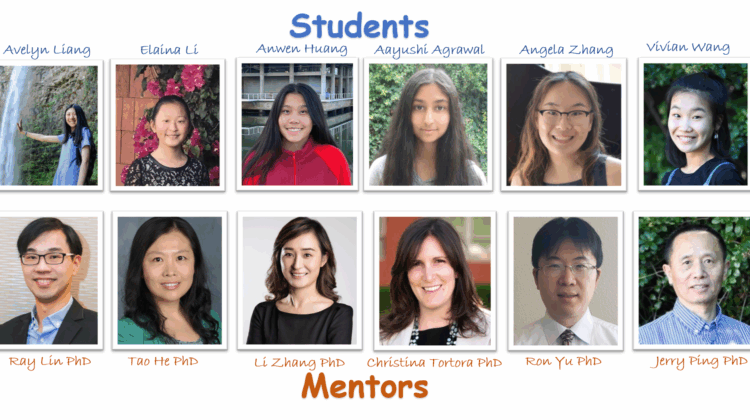
Anwen Huang, Elaina Li, Avelyn Liang, Aayushi Agrawal, Angela Zhang, Vivian Wang, and Li Zhang
Despite the obstacles COVID-19 has introduced this year, SFASA continued its K–12 student summer project program for the second year. First organized by Li Zhang—former president of SFASA—in 2019, this program consists of student-designed projects completed under the mentorship of SFASA officers.
This year’s program began with a virtual kickoff meeting on June 4, during which students were introduced to the program and assigned mentors. Working with their respective mentors, the students brainstormed topics for their projects. In the week that followed, students and their mentors worked together to finalize their project topics, study design, and data sources by group.
Over the summer, students worked on their projects and had group meetings every few weeks. All projects were survey-based. Students designed their own surveys and collected the data through Google forms with the guidance of their mentors. The students were able to use Excel to perform the data analysis, and most of them performed formal statistical hypothesis testing. A video conference was held August 9 to share the final presentations. It was open to all SFASA members and attracted around 30 attendees.
Elaina Li (7th grader, Mentor: Tao He, SFASA president/San Francisco State University) and Avelyn Liang (9th grader, Mentor: Ray Lin, SFASA president-elect/Genentech/Roche) presented their work about teenagers’ experiences with distance learning, which suggested distance learning is less effective than regular school, but students preferred the less difficult assignments and more lenient grading.
Angela Zhang (11th grader, Mentor: Ron Yu, SFASA past president/Gilead Sciences) investigated teenagers’ daily lives before and during distance learning. The data showed an increase in social media app usage, hours of sleep, and time spent with family and a decrease in time spent on homework, time spent with friends, motivation to do homework/classwork, and stress levels.
Anwen Huang (11th grader, Mentor: Li Zhang, SFASA director of public relations/University of California at San Francisco) presented on the impact of the COVID-19 pandemic on product purchases. She found that purchase frequency had a statistically significant change during shelter-in-place compared to before the pandemic.
Vivian Wang (10th grader, Mentor: Jerry Ping, AbbVie) was interested in a pandemic’s impact on social relationships. She concluded there was a decrease in students’ time spent with friends during shelter-in-place. In particular, younger students weren’t able to make new friends. As expected, there was an increase in time spent and closeness with family.
Aayushi Agrawal (11th grader, Mentor: Cristina Tortora, SFASA vice president/San Jose State University) used US Census data to assess the economic impact of COVID-19 on minorities and noticed a greatly increased education gap, increased unemployment among Asians in lower education levels, and increased gap in unemployment between men and women.
All students were self-motivated and contacted their mentors spontaneously to discuss questions they had. The mentors were impressed by what the students accomplished during the two-month summer break. Wang said, “Through this project, I was able to learn a lot about data collection, data handling, data analysis, and effective presentation methods. … I had a good experience and gained a lot from participating in this summer program!”
With the guidance of their mentors, students were able to learn new statistical techniques. Liang said, “Throughout this project, I learned more about how statistics work and how to analyze the data. My mentors taught me many components of statistics such as the usage of paired t-tests, variance, p-values, and how to quantify data. I felt that this experience made me more interested in this field of study …” Agrawal added, “Having taken AP Statistics prior to this project, I had already learnt many of the fundamentals of statistics, but I was given the opportunity to apply what I had learnt to a real-life scenario that I was interested in.”
This project also gave students a new view of the use of statistics in their lives. “After completing this SFASA project, I realized that statistics is so close to real life, way beyond placing bets on roulette wheels, poker tables, sports games, or predicting the weather; it touches so many aspects of life,” said Angela Zhang. “From this project, it has taught me to understand how to transform qualitative information from our daily lives into quantitative data to be analyzed by statistics,” she continued.
Both collaboration and mentorship had a significant impact on the students. Li said, “This summer project was unique and meaningful because we would not usually do such statistical projects at school. It was not only a great training, but also a collaborative experience. I am grateful for this opportunity to participate in this project, which introduced me to new domains related to statistics and the art of collaboration.”
Huang said, “Along the way, I learned many important things about conducting studies and got to experience hands-on what it was like to complete a study from start to finish. While I did encounter some hurdles along the way, my mentor was always there to help me overcome them, and through this process of revisions and editing, I was able to present a high-quality project during the final presentation seminar. This experience is unique in its personal one-on-one mentorship and a valuable opportunity for anyone interested in exploring the statistical field.”
Leave a Reply