
Penny S. Reynolds, University of Florida College of Medicine
1815
Ada King, Countess of Lovelace, was born. Known for her work on Charles Babbage’s ‘analytical engine’ and her published algorithm (‘Note G’), which was used for calculating a sequence of Bernoulli numbers with loops and branching and recognized as the first computer program. Far ahead of her time, she also predicted such programs would be able to output symbols and numbers and even compose elaborate pieces of music.
1877
Edward C. D. Molina was born. ASA Fellow 1945. A pioneer of statistical engineering, he championed application of advanced probability methods to telecommunication research and development.
1891
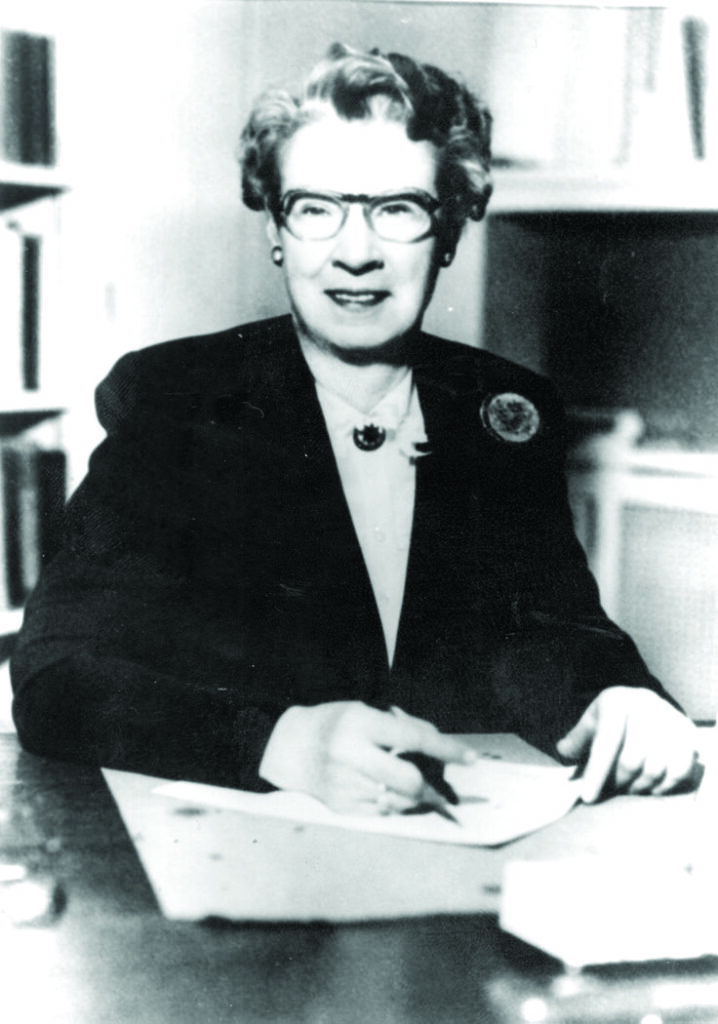
Helen Walker was born. In 1944, she became the first female ASA president. She was also an ASA Fellow best known for research in education and the history of statistics.
1895
Lancelot Hogben was born. Medical statistician and inventor of the N-of-1 clinical trial, he is better known for his arguments against the tyranny of averages, forceful attacks on the eugenics movement, and warnings about the dangers of poor statistical inference.
1897
Arthur L. Bowley introduced the concept of bias as differences in estimate errors due to bias, conscious or unconscious, on the part of the investigator.
1899
G. Udny Yule introduced a method for determining association of attributes for studying the relationship of two categorical variables. He described a variety of applications, including Darwin’s plant fertilization data, temper in fraternities, inheritance of artistic faculty, and low nutrition and dullness associated with age and sex.
1915
Lila Elveback was born. ASA Fellow 1970. One of the founding directors of the American College of Epidemiology, she is best known for significant contributions to medical statistics and the promotion of high-quality statistical research at the Mayo Clinic.
1917
Thomas C. Chalmers was born. Founder of the Mt. Sinai Department of Biostatistics, he was a pioneer in the application of randomized controlled trials and meta-analysis for evaluation of medical therapeutics.
1921
Geoff Watson was born. Best known as codeveloper with James Durbin of their eponymous statistic for detecting autocorrelation in least squares regression. Watson became an ASA Fellow in 1966.
1922
Edward H. Simpson was born. Best known for Simpson’s paradox (developed when a graduate student at Cambridge) and Simpson’s diversity index. He was a Bletchley Park codebreaker during World War II.
Martin B. Wilk was born in Canada. ASA Fellow 1962. From 1980–1985, he was chief statistician of Canada and is best known for developing the Shapiro-Wilk test with Samuel Shapiro and Q-Q and P-P plots for graphical comparison of probability distributions with Ramanathan Gnanadesikan.
1923
Janet L. Norwood was born. ASA president 1989. She is best known for being the first female commissioner at the Bureau of Labor Statistics and improving the quality of bureau statistical indicators. The New York Times wrote Norwood once observed, “You can’t have a democratic society without having a good data base.”
William S. Gosset (under the pseudonym Student) published the first modern-looking ANOVA table. It was a footnote in a 22-page paper on development of statistical tests for determining the most cost-effective grain varieties. He credits R. A. Fisher for correcting mistakes in the original formulation.
1946
Churchill Eisenhart (ASA Fellow 1943, ASA president 1971) presents a paper to the ASA describing the assumptions underlying ANOVA when used for statistical inference: random variables, additivity, homoscedasticity, and normality. He distinguishes Model I from Model II ANOVA based on differences in the expected variance components, all illustrated with (hand-written) ANOVA tables.
1964
Maurice Bartlett gives the first R. A. Fisher Memorial Lecture at a joint session of the ASA, Institute of Mathematical Statistics, and Biometrics Society. In June of 2020, the award was renamed the COPSS Distinguished Achievement Award and Lectureship.
Did You Know?
At its founding in 1839, the American Statistical Association was called the American Statistical Society. However, it soon dawned on the founding members that the acronym would lead to unfortunate connotations. The name was officially changed in 1840.
Between 1836 and 1851, other statistical societies formed in the United States but only the ASA remains. Despite having little funding and only a handful of members, the ASA managed to hold on through its first 50 years. Edward Jarvis, the third ASA president who served for more than three decades, was instrumental in keeping the society alive, often shouldering much of the effort himself.
In 1908, Carroll D. Wright, the ASA’s fifth president (1897–1909), broke tradition by holding the annual meeting in Atlantic City, New Jersey—the first outside Washington, DC, or Boston, Massachusetts—and introduced the yearly ASA President’s Address.
Leave a Reply