
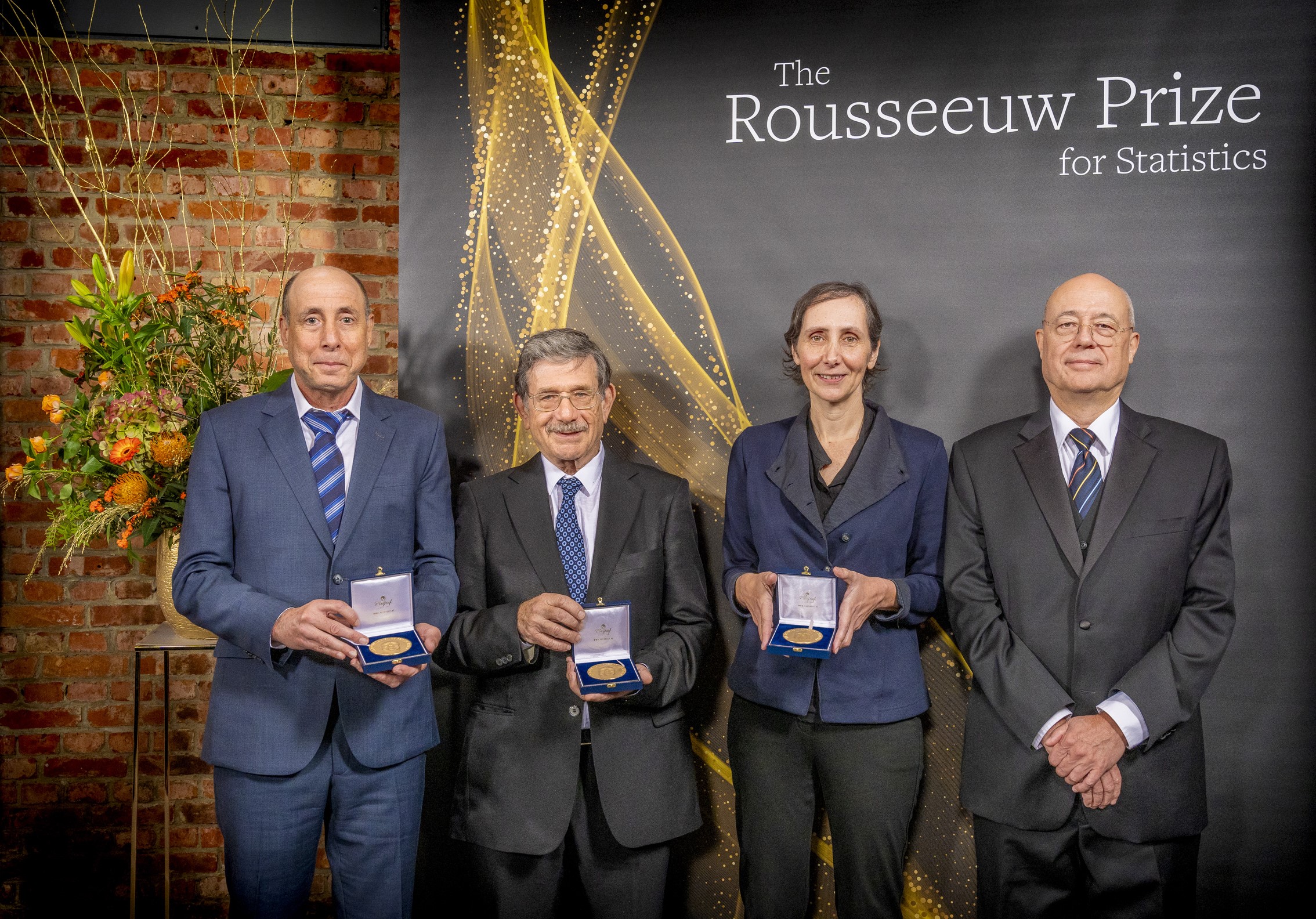
The second Rousseeuw Prize for Statistics ceremony took place on December 3, 2024, in Leuven, Belgium, recognizing groundbreaking contributions to statistical research.
This year’s prize honored Yoav Benjamini, Daniel Yekutieli, and Ruth Heller of Tel Aviv University for their pioneering work on the false discovery rate—a concept that has transformed how scientists handle multiple hypothesis testing.
First introduced in a 1995 paper by Benjamini and Yosef Hochberg, FDR addresses a major challenge in scientific research: the risk of false discoveries when testing multiple hypotheses. Traditional methods, which strictly controlled the probability of making even one false discovery (family-wise error rate), often proved too conservative, limiting researchers’ ability to identify true findings. In contrast, FDR strikes a balance, allowing researchers to manage errors while maximizing valid discoveries.
Benjamini and Hochberg’s method adapts based on data, providing a more flexible and accurate approach to statistical analysis. The impact of this work has been seen in data-heavy fields such as genomics and brain research, where distinguishing true signals from noise is critical. Over the years, Benjamini, Yekutieli, and Heller have expanded the FDR framework, developing new methodologies that continue to shape modern statistics.
The ceremony opened with remarks from Peter Rousseeuw, who emphasized the importance of recognizing statistical achievements. “The existence of a major award has an encouraging effect on its field,” he noted. “Nobel Prizes have elevated other disciplines, attracting students, bright researchers, and funding. Statistics deserves the same recognition.” He expressed hope that the Rousseeuw Prize would raise awareness of the field’s intellectual depth and its vital role in scientific progress.
David Hand of Imperial College London introduced the laureates before they received the $1 million prize, which is awarded biennially by the King Baudouin Foundation. The inaugural 2022 prize recognized advancements in causal inference, while this year’s award highlights the lasting significance of FDR methods in statistical science.
Leave a Reply