
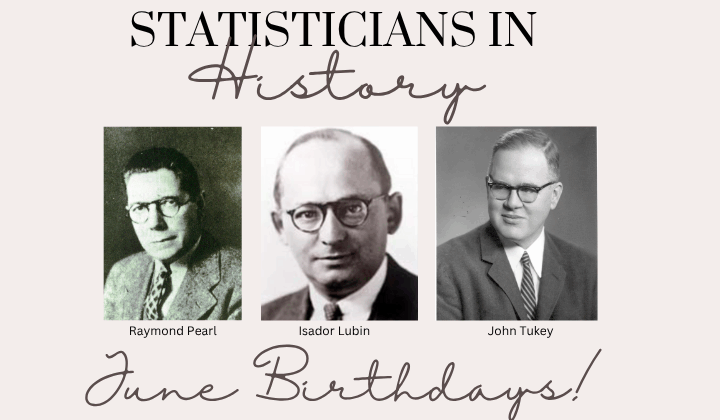
Penny S. Reynolds, University of Florida College of Medicine
JUNE BIRTHDAY
1623 Blaise Pascal is best known for developing foundational concepts for modern probability in 1654 in a series of letters with Pierre Fermat. He also developed an early mechanical calculator in 1642 and was a prolific writer; his work Pensées is considered by some a masterpiece of French prose.
1781 Siméon-Denis Poisson, whose name is most associated with the Poisson distribution. It was developed to model jury decision-making but gained traction in 1898 with Bortkiewicz’s analysis of Prussian horse kick data. Another example of Stigler’s Law of Eponomy, it had already been derived in 1711 by Abraham de Moivre. It was independently rediscovered in 1908 by Ed Molina.
1787 William Cogswell was one of the five original founders of the ASA. A preacher, not a mathematician, he shared with the other founders the belief that society and the social order could be best represented by numerical information—statistics in the original meaning.
1858 Alice Lee was one of the first women to graduate from University of London, working with Karl Pearson for most of her career. Her doctoral research outraged her (male) examiners, as it demonstrated that skull volume and intelligence were uncorrelated. Craniometry was used to ‘scientifically prove’ both genius and the inferiority of women and minorities.
1860 Thomas Bassett Macaulay was an inaugural 1914 ASA Fellow, one of four Canadian charter members, first Canadian president of the Actuarial Society of America in 1899, and president of Sun Life Assurance Company of Canada. In 1961, he was inducted into the Canadian Agricultural Hall of Fame for his contributions to Holstein cattle breeding
1866 Charles Davenport, ASA Fellow 1921. Director of Cold Spring Harbor Labs, he introduced Galton and Pearson’s biometric methods to America. A keen proponent of eugenics, his so-called ‘scientific’ justifications for reducing the population of ‘degenerates’ affected US policy on race and immigration for decades and were models for Nazi extermination programs.
1876 William Sealy Gosset, one of the first modern industrial statisticians, is best known as “Student” and for developing Student’s t-statistic and t-distribution while working for Guinness Brewery. Fisher said he was “one of the most original minds in contemporary science.”
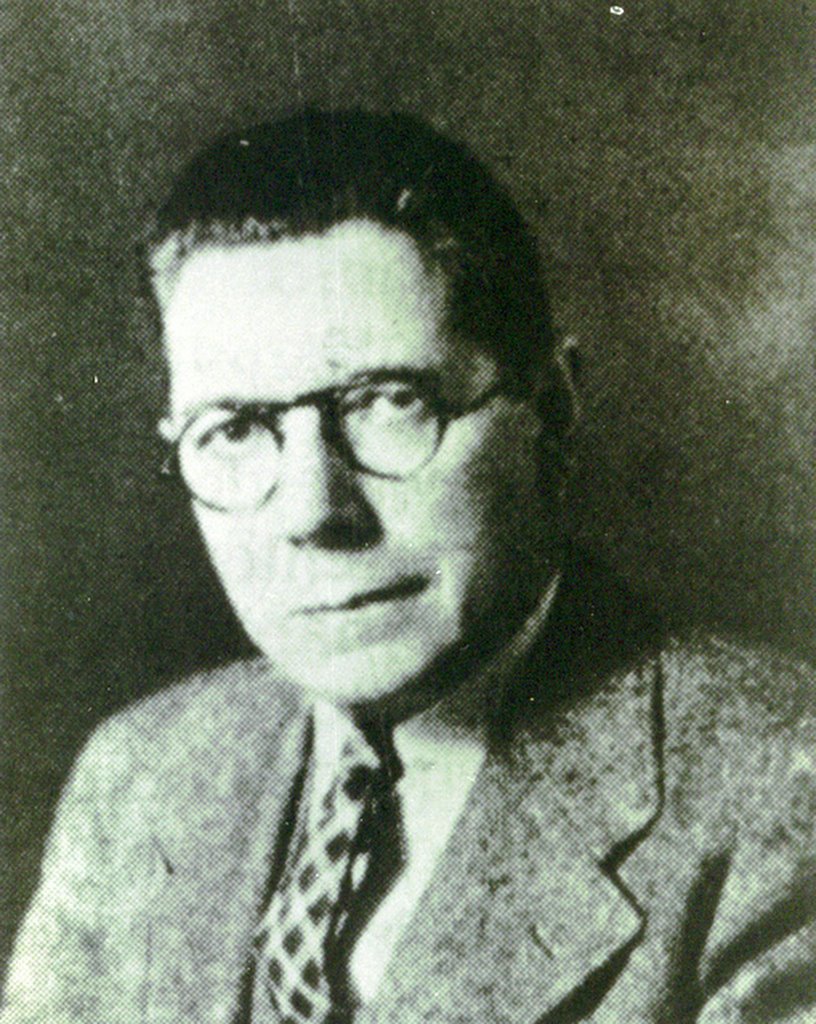
1879 Raymond Pearl, ASA Fellow 1920; ASA President 1939; Chief of the Statistical Division of the US Food Administration 1917–1919. One of the first biostatisticians to combine mathematics and statistics to interpret population genetics, he is best known for the Pearl-Reed-Verhulst logistic growth model.
1880 Willford Isbell King, ASA Fellow 1917; ASA President 1935. Political economist and statistician for the US Public Health Service, he may be best known for trying to take ASA funding support from the Annals of Mathematical Statistics in 1933 after endorsing it in 1930.
1881 Hilda Hudson, a distinguished mathematician and pioneer of quantitative aeronautical engineering, also developed the classic SIR model of epidemic infectious disease with Ronald Ross in 1916–1917.
1883 Mary van Kleeck, ASA Fellow 1945; Chair, ASA Committee on Governmental and Labor Statistics. Labor and women’s rights advocate and architect of the 1938 Fair Labor Standards Act, she exposed exploitation and abuse of workers through novel application of mixed quantitative and qualitative methodology.
1886 William Fielding Ogburn, ASA Fellow 1920; ASA President 1931; editor of the Journal of the American Statistical Association 1920–1926. One of most prolific sociologists of his generation, he is best known for the concept of “cultural lag” and social evolution through invention, accumulation, diffusion, and adjustment.
1893 Prasanta Chandra Mahalanobis, ASA Fellow 1961; Royal Statistical Society Fellow 1954. Father of statistics in India and founder of the Indian Statistical Institute and journal Sankhyā. Best known for the Mahalanobis distance and Feldman-Mahalanobis model.
1895 Charles P. Winsor ASA Fellow 1949. Best known for developing the method of winsorization, or “clipping,” of outliers by setting them to prespecified percentiles of the data.
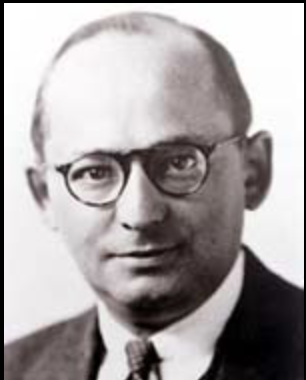
1896 Isador Lubin, ASA Fellow 1944; ASA President 1946. Head of Bureau of Labor Statistics 1933–1946.
1900 Samuel A. Stouffer, ASA Fellow 1940. Best known for his method of combining p-values from independent statistical tests as a test of the joint null. He also developed novel survey instruments and performed the first large-scale survey of soldier health.
1910 Maurice S. Bartlett, ASA Fellow 1951; Guy Silver and Gold Medals; RSS President 1966. Best known for Bartlett’s test for homogeneity of variances; he introduced Monte Carlo methods to ecology and epidemiology and did work on stochastic processes, time series, and multivariate analyses.
1912 Alan Turing, father of AI and theoretical computer science. The leader of Bletchley Park codebreaking efforts during WWII, his contributions to probability and statistics are almost unknown, as most of these papers were classified until the 1980s. He developed sequential analysis (independent of Abraham Wald) and, with Jack Good, the Bayesian and Good-Turing frequency estimation.

1915 John Tukey, ASA Fellow 1949; US National Medal of Science 1973. Although he claimed to loathe theoretical statistics for not informing data analysis, he made important contributions to simultaneous inference, time series (fast Fourier transform, spectrum analysis), and ANOVA (coined the acronym). He was a pioneer in both computational statistics (coining the terms “bit” for binary digit and “software”) and interactive computer graphics, which he considered central to exploratory data analysis.
1916 David B. Duncan, ASA Fellow 1962. Best known for the Duncan multiple range test and the k-ratio t-test (the first Bayesian multiple comparison procedure).
1919 Charlotte Kipling, RSS Fellow. Pioneered statistical methods for long-term population studies of freshwater fish (Lake Windermere Perch and Pike Project) to show how fish populations react to habitat change and overfishing.
1923 James Durbin, ASA Fellow 1960; one of the few winners of all three Guy medals; President, RSS 1986. With Geoff Watson, best known for the 1950 eponymous bounds test for serial correlation in regression.
1926 Marie D. Eldridge, ASA Fellow 1969; Director, Statistics and Analysis, National Highway Traffic Safety Administration; Director, Research Triangle Institute; President, Washington Statistical Society
1927 Sylvia Ostry, ASA Fellow 1972; Chief Statistician of Canada, 1972–1975. Distinguished economist and academic, government, and nongovernmental organization leader. Chief economist of OECD Paris.
1934 Michael Hills is best known for his classic book with David Clayton, Statistical Models in Epidemiology, link between statistical modeling, estimation, and epidemiology.
JUNE EVENTS
1676 In a June letter to Henry Oldenburg, secretary of the Royal Society, Isaac Newton describes his discovery of the general binomial theorem 12 years earlier and first uses modern notation for negative integers as exponents. (Nicolas Chuquet had already proposed the concept in 1484.)
1822 On June 14, Charles Babbage reads a one-page note to the Royal Astronomical Society in which he proposes a computational “Difference Engine,” a precursor to the modern computer. It was never completed. In 2002, the British Science Museum finally finished construction of a working model from Babbage’s drawings.
1833 On June 5, the 17-year-old Ada Byron (later Ada King, Countess of Lovelace) meets Charles Babbage for the first time at a social function. They corresponded for many years. In several letters, she complains that Babbage messed up her calculations.
1873 James Thomson, father of Lord Kelvin, introduces the term “radian” (a contraction of radial angle) in exams set for students at Queens College Belfast. Lord Kelvin may have been first to use the term during lectures as a verbal convenience.
1884 On June 27, US President Chester Arthur signs a bill into law (23 Stat. 60) creating the Bureau of Labor Statistics, one of the oldest statistical agencies in the government.
1885 In June 22–24, the Statistical Society of London publishes the Jubilee Volume. It is notable for featuring “Methods of Statistics” by Francis Y. Edgeworth, the first in-depth discussion of mathematical statistics at the society.
1885 Official founding of the International Statistical Institute on June 24 during the London Statistical Society Jubilee celebration meetings. The first president is Sir Rawson W. Rawson.
1901 On June 20, Karl Pearson reads a paper to the Royal Society describing a series of experiments quantifying inter-observer measurement error, using a device constructed by Horace Darwin.
1905 Karl Pearson introduces the terms “kurtosis,” “leptokurtic,” “platykurtic” and “mesokurtic” to describe shapes of skewed frequency distributions and explains the need for generalized families of frequency curves.
1934 Doomed to mediocrity or regression to the mean? Harold Hotelling (ASA Fellow, 1937) writes a polite but devasting critique on the 1933 book The Triumph of Mediocrity in Business by Horace Secrist (ASA Fellow, 1918). Secrist claimed that, under free enterprise, competition caused strong businesses to decline and weak to improve. Hotelling showed the effect was due to regression to the mean and, incidentally, Secrist had wasted 10 years of work in misunderstanding his own data.
1934 On June 19, Jerzy Neyman (1894–1981) reads his paper to the Royal Statistical Society in which he describes his groundbreaking method of stratified sampling, leading to modern probability-based population sampling methods.
1937 On June 17, Jerzy Neyman introduces the confidence interval in a talk given at the Royal Statistical Society. Listeners are not enthusiastic. AJ Bowley wonders aloud if confidence intervals are just a “confidence trick” and doubted their validity and use.
1948 William Feller (ASA Fellow, 1939) publishes a unified derivation for what is now known as the Kolmogorov-Smirnov goodness-of-fit test. He combined and simplified the proofs derived by Andrei Kolmogorov (published in Italian in 1933) and Nikolai Smirnov in 1939. Widespread adoption follows when Frank Massey (ASA Fellow, 1966) presents a practical description with examples in 1951.
1949 The term “frequentist” is first used by Maurice Kendall (ASA Fellow, 1950): “It might be thought that the differences between the frequentists [Venn, Neyman, and von Mises] and the non-frequentists (if I may call them such) [Jeffreys] are largely due to the differences of the domains which they purport to cover.”
1958 Ed Kaplan and Paul Meier (ASA Fellow, 1959) publish their now-famous Kaplan-Meier method for the analysis of censored observations. It took more than 12 years to become one of the most-cited statistical papers of all time after it was recognized as a useful tool for survival analysis in clinical studies.

1990 During the annual meeting on June 5, the Statistical Society of Canada is formally presented with the Letters Patent conferring the SSC Coat of Arms. It was designed by Charles Maier, Royal Heraldry Society of Canada. How many statistics-related items can you spot?
Download the answers.
View this month’s references.
Leave a Reply