
Maureen Mayer, Jianchang Lin, Wenting Cheng, and Gautier Paux
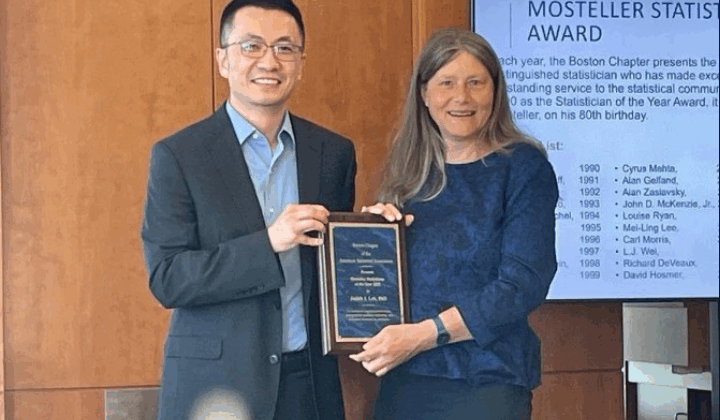
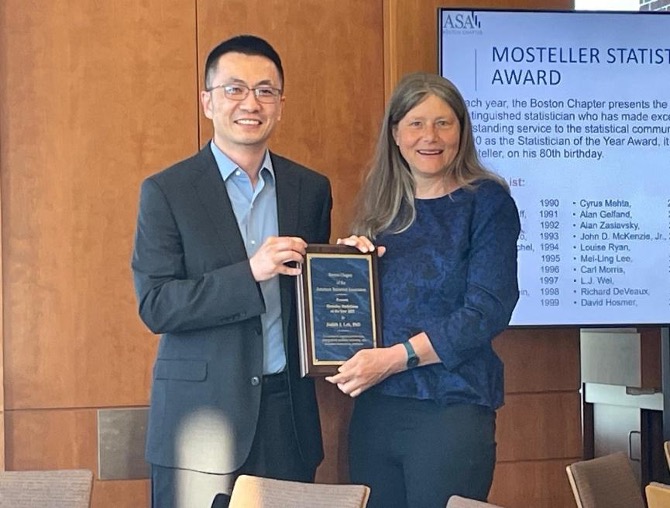
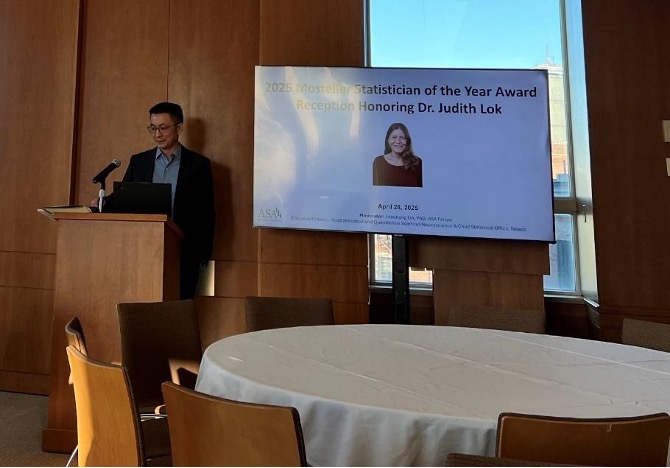
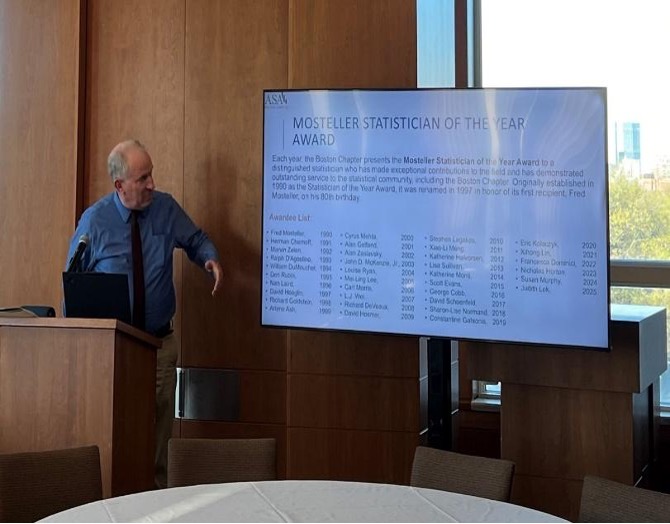
On April 28, the Boston Chapter of the American Statistical Association gathered to celebrate Judith J. Lok, a professor in the department of mathematics and statistics at Boston University, as this year’s Mosteller Statistician of the Year. This award honors statisticians who have made exceptional contributions to the statistics field and provided outstanding service to the statistical community.
Lok has made pioneering contributions to the theory and application of causal inference; developed the new learn-as-you-go—or LAGO—method for clinical trial designs; and carried out important research for mediation analysis, structural nested models, and adaptive causal methods. Her research has significantly advanced statistical methodology and its applications in clinical and biomedical research, particularly in improving treatment strategies for infectious diseases. Lok holds a PhD in mathematical statistics from the Vrije Universiteit Amsterdam. Before joining Boston University, she was a faculty member in the Harvard University Department of Biostatistics for 13 years.
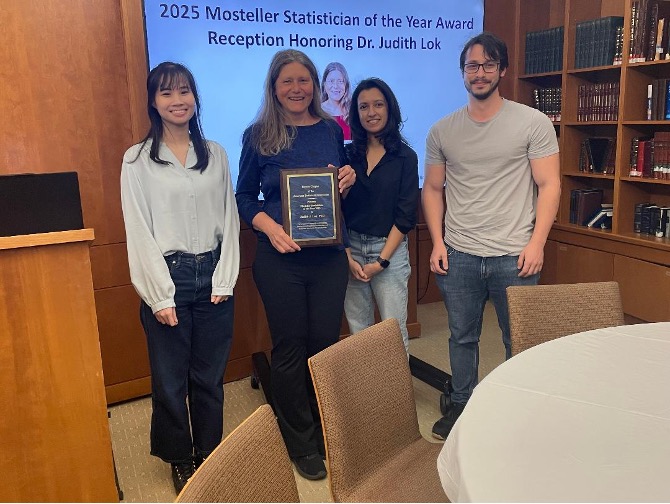
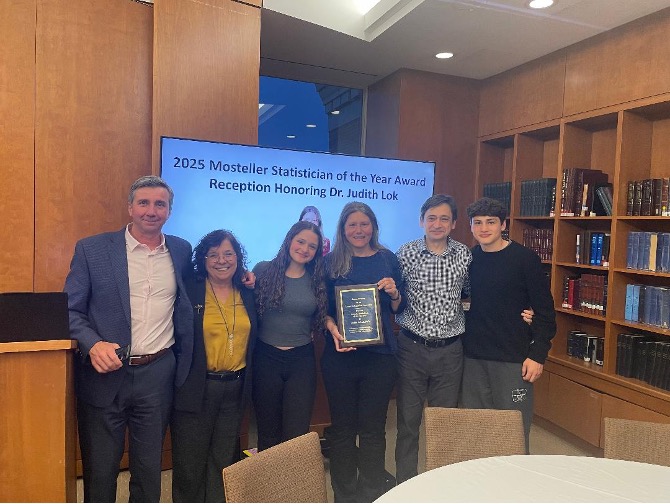
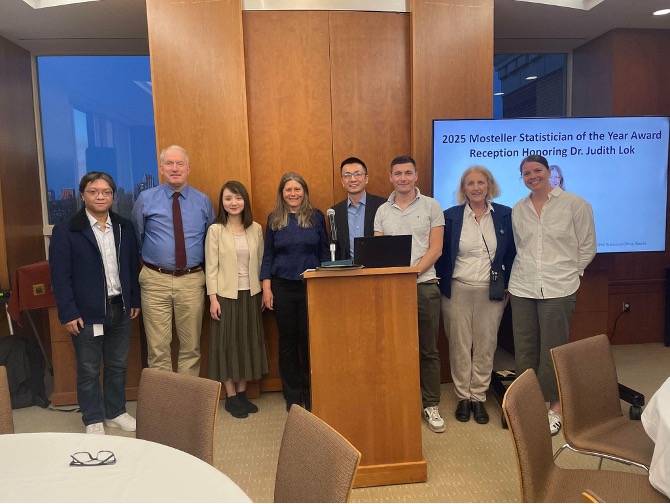
The Boston Chapter celebrated the 36th anniversary of the Mosteller Statistician of the Year Award at the Hillel House of Boston University. The evening began with a reception, during which members of the ASA Boston Chapter—along with Lok’s family, dearest friends, colleagues, and students—joined to honor her achievements.
Lok’s presentation, titled “Causal Inference: A Statistics Playground, with Lessons Learned,” focused on her extensive work in causal inference, including her upcoming book on causal inference from observational studies. She highlighted LAGO, an adaptive clinical trial design to prevent trial failure and ensure valid inference. Lok modifies accepted adaptive clinical designs and backs up modification with rigorous mathematical proofs. She gave a few examples of potentially failed randomized trials that could have benefited from the LAGO design. This talk provided attendees with a deeper understanding of how Lok’s contributions could transform causal inference from observational studies for the future.
Lok asked the audience, “Can we consider ourselves data scientists?” She pointed to Richard D. Gill’s definition, which says data science combines skills from statistics, computer science, and domain-specific knowledge to analyze data and inform decision-making. Gill said if you have at least two of the three skills, it is acceptable to call yourself a data scientist.
Lok accepted a plaque as attendees applauded her contributions as a dedicated mentor and advocate for students, as well as her service to the statistics field.

Recent Award Honorees
With Lok’s recognition as the 2025 Mosteller Statistician of the Year awardee, the Boston Chapter adds another name to the list of statisticians who have been honored recently with this award:
Susan Murphy, 2024
Nicholas Horton, 2023
Francesca Dominici, 2022
Xihong Lin, 2021
Eric Kolaczyk, 2020
Leave a Reply