

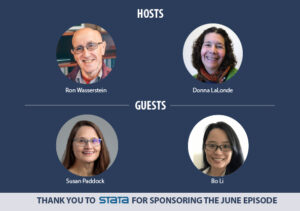
Susan Paddock and Bo Li are ASA members who often raise their hands when the call for association volunteers goes out. Currently, Paddock serves on the ASA Board of Directors and chairs the ASA Professional Issues and Visibility Council and Bo chairs the ASA Committee on Funded Research. During a recent episode of Practical Significance, Paddock and Li shared with cohosts Donna LaLonde and Ron Wasserstein personal stories and practical advice about ASA committee work, as well as how their service has broadened their networks, boosted their impact, and enriched their careers.
Donna LaLonde: Susan and Bo, tell us about your day jobs.
Susan Paddock: My name is Susan Paddock and I’m chief scientist and executive vice president at NORC at the University of Chicago. NORC is an independent nonprofit research organization.
Our focus is to provide trustworthy research and data for our clients, policymakers, and society. Our main substantive areas include health, education, economics, justice, and public affairs. My role is to provide strategy and vision to advance our capabilities in statistics, data science, survey methodology, and AI. We have well over 100 experts in these areas.
Bo Li: I’m Bo Li, a professor in statistics and data science at Washington University in St. Louis. Our department is almost two years old, and I’ve been here for about a year. I’m also codirector for the Transdisciplinary Institute for Applied Data Science, or TRIADS.
My daily job has two parts. One is like any professor: teaching; research; advising students; and service to the department, university, and our professional society. As codirector, I work with the other codirectors to offer data science training across campus—to faculty, students, and anyone interested—and to promote interdisciplinary research and enhance public engagement.
Donna LaLonde: What initially motivated you to volunteer to serve on an ASA committee?
Bo Li: I’m motivated to volunteer if I believe I’m a good fit and can make contributions to the committee—to bring new ideas and improve upon the work of the committee.
First, I must make sure I have the bandwidth to do the work. If I do, I’m eager to serve our society. This is where we live, where we work, and where we make friends. I served as chair of the ASA Statistics and the Environment Section. I love this section. This section is how I grew up in the statistical world, and I know the people and I have benefited from section activities. I feel everyone needs to take a turn to serve. Right? And I was eager to serve as chair.
Susan Paddock: I was fortunate early in my career to be invited to serve on the ASA Committee on Law and Justice Statistics. And I suspect what happened there was that the ASA president-elect at the time was aware of the work I was doing at the start of my career at the RAND Corporation. One of the first areas I worked in was illicit drug policy. And so, there are some obvious connections to law and justice statistics. I was excited for the opportunity to not only bring my statistical knowledge and the knowledge I was quickly gaining from the research projects I was on in drug policy, but to also be able to contribute to the committee’s mission, which is really interesting. It’s a committee that has significant involvement from the Bureau of Justice Statistics.
Ron Wasserstein: How does the committee appointment process work?
Susan Paddock: There are many ASA committees, so let me just give a bit of context about these and where they sit in the ASA. Some committees have a focus that is internal to the ASA. For example, we have committees with a focus on membership and making sure members’ needs are met. And so, there is the ASA Membership Council that consists of the group of those committees.
I chair the ASA Professional Issues and Visibility Council, which focuses on committees that have an external focus such as AI and data science. As chair, one of the roles I have with the Professional Issues and Visibility Council is working with ASA committees and the vice chair of the council to gather names and suggestions for potential committee nominations.
Now, formally, it’s the president-elect who makes the nominations for the committee members. And that’s a big job. The councils are there to support the president-elect with those nominations, so we gather suggestions from the committees. And we ask the committees to think not just about members who are already on the committee, but people beyond just their immediate networks.
And I know this is a priority of president-elect Jeri Mulrow. She wants to expand opportunities for those who are early or mid-career to have this type of service and have the experience. I would encourage everyone who’s interested in any of these committees to reach out to the committee chair. Reach out to a council chair, vice chair, or fill out the ASA’s Committee Interest Form also known as the “Light Bulb” form. This is where you can express interest in serving.
Donna LaLonde: Bo, we’re going to ask you to take a deep dive into your role as chair of the ASA Committee on Funded Research and how your role on that committee evolved.
Bo Li: I became involved with this committee following a conversation with Steve Pierson [ASA Director of Science Policy] at JSM. We were talking about the work I was currently doing on the West Nile virus. I was also working on a project on climate data, and both were funded by the NSF [National Science Foundation]. For the West Nile virus, my work was funded by the Algorithms for Threat Detection program at the Division of Mathematical Sciences at NSF. And the climate work was funded by the NSF Division of Atmospheric and Geospace Sciences within the Directorate of Geosciences. So, that’s a little bit unusual for statisticians.
Steve said, “Well, there is an ASA Committee on Funded Research, and your expertise can probably help diversify the grant opportunities for statisticians.” A few years later, I was invited to serve on that committee, and I believe I can make some contributions—I really love the work of this committee.
It has two important missions. One is to increase communication and interaction between statisticians and the funding agencies. Funding agencies could include everything like NSF, NIH [National Institutes of Health]—those typical ones—but also private foundations and industry funding opportunities. We try to broaden our funding opportunities for everybody in our field to bring more resources to develop statistics.
And the second mission is to distribute the information to bring opportunities to everyone in the community, especially for the junior researchers, because they just came to this field and may not have broad knowledge about funding for their work.
Many of the committee members are friends I’ve known for a long time. Everyone on the committee is brilliant, and I really enjoy working with them.
Ron Wasserstein: What advice would you give to help members find the right committee to match their interests and abilities?
Susan Paddock: I recommend starting with the ASA’s Committee Interest Form for those who would like to express interest in serving on a committee. When filling out that form, it’s helpful to indicate which committee or committees you’re interested in and to explain why, if you have relevant experience.
We aren’t necessarily looking for those with the most experience to serve on committees. These are time-limited appointments, and so we have a mix of people serving at different career stages. So, don’t feel like you must have the perfect résumé to say you’re interested.
Bo Li: First, it’s very important to understand the mission and the specific jobs for the committee. Typically, there are descriptions that outline these online. If possible, talk to someone who currently serves on the committee or previously served to get first-hand information about what they have been doing and how much time is required to contribute to the committee.
It’s important to really understand the scope of responsibilities before you make your commitment and, again, make sure you have the time to contribute to the committee. It’s challenging for both the individual and committee if a person doesn’t have the bandwidth or doesn’t have the expertise to serve on it.
Ron Wasserstein: What advice would you give to someone who wants to become more involved in ASA service?
Susan Paddock: First, show up to some ASA meetings, because it’s such a great opportunity to meet people and find out what the opportunities are and for people to get to know you and your interests.
Especially for people who are brand new to the ASA—if you’re going to a meeting, volunteer to chair a session. Session chairs are always needed, and you learn so much and connect with people when you volunteer.
I became heavily involved in the ASA through sections. And sections are wonderful because, when we enter the ASA, we usually have some very particular areas of activity and focus. There are several sections that are geared toward topics that range from specific methodology, such as the Bayesian Statistical Science Section, which I’ve been a member of since graduate school, to substantively focused sections such as the Statistics and the Environment Section or Health Policy Statistics Section. There is something for everyone in those sections. These groups have their own activities, everything from mixers and business meetings at JSM to hosting their own webinars and conferences.
People also get involved with ASA through chapters [and student chapters], which are regionally focused. And there are lots of chapters around the United States. Chapter membership can be a great way to become more involved with the ASA, especially if you’re interested in having that local interaction and focus. I don’t even live in Washington, DC, and I’m a member of the Washington Statistical Society because the people with whom we work at NORC happen to be in DC, as well. So yes, there are many, many ways to get involved in the ASA.
Ron Wasserstein: Bo, we must ask about your new role as the editor of ASA Discoveries, the ASA’s brand-new journal. We want to know what it’s like to be the inaugural editor of an ASA journal. So, will you give us a little sneak peek at that and at what you and your editorial team are planning for ASA Discoveries?
Bo Li: Yes, of course. Honestly, I’m quite honored to be the inaugural editor. But I was a little anxious when the ASA checked with me about this task. I talked to a few people, including you and Donna, Kathy Ensor, and my department chair, Xuming. I also consulted with Marina Vannucci, a professor at Rice, because she just started a new journal, and I received lots of encouragement and support from them.
Everything has been going very well. I’m excited about its launch. I have an excellent editorial board: four outstanding coeditors, including Sebastien Haneuse at Harvard University, Galen Jones from the University of Minnesota, Shujie Ma from the University of California, Riverside, and Abel Rodriguez from the University of Washington.
They all represent different fields. Sebastian is in biostatistics, and Galen is in computation and physical science. And Shujie is excellent in theoretical work, and Abel is in social science and computation. We have a very comprehensive and diversified group on our editorial board, and all of them also have rich experience in editorial work.
We have spent a lot of time discussing the vision of the journal and the types of articles we want to include. So, I wanted to make two points about the vision of this journal. One is it will be an open-access journal. This is to ensure research findings are freely available to the global scientific community and public. And the second point is we welcome all significant contributions to the advancement of statistical and data-driven research—either in theory or practice. So, we want all the work that can help make statistics remain pivotal in emerging research fields. And we want to promote a broad and inclusive scope of work. The ASA has carefully considered the vision for this journal.
The publisher, Taylor and Francis, has been very supportive, and we are currently finalizing the details for launching the journal. Stay tuned!
Leave a Reply