
As a DataFest host, Ben Baumer from Smith College reflects on how the ASA Five College DataFest started and what makes it so valuable—from student creativity to community building.

By the late 2000s, a small group of isolated statisticians was dining monthly over Chinese food in Amherst, Massachusetts, and discussing their teaching, coordinating course offerings, offering each other mentorship, and strategizing. The group included George Cobb and Janice Gifford of Mount Holyoke College, Amy Wagaman of Amherst College, Katherine Halvorsen and Nicholas Horton of Smith College, and Michael Lavine of the University of Massachusetts, among others.
“At that point, there were between zero and two statisticians at each of the four colleges and all existed within larger structures (typically a mathematics department),” Horton recalled. “To some extent, it provided a ‘department’ for those faculty.”
You would have been hard-pressed to find an official mention of data science anywhere nearby. Fast forward to the present and the University of Massachusetts boasts a Center for Data Science and Artificial Intelligence, Mount Holyoke College offers an interdisciplinary bachelor’s degree in data science, Amherst College now has a standalone department of statistics, and Smith College is approaching a decennial review for its undergraduate major in statistics and data science (one of the first at a liberal arts college). With certainty, the Five Colleges have benefited from the rising tide of interest in statistics and data science that spans international waters. But the Five College group was able to exploit another often-overlooked catalyst: The ASA Five College DataFest.
This is the story of how a small data analysis competition for undergraduate students fueled the transformative growth in statistics and data science at one of the nation’s premier higher education consortiums. And while sufficient tinder existed (as it did in many places), it was the combination of DataFest and its emergent corporate sponsor, MassMutual, that ignited the fire.
In 2009, the group (shortly thereafter organized officially as the Five College Statistics Program) received a grant from the National Science Foundation to hire a series of Five College postdocs, who would be based at UMass but teach at several of the other colleges over a three-year period. The third, and final, person they hired was Andrew Bray, a freshly minted statistician from the University of California at Los Angeles who was involved in the organization of the first two DataFests as a graduate student. Bray brought the idea of a Five College DataFest to this group.
Bray knew how to organize the event but needed a little bit of money (most of which would buy T-shirts and food) to run it. A cold call from Bray to MassMutual, a Fortune 500 life insurance company with a large office in nearby Springfield but no obvious ties to statistics and data science, proved to be fateful. It turned out a high-ranking executive at MassMutual named Gareth Ross lived in Amherst and had millions of dollars to spend on jump starting data science at the company. He used a strategy that would later be described as “Moneyball for insurance.” Ross agreed to sponsor the inaugural 2014 ASA Five College DataFest and dispatched his chief data scientist, Sears Merritt, to put eyes on the event. What he saw changed the course of, at a minimum, several people’s careers, including my own.
“I remember the energy,” recalled Dana Udwin, a Smith student at the time who took part in the event. “The format is conducive to real creativity and discovery. You’re not in a classroom and there is no right answer. You’re with your buddies handling a mess of data.”
Udwin’s five-person team won the Best in Show prize at the first Five College DataFest, not by impressing the judges with sophisticated statistical models, but by using their data wrangling skills to quickly overcome challenges that waylaid their competitors, creating an innovative and comprehensible data graphic, and telling a coherent story. It was these meta data science skills that impressed the judges and Merritt.
“It taught me the value of a ‘commit and go’ mentality,” Sara Stoudt, another member of Udwin’s team, reflected. “I definitely had more of a perfectionist tendency in those days, so it was helpful to experience a time-boxed task that was on an even shorter scale than something like a class project.”
A few months after the first DataFest, Ross and Merritt commissioned Bray and me to develop a prospectus for what would become the MassMutual Data Science Development Program, a three-year training program in which recent graduates would pursue a master’s degree at UMass while getting paid to do data science work at MassMutual’s new dedicated office in Amherst. Udwin, who was the first person hired into the program, saw the DataFest-to-MassMutual connection become “an incredible pipeline of local talent.” Over the next half decade, scores of Five College graduates passed through the program, and MassMutual fleshed out its data science team.
“MassMutual was founded in the 1800s (!!!),” Udwin noted. “They’ve amassed a lot of domain expertise and a trove of data. Melding that foundation with the fresh, innovative science that is showcased at DataFest was a recipe for success.”
But there weren’t enough students graduating with these skills to meet MassMutual’s needs. They wanted to know what we would need to generate more such graduates. More faculty was the clear response—we knew what to teach and how to teach it; we just needed more faculty to help us do it. What followed was a series of grants from MassMutual to various members of the Five Colleges to fund faculty positions: a $2 million grant for “Women in Data Science” to Smith and Mount Holyoke; another million-dollar grant to Smith for runway money for two tenure-track positions; and a $15 million grant to UMass for the Center for Data Science.
Enrollments and participation at DataFest continued to swell. After roughly 40 students took part in that first Five College DataFest, registrations grew to more than 200 by 2019, making the Five College event one of the largest in the country.
For all these reasons, the Five Colleges and MassMutual were recognized by the ASA with the 2019 SPAIG Award, which celebrates partnerships between industry, academia, and government. While DataFest certainly played a large role in that nomination letter, its instrumental role in growing the community around data science in the Pioneer Valley has not been celebrated publicly until now.
While DataFest can serve as an on-ramp to a job in industry, it’s more than that. Both Stoudt and Udwin went on to complete PhDs in (bio)statistics, and DataFest bolstered their experience in graduate school.
“DataFest provides an environment where you learn to borrow strength across a team,” Stoudt says, “and I do think that the willingness to lean on team members and not being afraid to fail publicly were both essential ingredients to my time in graduate school.”
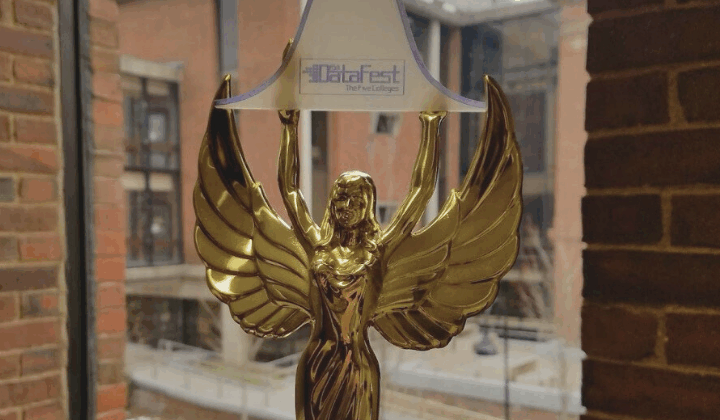
DataFest continues to be a focus of the Five College Statistics Program and the statistics and data science community in the area. The related Meetup group, founded in 2013, now boasts more than 600 members, many of whom have served as judges or VIP consultants at DataFest. Much to the amusement of students and faculty alike, a large trophy spends the year at the institution whose students won the Best in Show prize at the previous event.
The added faculty lines made the beefed-up presence of statistics and data science across the Five Colleges possible. Yet, while MassMutual and the Meetup group continue to support networking events that involve food and drink, an unfortunate casualty of the growth of statistics and data science in the Five Colleges has been the meals over Chinese food. With so many (now non-isolated) statisticians around, the Five College Statistics Program has moved to a representative governing model, and meetings are held over Zoom for convenience.
For Horton, the meals were “a place to vent frustrations and an opportunity to share ideas and proposals to leverage our connections” that are sorely missed.
No one could have predicted the downstream consequences of the decision to host that first DataFest. And while much has changed in the last decade, Stoudt encourages students to take the plunge.
“Think of it as getting the experience of learning on the job without having to get a foot in the door first,” she advises. “Giving up one weekend to go through the full investigative data process on a real-world data set is more than a fair trade. Use that experience to land that next experience!”
Read more perspectives from DataFest hosts:
Leave a Reply