
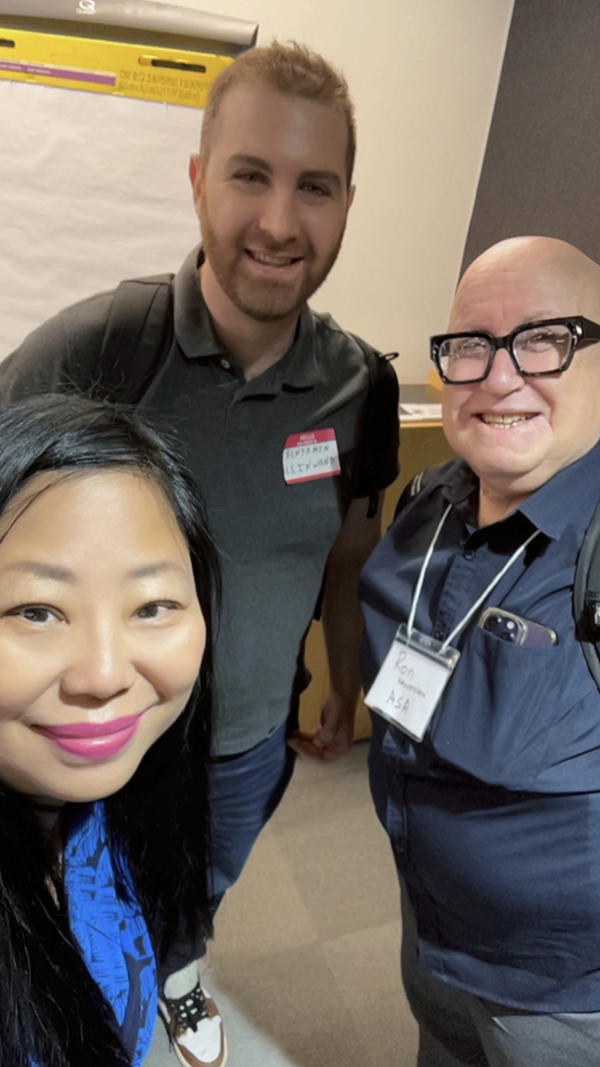
On July 20 in the heart of Midtown Manhattan, the inaugural AI Workshop New York City 2025 unfolded at the conference center at Cornell University. Organized by the American Statistical Association’s NYC Chapter and AI4Purpose, this workshop focused on the new era of collaborative AI exploration. Participants engaged with thought leaders from academia, industry, and government, fostered cross-sector dialogue, and sparked new collaborations.
AI Workshop NYC united 125 registered researchers, technologists, students, and enthusiasts across disciplines and offered a blend of plenary presentations and panel discussions, along with matchmaking for mentorships and a mini pre-workshop hackathon with live winners’ pitches in digital health. The event included many conversations, hands-on AI and start-up demonstrations, and deep engagement around the role of AI in shaping future innovations.
Attendees began with breakfast and networking led by Carolyn Lou and followed by opening remarks from Kelly H. Zou, Beniy Leinwand, Dhaval Patel, and Ron Wasserstein.
The morning sessions featured plenary speakers. Abdur Rahman offered insights into AI in private investing, and Hiya Banerjee compared AI and clinical endpoint committees. After a coffee break, Sonali Shah introduced several plenary speakers: David Banks discussed AI in education; Aaron Galaznik addressed AI’s role in health tech; and Susan Paddock examined data quality. After lunch, Margaret Gamalo presented on AI/ML in biopharma development.
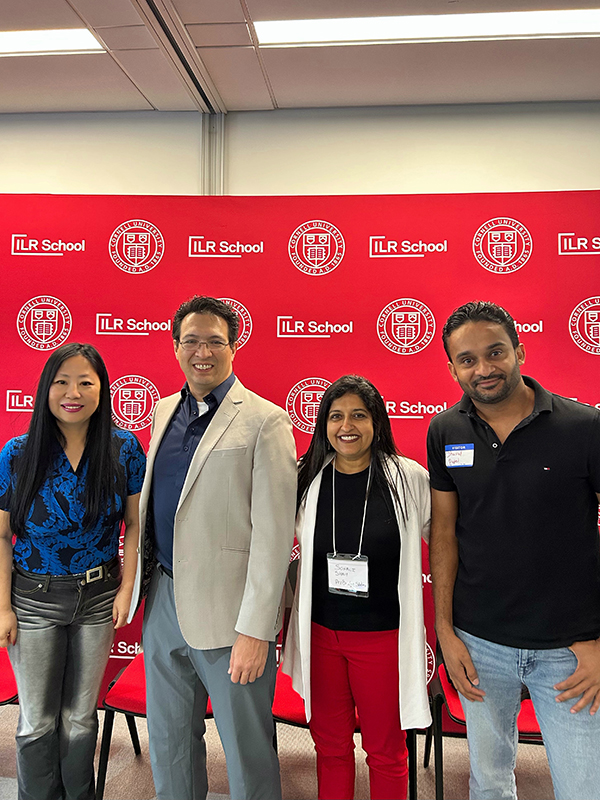
Two panels were held in the afternoon, one on digital innovation moderated by Stan Kachnowski (panelists: Amajot Kaur; Ashish Patel, Lesley Shane, and Vik Sharma) and another on AI’s risks and hallucinations moderated by Wasserstein (panelists: Lisa DeTora, Rahman, Sonali Shah, and Yuelin Zou).
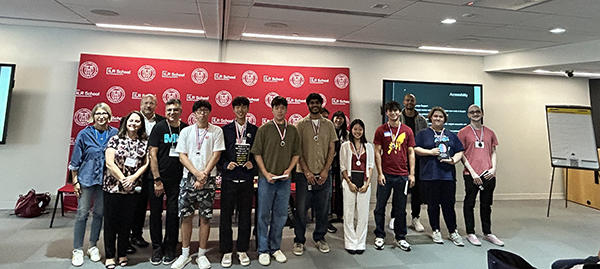
During the digital panel, speakers emphasized how AI-enabled evidence generation supported successful commercialization and market access for startups. The panelists discussed the importance of initiating efforts early through multidisciplinary collaboration involving scientists, clinicians, payers, patients, legal experts, and regulators. Panelists highlighted the need to develop regulatory-grade strategies for reimbursement and market access. They also stressed building differentiated value evidence aligned with AI framework guidance. Exploring payer reimbursement pathways, such as procedure codes, was considered essential. Finally, integrating evidence with clinical guidelines and real-world patient data was presented as a critical step in ensuring credibility and adoption in health care markets.
Will Ma delivered a demonstration of HopeAI’s dual-agent AI system to revolutionize clinical trial design. The platform pairs an AI clinical scientist—which synthesizes complex clinical evidence—with an AI statistician who implements real-time statistical methods, creating a suite of tools for clinicians, scientists, and statisticians. Ma and his team showcased how this AI-augmented approach enables researchers to select optimal endpoints, design smaller and faster trials using cutting-edge statistical methods, and improve recruitment timelines for accelerated study completion.
Mei Yang delivered a demonstration of two AI systems from NouStarX, transforming evidence synthesis and clinical development. The first—an AI-driven literature review platform—accelerates information synthesis by rapidly screening, extracting, and structuring scientific evidence, reducing months of manual review to days. The second, AutoSAP, leverages trial protocols and company-specific templates to automatically generate statistical analysis plans, ensuring methodological rigor while streamlining documentation. Together, these tools form an end-to-end AI suite that empowers statisticians, clinicians, and researchers to synthesize knowledge efficiently, standardize statistical planning, and accelerate trial execution.
The afternoon featured a Shark Tank–style showcase of hackathon winners, hosted by Instats.org and judged by multiple experts in AI or health care, including head judges Vik Sharma, Richard Cunningham, and Anna Sandoval. Teams—high school–level winner Dragon Boat, as well as college-level winners NCHacks, cMunchers, and Jesse Brandt—pitched the following projects to a panel of judges across age groups:
- Team Dragon Boat designed a web-based tool that employs AI to convert spoken audio into structured, categorized data. Using speech recognition and natural language processing, it transcribes speech and extracts key details, organizing them into predefined categories. Its interface enables recording, editing, and reviewing, transforming unstructured speech into actionable, organized information.
- Team NCHacks developed Pulsepanion, a bilingual web-based dashboard that enables caregivers to upload patient health data and instantly generate clear, actionable health summaries. The tool addresses the challenge clinicians face in synthesizing complex patient data from multiple sources and formats. Built with R Shiny and integrated with Python via the reticulate package, the system combines data preprocessing with OpenAI-powered natural language summaries. Users can filter by time range and visualize key metrics (e.g., heart rate, respiration, sleep patterns) through interactive charts. Designed for nontechnical users, the app reduces manual review time by more than 70% and supports both English and Spanish to serve diverse caregiving communities. Pulsepanion transforms raw health data into insights in less than 15 seconds, helping caregivers and clinicians focus more on care and less on computation.
- Team cMunchers engineered a full-stack, web-based tool to translate speech into specific categories with multilingual capabilities. Using Deepgram AI and NLTK, the tool takes in user speech and transcribes it into comprehensive sentences. Under Deepgram, Nova3 Medical assisted in transcribing medical terminology to improve the integration software. Hugging Face API’s Zero Shot Classification helped split the body of text into caregiver-requested categories for further medical inspection, including labeling, flagging, and modifying capabilities. All patient and caregiver information is stored in a secure SQL database for caregiver use.
- Jesse Brandt, a one-member team, created a prototype caretaker notetaking application that records audio input, transcribes it, and categorizes each sentence as either observation or activity and allows caretakers to correct the results before saving their notes as structured data. Large language models excel at transcription and simple sentence categorization. In this case, GPT and Llama achieved high classification accuracy when prompted with less than 20 examples of correct classifications. Since users can correct the model’s classifications, user data—if properly deidentified—would enable fine-tuning of the model that would account for real-world usage and diverse notetaking styles.
The afternoon concluded with winning digital health pitches, including Anti-Sepsis led by Henry Shi and LimbGuard led by Naomi Choi.
Team Anti-Sepsis developed Anti-Sepsis for Infants and Moms, an AI-driven approach to remotely monitor sepsis at home. Key features include the ability to stream smartwatch/patch vitals (e.g., blood pressure, heart rate, temperature, and blood oxygen levels) to the cloud, a 30‑second daily check‑in (e.g., pain, lochia or wound photo, baby symptoms) to add context, and an XGBoost risk engine score of sepsis risk and an auto alert to clinicians via SMART‑on‑FHIR when thresholds are exceeded.
LimbGuard was developed to aid in limb salvage and patient recovery. The team used smart monitoring and aim to use AI digital monitoring to prevent future amputations. This solution demonstrates the advantages of digital health through innovative design to support patients and caregivers. LimbGuard’s “smart garment” aims to create a preventative digital nervous system to address neuropathy and reduce limb loss, saving both limbs and lives.
Zou and Ching-Ray Yu jointly hosted an AI trivia session, and the “OptiMatch” mentorship initiative—with matching led by Gabriel Jipa—wrapped up the day. Zou also delivered closing remarks. As program chair, Siddhesh Kulkarni designed social media announcement cards. The photographer for this event was Frank Yoon, and live music was performed by Miguel Zapico.
Overall, this inaugural event served as a launchpad for ongoing community engagement. All attendees received a certificate upon completion.
Editor’s Note: The content of this article may not reflect the opinions of the individual organizing committee members, presenters, or panelists’ respective affiliations.
What a wonderful event full of cutting-edge AI technologies, lively interactions, and soft-skill development…
We hope to extend this AI momentum from our inaugural workshop to this year and future years to come.
Thanks for organizing, volunteering, presenting, showcasing, and volunteering! It all came together seamlessly!