
The ASA’s Partner Program—a strategic initiative designed to build year-round, mutually beneficial relationships between the ASA and its corporate and institutional supporters—launched last year, and building partnerships was at the heart of a recent episode of Practical Significance. Cohosts Donna LaLonde and Ron Wasserstein talked with American Statistical Association Director of Development Amanda Malloy and Director of Membership Development and Marketing Amy Farris to explore the vision and impact of the program. Here is what they had to say.
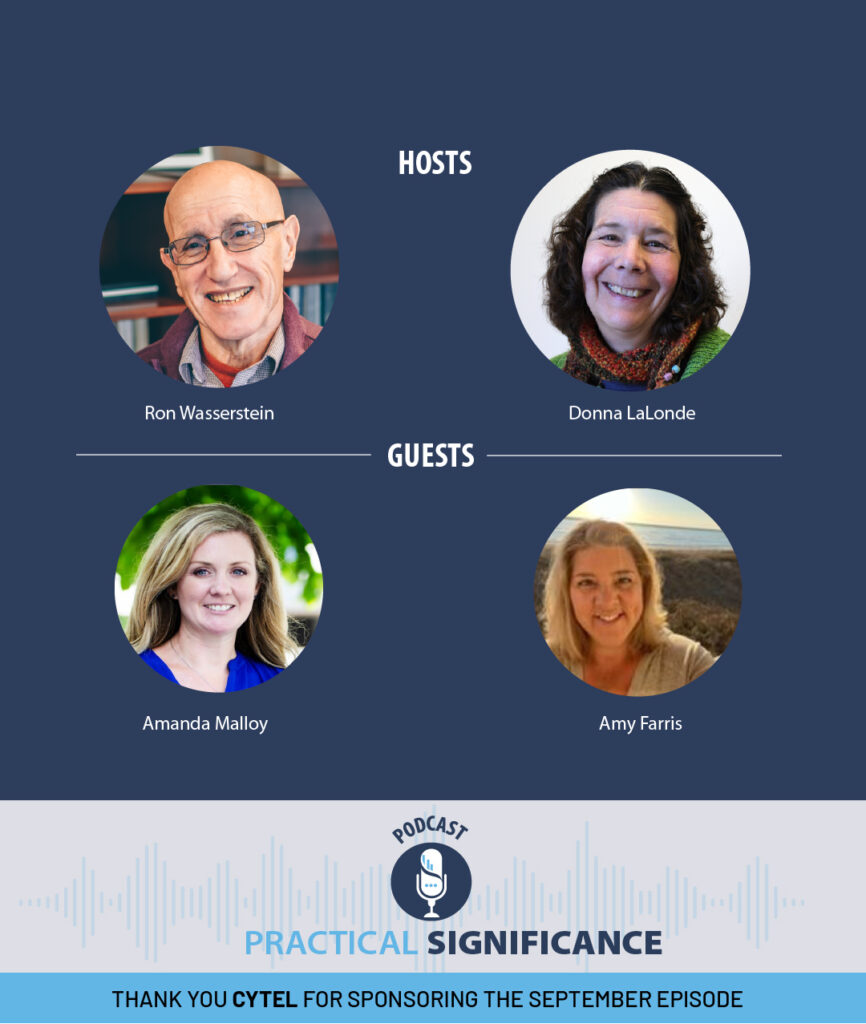
Donna LaLonde: Amanda and Amy, tell us about your day jobs.
Amanda Malloy: My name is Amanda Malloy, and, as director of development, I lead the ASA’s fundraising activities that support the important programs advancing the ASA’s mission. I basically connect donors with opportunities to make a meaningful impact.
Donna LaLonde: And Amy, tell us what you do.
Amy Farris: I’m Amy Farris and I’m the director of membership development and marketing. I’m responsible for campaigns, emails—everything you see from a membership perspective. I oversee the ASA Community and, more related to this podcast, I work across our meetings—JSM [Joint Statistical Meetings] and many of our smaller meetings—on sponsorship and career service programs.
That’s the bulk of what I do. But anything you see with an ASA brand on it usually comes from my department, and it’s definitely not just me. I’m lucky to work with great colleagues, Kim and Christina, who contribute a lot. You’ll see their names often in our work.
Ron Wasserstein: Amanda, what inspired the creation of the ASA Partner Program?
Amanda Malloy: The ASA has long had strong relationships with companies and institutions that sponsor our meetings. They’ve supported programs such as DataFest, StatFest, and many others. Historically, recognition was tied to a specific meeting or event.
With the launch of the Partner Program, we wanted to do two key things: provide broader, year-round recognition that helps create mutually beneficial relationships with our partners and raise awareness of the full range of ASA programs and how they align with partners’ goals.
These programs offer valuable opportunities for engagement. While financial support is important, we also value the expertise partners bring. Their involvement strengthens our programs and our community.
Ron Wasserstein: Amy, what aspects of the ASA Partner Program are you most excited about?
Amy Farris: The ability to take existing relationships and grow them. I’ve worked with many companies for decades, and offering something that provides year-round recognition for what some already do—while increasing their visibility and ability to engage beyond traditional meetings—is wonderful.
Letting partners assemble a program that fits their goals—pick and choose while still achieving overall impact—appeals to my sense of order and connectivity. I love connecting with them. I’ve seen them for years at JSM or other conferences, but the year-round impact goes deeper than a single sponsorship.
Donna LaLonde: I’d like both of you to dive deeper into the types of projects and initiatives partners might support. Tell us one or two you’re most excited to see come to life.
Amy Farris: One great outcome of the Partner Program is this podcast. We’ve established a way for corporate sponsors to affiliate with it and gain broader reach on topics that matter to them and our members.
I also love the smaller meetings. They’re a great way to get involved without being drowned out by the bigger JSM experience. Partner engagement at smaller meetings is wonderful because I constantly hear, “I met so many people. I engaged with organizations I wouldn’t normally connect with, one-on-one.”
Another priority for me is supporting emerging statisticians, students, and early-career folks through travel grants, mentorship programs, and new initiatives that meet real needs.
Amanda Malloy: The ASA is unique in the breadth of what we do. We try to match partners’ goals with ASA initiatives where they can truly help—meetings, K–16 education, professional development, mentoring—there are endless possibilities.
For example, I’m excited about our partnership with Stata. They’ve joined our efforts to improve K–16 education through the Stats&DataNet program and will deliver a webinar this fall, which is a perfect example of a partner providing both financial support and expertise.
Ron Wasserstein: “Partner” is the key word in the ASA Partner Program. We describe it as “strategic alliances for success.” Amanda, what can partners expect in terms of recognition and impact?
Amanda Malloy: It goes beyond logo placement, though that matters and we ensure it’s there. It’s about building mutually beneficial relationships and tailoring a partnership that makes sense for each organization.
It’s not one-size-fits-all, though we do have standard benefits: year-round recognition across ASA platforms and events; tailored opportunities to engage with members or target groups; and visibility that reflects their commitment to statistics and data science.
In terms of impact, partners help strengthen the pipeline of statisticians and data scientists, elevate awareness of the critical role of statistics, and improve education. Employees also feel proud when they see their organization supporting the profession; it builds goodwill.
Ron Wasserstein: Amy, many our ASA conference and event attendees have benefited, whether they realized it or not, from the support of our sponsors. What are some of the sponsorship opportunities available at ASA meetings and events?
Amy Farris: If you can name it, we’ve probably done it—or we can try to make it happen. That’s always been my philosophy. Some of the most exciting ideas come from organizations that approach us and say, “We want to support this event, but we’d like to do it in a new way.”
One example is Jane Street. They’ve attended JSM and hosted something called the Estimathon. We provide the space, they bring the expertise, and we create a fun experience together. It’s a perfect icebreaker for attendees without them even realizing that’s what it is. That’s an example of an out-of-the-box sponsorship idea.
Of course, there are all the standard opportunities. JSM, the Biopharmaceutical Section Regulatory-Industry Statistics Workshop, Symposium on Data Science and Statistics, Women in Statistics and Data Science—every one of these has sponsorships built in. It’s à la carte. When you reach a certain level, additional recognition kicks in. Options include sponsoring events and networking opportunities like an opening mixer, funding student travel or poster awards, or sponsoring swag. People love swag: bags; lanyards; pens; and sometimes more creative items.
The real goal is making sure the organization gets what it wants, which is usually connection with our phenomenal attendees. JSM is an easy sell, but smaller meetings are where that warm, engaging atmosphere really shines. Those are especially valuable for emerging professionals who might feel overwhelmed at JSM.
I’m also excited about our growing focus on section-oriented conferences. Sections have hosted conferences for a long time, but we’re really leaning into that format. It allows experts to host focused events in a smaller setting, which is often underrated.
Donna LaLonde: We’ve described the Partner Program as “strategic alliances for success.” Looking ahead, how do you see the program evolving in the next few years? What part of the vision makes you most excited?
Amanda Malloy: I envision the program becoming a hub for collaboration between the ASA and our partners across industries. Partners can help identify emerging trends and areas in which the ASA, given our history and membership, is especially well positioned to make an impact in advancing statistics and data science.
That vision—building connections and facilitating meaningful collaborations—is what excites me most about continuing this work.
Amy Farris: Honestly, the unknowns keep me excited. Piggybacking on Amanda, partnerships give us opportunities to expand into areas we don’t even know are important yet.
Meetings are both my most difficult and my favorite “child.” The planning appeals to my sense of order (and, yes, sometimes makes me pull my hair out), but being onsite and engaging face-to-face is always a joy. You meet everyone, from keynote speakers to students attending their very first conference. You don’t get that anywhere else.
I’m also excited about developing content for people who can’t attend meetings, like webinars and online learning opportunities. The Stata example you mentioned earlier, with their upcoming webinar, is a great model. It will help us serve even more people.
I’ve been at the ASA a long time, and the ASA of today is not the ASA I would have recognized when I started … or even 10 or 15 years ago. It’s exciting to see how much we’ve evolved. In the moment, you don’t always notice it, but looking back, it’s like, “Wow, we did it that way just five years ago?” It motivates me to keep making things more efficient, clearer, and better for people who want to connect with us. Ultimately, it’s about better serving our members.
Interested in learning more? Reach out to Amanda Malloy and explore the ASA Partner Program.
Leave a Reply