
Kung-Sik Chan
Professor emeritus Richard (Dick) Lynn Dykstra passed away peacefully on September 19, 2025. Dykstra was born on October 19, 1942, and grew up on a farm in Runnels, Iowa. As an athlete, he played football at Central College during his undergraduate studies, where he was inducted into Central College’s Athletics Hall of Honor in 2003. He was selected as an All-State running back/defensive back three times and was a co-captain of the football team (that went on to capture the league title) in his senior year. He was also an all-league selection in baseball.
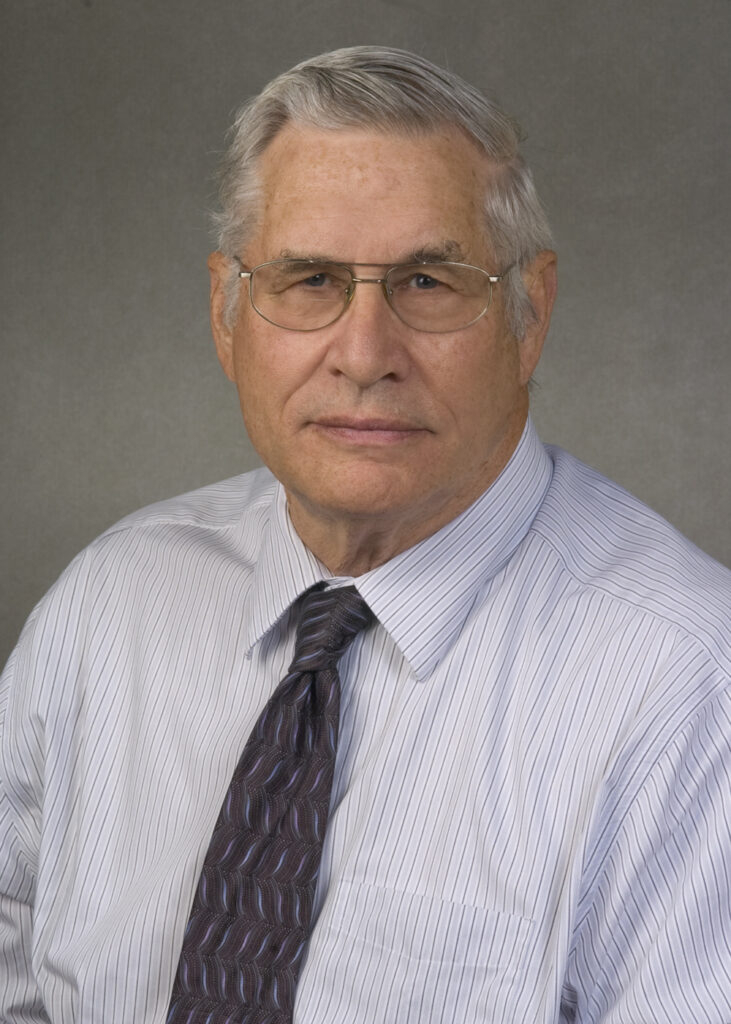
In 1964, Dykstra married his high school sweetheart, Patricia. They raised four children and fostered many others, creating a home filled with love and laughter.
Dykstra earned his PhD in 1968 from the University of Iowa, where his doctoral work on characterizing a conditional expectation with respect to a sigma-lattice was advised by Tim Robertson and Jon Cryer. He then worked at the University of Missouri, Columbia, first as an assistant professor and then as a full professor in 1981. In 1982, he returned to the University of Iowa as a full professor in the department of statistics and actuarial science and worked there until his retirement in 2012.
Dykstra made significant contributions to probability, mathematical statistics, nonparametric inference, multivariate theory, and constrained optimization. Of note are his deep and fundamental contributions to order-restricted inference. Many interesting problems in order-restricted inference can be posed as constrained optimization problems subject to convex cone constraints, and these problems often do not have closed-form solutions. Dykstra developed several useful and efficient algorithms for solving such constrained optimization problems.
Dykstra’s algorithm, with variants for other settings including Hilbert space, is now a classic optimization technique. Dykstra invented the algorithm for solving the general problem of least squares regression subject to finitely many closed convex-cone constraints. His algorithm assumes the problem has a tractable solution if it were subject to only one (any one) of the convex-cone constraints. The solution is then simply obtained by projecting the response vector into the convex cone under consideration. The solution to the easier problem subject to one constraint can be expressed as the sum of the response plus an increment vector specific to that convex cone. Dykstra’s algorithm alternately updates the increment vectors one constraint at a time until convergence.
He co-wrote a monograph on order-restricted inference and co-edited conference proceedings with Tim Robertson and Farroll T. Wright.
He and Robertson ran a well-attended seminar on order-restricted inference almost every semester until their retirement, which covered hot research topics at the time. They also organized at least three conferences on order-restricted inference. Because of Dykstra and Robertson and the strong faculty interest in order-restricted inference, the department enjoyed the presence of many visiting scholars as they came to Iowa City to collaborate with them.
Dykstra was the department chair from 1989–1992. As department chair, he hired several faculty members (including Martin Appel, Kung-Sik Chan, Elias Shiu, Bruce Jones, Joseph Lang, and Jens Praestgaard), some of whom have played leadership roles in the department. His steady leadership and vision during those years cemented the strength of the department.
Dykstra was an outstanding teacher. Besides regular class meeting times, he held a weekly problem session for many of his classes in which he worked lots of problems for the students “and sometimes digress[ed] to statistical topics not covered in class,” as he characterized them in his understated mannerism. The extra problem sessions were not required, but almost the entire class would show up. He undertook the extra work willingly because he loved teaching and wanted to help students realize “that knowledge and understanding usually only come with lots of hard work and perseverance.”
Dykstra will be remembered as a kind person, generous with his time and freely sharing his insights with students and colleagues, and a penetrating yet humble thinker. His legacy will continue through the many lives he touched.
He is survived by his wife, Patricia Dykstra.
Leave a Reply