
Two distinguished leaders in federal statistics—Nancy Potok, former chief statistician of the United States and CEO of NAPx Consulting, and Connie Citro, senior scholar at the National Academies’ Committee on National Statistics—recently joined Practical Significance cohosts Donna LaLonde and Ron Wasserstein to discuss their participation in two ASA-led projects: Assessing the Health of the Federal Statistical Agencies and Modernizing the Federal Statistical System. Here is what they had to say.

Donna LaLonde: Connie and Nancy, tell us about your day jobs.
Connie Citro: My doctorate is in political science. My dissertation used census data. When we moved to Washington, DC, in 1967 for my husband’s research, I needed a job and fell into one at the Census Bureau out in Suitland, Maryland.
I was in a unit that was working on helping data users effectively use computer summary files and microdata files, which, for the first time, were going to be official products of the 1970 census, in addition to the traditional printed reports. Then, I was at an organization that expanded on training, education, and software writing for the new computer-readable products. We trained the first generation of data librarians at universities and in state and local governments. I was then at Mathematica for 10 years working on income and poverty data and analysis.
In 1984, I went to the Committee on National Statistics at the National Academy of Sciences to direct a study to investigate the possibility of statistical adjustment for the undercount in the upcoming 1990 census. I have been there ever since, doing studies on various aspects of federal statistics. I was the staff director for several years. I am now a part-time senior scholar with the Committee on National Statistics and, I’m happy to say, doing projects with the American Statistical Association.
Nancy Potok: I’ve worked in all three branches of government during my career. I’ve also been a political appointee and a career appointee. And I have worked inside and outside of the statistical arena. I’ve worked in social science research in both the private and nonprofit sectors.
Probably what’s of most interest to people were my last two jobs before I left government in 2020 and started consulting independently. I was the deputy director of the Census Bureau from 2012 to 2017, and then I moved to the executive office of the president and OMB [Office of Management and Budget] and became the chief statistician of the US.
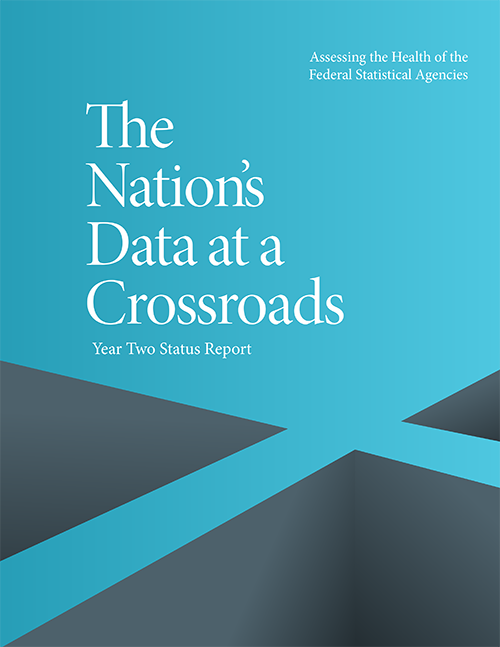
Ron Wasserstein: You were members of the assessment team that released The Nation’s Data at a Crossroads in July 2025. What keeps you up at night about the future of federal statistical agencies?
Nancy Potok: I worry about the ability of the statistical agencies to modernize and stay relevant in the current, rapidly changing data environment, particularly because there are so many competing sources of information. Right now, we’re at the crossroads because a lot of people are leaving public service across the federal government.
Many of the statistical agencies are losing key staff and institutional knowledge at the same time. It is difficult to recruit mathematicians, statisticians, and data scientists into government. I mean, why would you enter public service when there are so many other opportunities in these fields right now and government is being downsized?
You must be willing to take the long view. I am not sure recent graduates and others are going to do that. Plus, there is a hiring freeze. So, I worry about losing people and not being able to replace them. And this is contributing to a loss of trust from the users, from the public, researchers, policymakers, Wall Street, everyone who is dependent on those numbers. Once the system gets to that point, it becomes difficult to recover.
That’s why we say we’re at a crossroads. The government is either going to take some drastic action now and say we care about this and we’re going to address it or we’re just going to let people leave the system, not replace them, and put the agencies in a position where even the best leadership would have trouble recovering in a reasonable amount of time. That is what keeps me up at night.
Connie Citro: Yes, my biggest concern is the loss of staff. Both the new people with new skills, many of whom recently came into federal service, who were the first to go because they were still in probationary status, and then the experienced folks who are taking these buyouts because why would you not?
The statistical agencies are very labor intensive. They need a lot of talented people willing to work hard and selflessly for the public good. Trying to keep people and recruiting people is hard with the loss of trust.
Also, many agencies have been neglected starting well before this administration, with declining budgets—when adjusted for inflation—and the loss of purchasing power. In addition, businesses and households do not want to answer surveys anymore. And this is true worldwide.
There is a need to modernize and use blended data and other techniques for some of the major data sets that underlie principal economic indicators, like the inflation rate and unemployment rate. But, for that, you need money not just to reinvent your program, but also to keep the old one running until you have proven the new one. You cannot just drop in a new system overnight and then find out there are problems and glitches and go back to the drawing board.
Ron Wasserstein: You’re both working on Modernizing the Federal Statistical System. How did that project come about, and what are its goals?
Nancy Potok: The need to modernize the system has been recognized for a while. Over the years, many groups have studied the federal statistical system because of its decentralized nature and have asked whether there are better ways to have an efficient but relevant system in an era of reduced resources. I have been thinking about improvements for a long time. It was a high priority for me when I was chief statistician to try to move that effort forward.
I was a commissioner on the Evidence-Based Policymaking Commission during that period. We recommended a lot of actions that started to address some of the things Connie mentioned. More combined data, easier data sharing, looking at the whole system to create data that answers the questions people want answered.
We were able to accomplish some things while I was chief statistician, such as enactment of the Evidence Act of 2018 but, also, we identified many things that had to be done in the future. But after I left government, the chief statistician position was vacant for a long time, and several activities did not really get off the ground. And when the new administration came in this year, we saw a lot of disruption. Disruption can be destructive, but it also creates opportunities.
I’m a very optimistic person, and I think when you see radical change happening, that’s an opportunity to get involved and help direct or structure or recommend ways that can accomplish these goals that many people have been looking at for a long time. So, a group of us got together and asked, can we put together a white paper for discussion that takes advantage of this radical change and can lead to action?
We’re in the midst of that environmental disruption. A lot of the things that can improve federal statistics require changes in technology, in uses of AI, and developing different ways of gathering and using data. You can do those in a disruptive environment. So, the challenge is can we take what looks like destruction and make it positive?
To get ideas, we have so far held two focus group conversations with data users and people who think about government structure and are very familiar with the structure of the federal statistical system. What do people think are priorities? What should this look like at the end?
I don’t think any of us are giving of our time for this just to have one more report on a shelf. We want to see real actions come out of the effort. We’re trying to think about actions that can be taken in the short term, in the medium term, and in the long term.
Donna LaLonde: Connie, as a key adviser to the project, what do you hope this project will achieve?
Connie Citro: The project recommendations deal with nuts and bolts, like data sharing among the agencies. We do not have a Statistics USA like Statistics Canada, which can use administrative data, for instance, across their whole portfolio. We must negotiate among the agencies. There are some forms of data, particularly tax data, with limitations on which agencies can access them. So, we have duplicative business lists among BLS [Bureau of Labor Statistics], Census, BEA [Bureau of Economic Analysis], etc. One of my big hopes is that if these recommendations are enacted, then the agencies will be able to act more like an integrated Statistics USA.
I would not mind seeing an actual Statistics USA here. But that may be a step too far. There are all kinds of laws and congressional committees and what not that would need to be dealt with.
But if data sharing among the statistical agencies in secure environments can become routine and easy to arrange, my hope is that the agencies will go to town on creating blended data sets from surveys, administrative records, commercial data, and so on to improve data quality and utility. I also hope agency leadership will step up and be willing to say “Yes” to projects that involve collaboration with other agencies. Some blended data and collaborative efforts are already happening, but much more is needed. When it does, I’m hopeful we will see some major improvements in quality and utility of key data sets.
Ron Wasserstein: These are big projects, and you are both very busy. What made you decide to work with the ASA to take them on?
Connie Citro: I’ve been a member of the ASA for some decades. When Steve asked me to sign up for the assessment project, I thought it would likely be fun and interesting and Steve would be great to work with. He was signing up other great people and hopefully it would be impactful. I did not realize the amount of work that was required to find out what was going on.
But it was so interesting and so important, particularly now when careful documentation of what is happening and the ultimate impact on the data policymakers and the public use is so critical. So, I am glad I signed up, even though I have spent some weekends burning the midnight oil to get our reports out. It has been truly rewarding.
Nancy Potok: I’ve had a long affiliation with the ASA and had chaired another group after the 2020 census looking at the quality of the census. Rob Santos and I co-chaired that Census Quality Task Force. Some of the people who put this project together also worked on the Census Quality Task Force. I knew what I was getting into. But I felt it was an important effort, something the ASA was absolutely positioned to sponsor in terms of monitoring the whole system on an ongoing basis, not just one data product or the census. That intrigued me, as did the challenge of coming up with the metrics.
The ASA has a reputation for being credible, for being objective, for being nonpartisan. It’s a very important space the ASA occupies, and people listen when the ASA says something. I wouldn’t put my effort into something I thought people were not going to pay attention to.
It wasn’t just a couple of people who decided to do this. It was an ASA-branded and sponsored and supported activity. And that’s why I did it, because it was the ASA.
Leave a Reply